Aseptic Filling In Pharma: A Detailed Guide To Sterile Manufacturing
If you’ve ever wondered how a liquid medicine remains perfectly sterile from the factory floor to your medicine cabinet, the answer lies in a process called aseptic filling. It is one of the most critical, high-stakes operations in pharmaceutical manufacturing. Unlike conventional sterilization, where the final product is sealed and then subjected to high heat or radiation, aseptic filling involves assembling pre-sterilized components into a final sterile product under strictly controlled conditions.
Think of it as building a car, but every single part—every bolt, wire, and panel—has been sanitized before it touches the assembly line. The environment itself must be impeccable. If even a single microbe sneaks in, the entire batch is compromised. This isn’t just about quality; it’s about patient safety. For patients who cannot tolerate terminal sterilization, such as those receiving live vaccines, proteins, or sensitive biologics, aseptic filling is the only viable option.
Why Aseptic Filling Is Different From Terminal Sterilization
To understand aseptic filling, you first need to understand what it isn’t. Terminal sterilization is the gold standard for heat-stable products. You fill the vial, cap it, and then blast it with steam (autoclaving) or radiation. It’s robust and reliable.
But many modern therapeutics are fragile. Insulin, monoclonal antibodies, and certain vaccines denature or lose potency when heated. You can’t cook them to kill bacteria; you have to keep them away from bacteria entirely. This is where aseptic processing steps in. The strategy shifts from "kill what’s inside" to "keep what’s outside, out."
This distinction changes everything about the facility design, the equipment validation, and the daily operations. It transforms manufacturing from a mechanical process into a microbiological tightrope walk.
The Core Components of an Aseptic Line
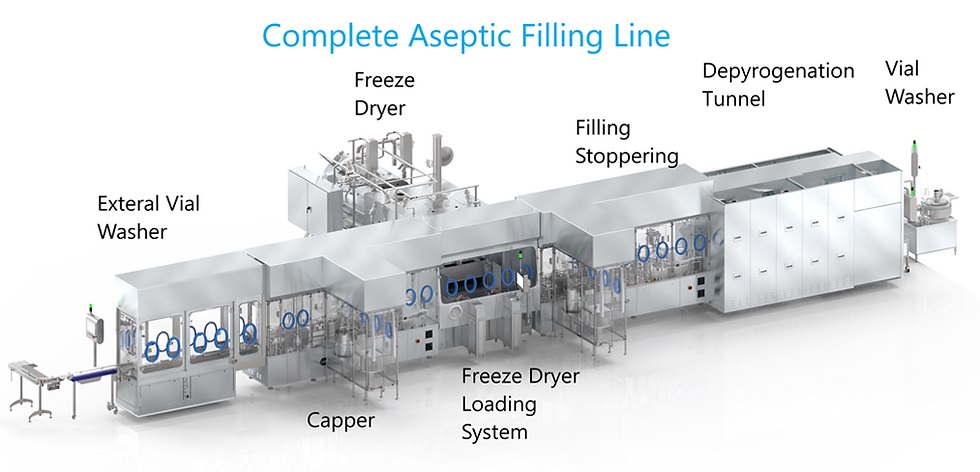
An aseptic filling line is a complex ecosystem. It’s not just a machine; it’s a series of interlocked environmental controls. Here is how the pieces fit together:
- The Isolator or RABS: These are the physical barriers. An isolator is a completely sealed glovebox system where operators never touch the product. A Restricted Access Barrier System (RABS) is an open-arm cabinet within a cleanroom, offering protection while allowing more human interaction.
- HEPA Filtration: High-Efficiency Particulate Air filters scrub the air down to 0.3 microns. This is the lungs of the facility, constantly sweeping out particles that could harbor microbes.
- Lyophilizers (Freeze Dryers): For injectables that need to be stored as powders, the filled vials are frozen and dried immediately to maintain stability.
- Fill-Finish Machines: These robotic or semi-automated systems perform the actual dispensing of liquid into containers with precision, ensuring accurate dosing without contamination.
The Critical Role of Environmental Monitoring
In the world of aseptic filling, trust is earned through data. You can’t just say the room is clean; you have to prove it, every hour, every day. This is where environmental monitoring (EM) becomes crucial.
Facilities use settle plates, air samplers, and surface swabs to detect microbial growth. If a settle plate on a filling machine shows a colony of Bacillus spores, production stops immediately. It’s a major headache, but it’s non-negotiable. The goal is to catch trends before they become failures. You’re looking for patterns—maybe humidity is spiking in the northeast corner of the cleanroom, or maybe a specific shift has higher touch contamination rates.
Personnel are often the biggest risk. Humans shed skin cells and carry bacteria on their skin. That’s why gowning procedures are rigorous. Operators must wear full-body suits, hoods, gloves, and sometimes even sterile socks. Every movement is choreographed to minimize turbulence and particle generation.
Media Fills: Simulating the Worst-Case Scenario
Before a single drop of expensive drug substance ever enters a sterile vial, the line undergoes a "media fill." This is a simulation of the entire manufacturing process using a nutrient-rich broth instead of the actual medicine.
If the process is truly aseptic, the broth should remain sterile. If bacteria grow in the broth during the simulation, the process has failed. It’s a stress test. Engineers might intentionally introduce defects—like opening a cabinet door for too long—to see if the system catches the contamination. Media fills are required periodically and whenever there is a significant change in equipment or procedure.
Challenges and Future Trends
Aseptic filling is expensive. The infrastructure costs for cleanrooms, HVAC systems, and validation are astronomical. Furthermore, it is labor-intensive regarding quality assurance and monitoring. The margin for error is razor-thin.
However, technology is evolving. We are seeing a shift toward continuous processing rather than batch processing, which can reduce variability. Robotics are becoming more sophisticated, reducing the need for human presence in Grade A zones. Additionally, predictive analytics using AI are starting to help identify potential contamination risks before they happen by analyzing real-time sensor data from the cleanroom environment.
Why This Matters For Patients
At the end of the day, aseptic filling isn’t just about regulatory compliance or engineering prowess. It’s about saving lives. When a patient receives a sterile injection, they are trusting that this complex chain of controls worked perfectly. Aseptic filling ensures that sensitive, life-saving therapies reach patients in a state that is safe, effective, and potent.
For manufacturers, it is a discipline of extreme precision. For the industry, it is the backbone of modern biopharmaceutical production. And for us, it is a reminder that behind every simple-looking vial is a sophisticated fortress of microbiological control.
Frequently Asked Questions
What is the difference between Grade A and Grade C cleanrooms?
Grade A is the highest level of cleanliness, required for critical operations like filling and stoppering. It allows for very low particle counts. Grade C is used for less critical preparation steps. The air quality and gowning requirements drop significantly as you move from Grade A to D, with A being the most stringent.
How do you validate that a product is sterile?
You can’t test sterility by destroying the entire batch. Instead, you validate the process. Through media fills, environmental monitoring, and personnel hygiene audits, you prove that the process is capable of producing sterile products consistently. Sampling is done, but it is not 100% conclusive for the whole batch, which is why process control is paramount.
Can viruses penetrate HEPA filters?
Standard HEPA filters are designed to capture particles down to 0.3 microns with 99.97% efficiency. Most bacteria are larger than this. However, some viruses are smaller. Therefore, environmental controls often include additional measures, such as UV light or specific gowning protocols, to mitigate viral transmission risks, although the physical barrier is primarily for bacteria and particulates.
Why is aseptic filling more expensive than terminal sterilization?
Terminal sterilization is a single step added at the end. Aseptic filling requires a massive infrastructure of cleanrooms, specialized containment equipment (isolators), rigorous environmental monitoring, and extensive personnel training. The operational overhead and capital expenditure for maintaining a sterile environment are significantly higher.