Constant Returns to Scale: What It Means for Business Growth
Imagine you run a small bakery. You’ve cracked the code: perfect sourdough, loyal customers, and a workflow that feels almost poetic. Now, decide to open a second location. Do you simply double your ovens, hire twice as many bakers, and ship twice the bread? Ideally, yes. That’s the intuitive appeal of constant returns to scale. It’s the economic sweet spot where growth is predictable. It’s also a concept that trips up plenty of entrepreneurs who assume scaling is always linear.
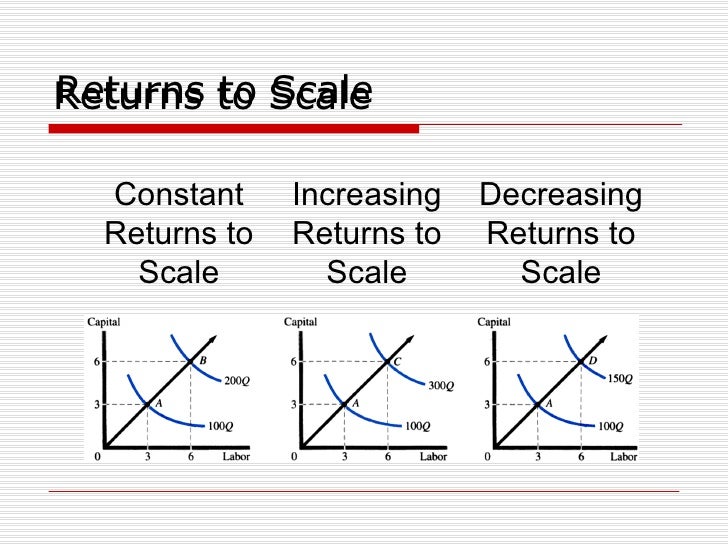
In economics, constant returns to scale (CRS) describes a specific relationship between inputs and outputs. It’s not flashy. It doesn’t promise explosive growth like increasing returns, nor does it hint at the drag of diminishing returns. Instead, it offers stability. If you increase all inputs by 10%, output increases by exactly 10%. Double the labor and capital, and you double the production. Nothing more, nothing less. It sounds simple on paper, but in practice, maintaining that ratio is harder than it looks.
The Math Behind the Magic
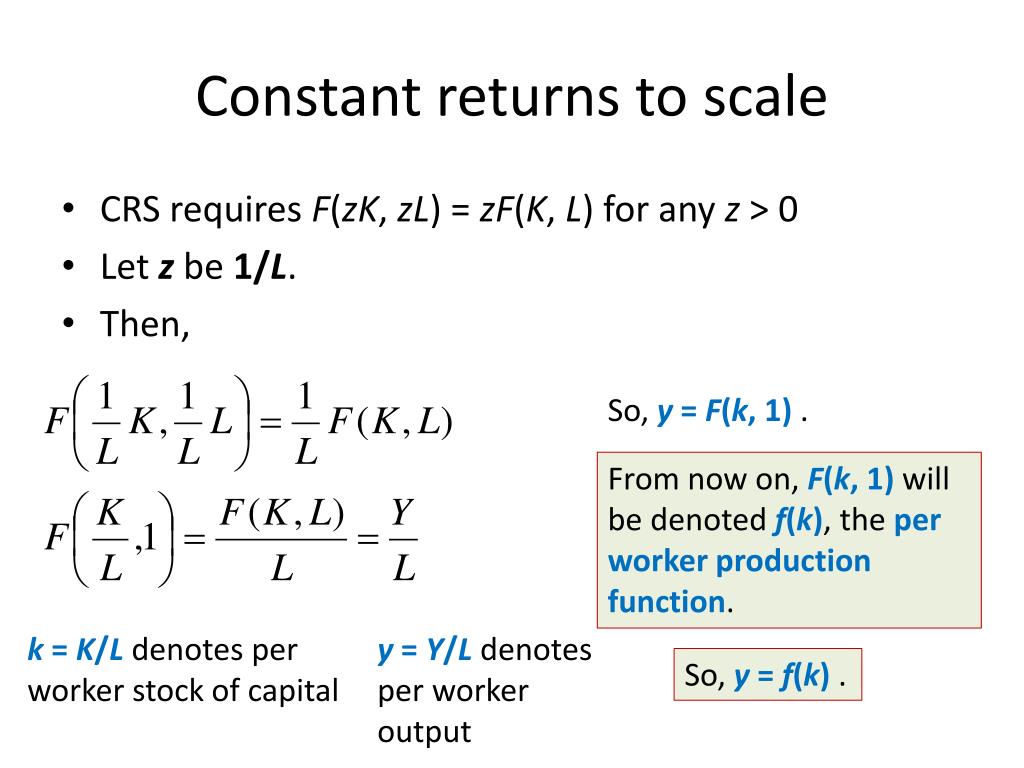
You don’t need to be a mathematician to grasp the concept, but understanding the production function helps. Think of a production function as a recipe. It takes inputs—labor, capital, land, raw materials—and turns them into output. In a CRS scenario, the function is homogeneous of degree one.
Let’s break that jargon down. If F represents your production process, and you multiply every input by a scalar factor t (say, 2), the resulting output is also multiplied by t. In simpler terms:
- 1 unit of labor + 1 unit of capital = 100 units of output.
- 2 units of labor + 2 units of capital = 200 units of output.
- 10 units of labor + 10 units of capital = 1,000 units of output.
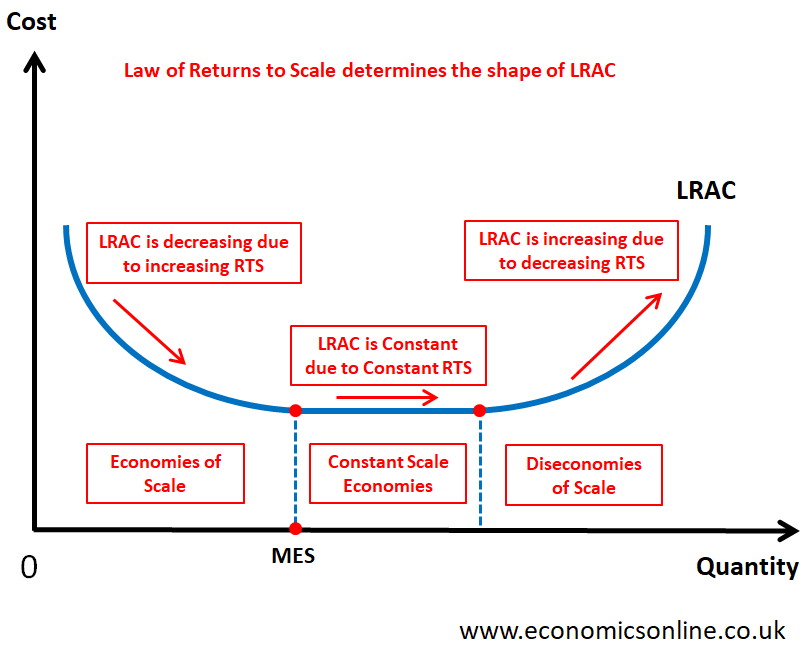
The ratio holds. The efficiency per unit remains constant. This is distinct from increasing returns to scale, where doubling inputs might yield triple the output due to specialized division of labor or technological efficiencies. It’s also different from decreasing returns, where doubling inputs yields less than double the output, often because management becomes overwhelmed or resources become scarce.
Real-World Examples of Constant Returns
So, where do we see this in the wild? CRS is most common in industries where production methods are standardized and easily replicable. It’s rare to find perfect CRS in the real world because friction always exists, but several sectors approximate it closely.
Food Processing and Canning
Consider a factory that cans peaches. The process is mechanical. Cutting, canning, sealing, and sterilizing are all automated steps. If the company decides to expand, they can buy another identical production line. Hire the same number of operators. Source double the peaches. The output should nearly double. There’s no inherent bottleneck that grows disproportionately faster than the inputs. It’s modular by nature.
Garment Manufacturing
Textile production often exhibits constant returns. A clothing brand that outsources its manufacturing doesn’t face significant coordination costs as it scales within a reasonable range. If a factory needs to produce twice as many t-shirts, it doesn’t need to redesign its workflow. It just runs the machines longer or adds a shift. The complexity of managing 1,000 shirts isn’t drastically different than managing 2,000, assuming the infrastructure is in place. The labor and fabric costs scale linearly with the revenue generated.
Independent Contractors
Think about freelance services. If a graphic designer charges $500 per logo and it takes ten hours of work, their “production function” is fixed by their time. To double their income, they must double their hours (with the help of assistants) or raise prices. They can’t produce twice the logos in the same ten-hour window without changing the nature of the work. Their capacity is tied directly to their input: time and effort.
Why CRS Matters for Strategic Planning
Understanding whether your business operates under constant, increasing, or decreasing returns is crucial for forecasting. If you assume increasing returns when you actually have constant returns, you’ll overestimate profits and cash flow. You might invest heavily in capacity that sits idle because costs rose faster than you anticipated.
For firms with CRS, competition tends to be fierce. Since no single firm gains a massive efficiency advantage simply by growing larger, price becomes the primary differentiator. This often leads to perfectly competitive markets where profit margins are thin. There’s no “winner-takes-all” dynamic driven by scale economies. Instead, success depends on operational efficiency, quality, and brand loyalty.
It also simplifies financial modeling. When inputs and outputs move in lockstep, unit costs remain relatively stable. You don’t have to guess whether marginal costs will plummet as you grow (increasing returns) or skyrocket due to bureaucracy (decreasing returns). This predictability is a blessing for budgeting, even if it lacks the excitement of exponential growth curves.
The Limits of Linearity
Here’s the catch: CRS is usually a short-run or medium-run phenomenon. Very few businesses maintain constant returns indefinitely. Eventually, you hit diminishing returns. Maybe you run out of skilled labor in your local area. Maybe supply chains stretch too thin. Maybe communication overhead eats into productivity.
Conversely, small startups often experience increasing returns early on. They fix fixed costs (like software licenses or office rent) across a small base, then expand. But as they grow, those fixed costs get smoothed out, and they settle into a CRS phase. If they grow too fast without refining processes, they slide into decreasing returns.
Recognizing which phase you’re in is half the battle. For the baker, the canner, and the factory owner, constant returns to scale is a reminder that growth requires proportionate investment. There are no free lunches. You get out exactly what you put in, adjusted for market prices. It’s not glamorous, but it’s sustainable. And in the long run, sustainability often beats hype.