Demystifying Financial Models: A Practical Guide for Beginners
Financial modeling is one of those terms that sounds intimidatingly complex. You hear it thrown around in boardrooms, investment banking interviews, and strategy meetings. It sounds like something reserved for Wall Street quant wizards who live inside Excel and speak a language of dense formulas.
The reality is much less glamorous, and frankly, much more useful. At its core, a financial model is simply a mathematical representation of a company's financial performance. It is a spreadsheet used to forecast future financial results based on historical data and specific assumptions. Whether you are a founder looking for funding, a manager trying to secure budget approval, or an investor analyzing a potential buy, understanding how these models work is a critical skill.
Most people think of financial modeling as just crunching numbers. But that’s only half the battle. The real value lies in the narrative those numbers tell. A model allows you to test scenarios. What happens to cash flow if sales drop by 10%? What is the impact of hiring five new engineers? These questions don't have easy answers without a structured framework. That is where the model comes in.
The Basic Architecture of a Model
While sophisticated models can span hundreds of tabs and millions of cells, the fundamental structure remains surprisingly consistent. Most standard corporate finance models rely on three integrated statements: the Income Statement, the Balance Sheet, and the Statement of Cash Flows.
Think of these statements as the engine of the model. They must balance perfectly. If you change a single number in the inputs—say, increasing revenue assumptions—the entire engine should adjust automatically. Revenue flows down the Income Statement to Net Income. Net Income then closes Retained Earnings on the Balance Sheet. Finally, the change in assets and liabilities flows into the Cash Flow statement. If your model doesn’t balance, something is broken. This interconnectivity is what makes building these models tricky but also powerful.
A robust model usually consists of three distinct sections:
- Inputs: These are the assumptions you make. Things like growth rates, profit margins, tax rates, and hiring plans. These are usually placed at the top or in a dedicated summary tab for easy access.
- Calculations: This is the "meat" of the model. Here, the formulas take the inputs and run them through the three financial statements. This section requires strict logic and error-checking.
- Outputs: These are the results. Charts, graphs, key performance indicators (KPIs), and valuation summaries that stakeholders actually look at. This is the storytelling part.
Why Assumptions Matter More Than Formulas
Anyone can learn the XNPV or INDEX MATCH function in Excel. That is just syntax. The real challenge in financial modeling is setting reasonable assumptions. A model is only as good as the data put into it. This is often referred to as "garbage in, garbage out."
When building a model, you aren't predicting the future with perfect accuracy—no one can do that. Instead, you are creating a logic framework to test sensitivity. For example, instead of guessing that sales will grow 5%, you might create a scenario where sales grow 3%, 5%, and 7%. By running these variations, you understand the range of possible outcomes. This helps decision-makers prepare for best-case, base-case, and worst-case scenarios.
It is crucial to be transparent about where your assumptions come from. Are you basing your customer acquisition cost on industry benchmarks? Historical company performance? Market research? Documenting this lineage builds trust with whoever reads your model. If a stakeholder questions a number, you need to be able to pull back the curtain and show the Excel cell that drives it, and the reasoning behind that cell.
Common Types of Financial Models
Not all models are created equal. The structure depends heavily on what you are trying to achieve. Here are a few of the most common variations you will encounter in the business world:
The Three-Statement Model
This is the bread and butter of corporate finance. It links the Income Statement, Balance Sheet, and Cash Flow Statement together. It is typically used for general planning, budgeting, and forecasting. It provides a holistic view of the company’s financial health over a 3 to 5-year period.
Disked Cash Flow (DCF) Analysis
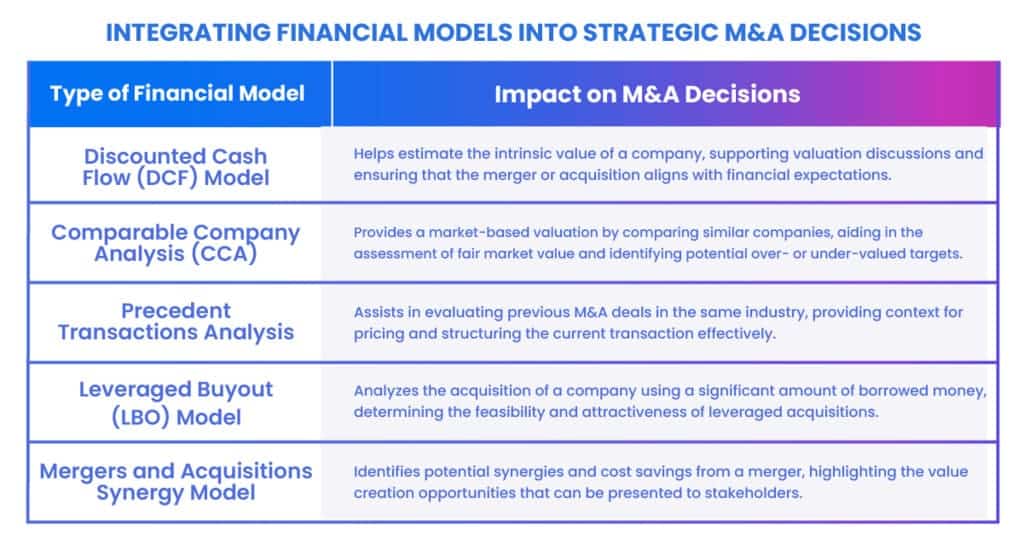
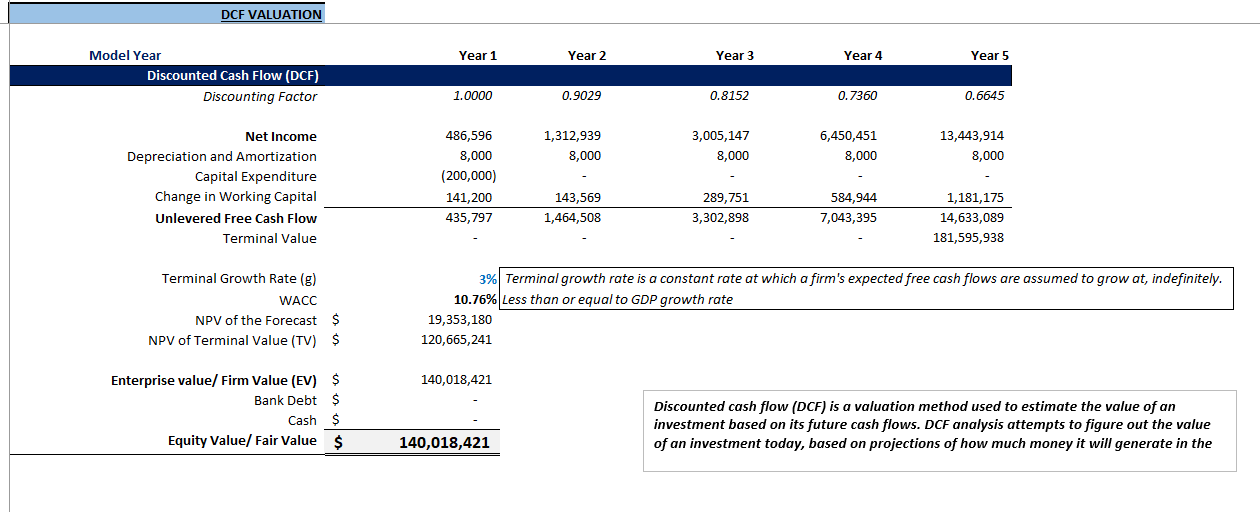
If you are trying to figure out what a company is truly worth, you use a DCF. This model projects the future free cash flow of a business and then discounts it back to today’s value using a required rate of return. It is central to valuation and is heavily used in investment banking and equity research.
Budget Models
These are more operational. Managers use them to plan expenses and revenue for the upcoming fiscal year. They are often static, meaning they don’t fluctuate dynamically with every key financial metric like a three-statement model might. They are primarily used for resource allocation.
Best Practices for Clean Modeling
If you ever open someone else’s financial model, you might feel a sense of dread. Spaghetti-like formulas, hard-coded numbers hidden inside cells, and colors that serve no purpose are common pitfalls. To avoid creating a nightmare for your colleagues (or your future self), follow a few golden rules.
Keep it simple. Complex formulas are difficult to debug. If a cell requires a nested function that spans half a screen, break it down into sub-steps. Readability is more important than cleverness.
Use standard colors. In financial modeling, color coding is not just aesthetic; it is functional. The industry standard is usually blue for hard-coded inputs (numbers you type in) and black for formulas (numbers that Excel calculates). If you mix these up, anyone trying to update the model will struggle to distinguish between driver assumptions and calculated results.
Avoid hard-coding. Never type a number directly into a formula. For example, instead of typing =A1 * 0.1, type =A1 * TaxRateCell. This ensures that if the tax rate changes, you only have to update one cell, not hunt for every instance of "0.1" in your workbook.
Financial modeling is essentially financial storytelling. It takes the past, applies logic and assumptions, and presents a plausible future. It is a skill that blends accounting knowledge with analytical thinking. You do not need to be a math genius to be good at it. You just need to be organized, skeptical of your own assumptions, and committed to clarity.
Frequently Asked Questions
Do I need to know advanced Excel to build financial models?
You need a solid grasp of intermediate Excel functions. You should be comfortable with VLOOKUP, XLOOKUP, INDEX-MATCH, and basic logical functions like IF. You do not necessarily need VBA or macro skills unless you are automating repetitive tasks. Logic and structure are far more important than exotic functions.
How long does it take to build a financial model?
It varies wildly. A simple budget model might take a few hours. A comprehensive three-statement model for a public company can take days or even weeks. The time depends on data availability, the complexity of the business, and how detailed the historical analysis needs to be.
Are modern AI tools replacing financial modelers?
AI tools are becoming excellent at automating data entry and basic calculations. However, they still struggle with strategic judgment and nuanced business assumptions. A human must still define the drivers, validate the logic, and interpret the results in the context of the specific business environment.
What is the most common mistake beginners make?
Hard-coding numbers within formulas is the number one error. Another common mistake is poor formatting, which makes the model confusing for reviewers. Always separate inputs from calculations and ensure your model is easy to read and audit.