FastAPI vs. Django: Which One Actually Runs Faster?
When you’re building a web application, speed isn’t just a nice-to-have feature; it’s often the difference between a user staying on your site and bouncing to a competitor. But when the conversation turns to backend frameworks, performance can get a bit blurry. Specifically, the debate between two of Python’s heavyweights, FastAPI and Django, often centers on a single question: which one is faster?
The short answer might surprise you. If we’re talking about raw request handling, FastAPI wins hands down. It’s designed for speed from the ground up, leveraging modern Python standards to deliver impressive throughput. However, if speed means how quickly you can get a complex, database-backed application to market, Django might ironically be the faster choice for your team.
It sounds contradictory, doesn’t it? That’s because these two frameworks solve different problems. Let’s dig into the technical realities to see which “fast” matters more to your project.
Why FastAPI Is the Speed Demon
FastAPI was built with performance as a primary design goal. Unlike traditional frameworks that rely on synchronous code execution, FastAPI uses asyncio, allowing it to handle thousands of concurrent connections without blocking. This is crucial for I/O-bound tasks like fetching data from other APIs or reading from databases.
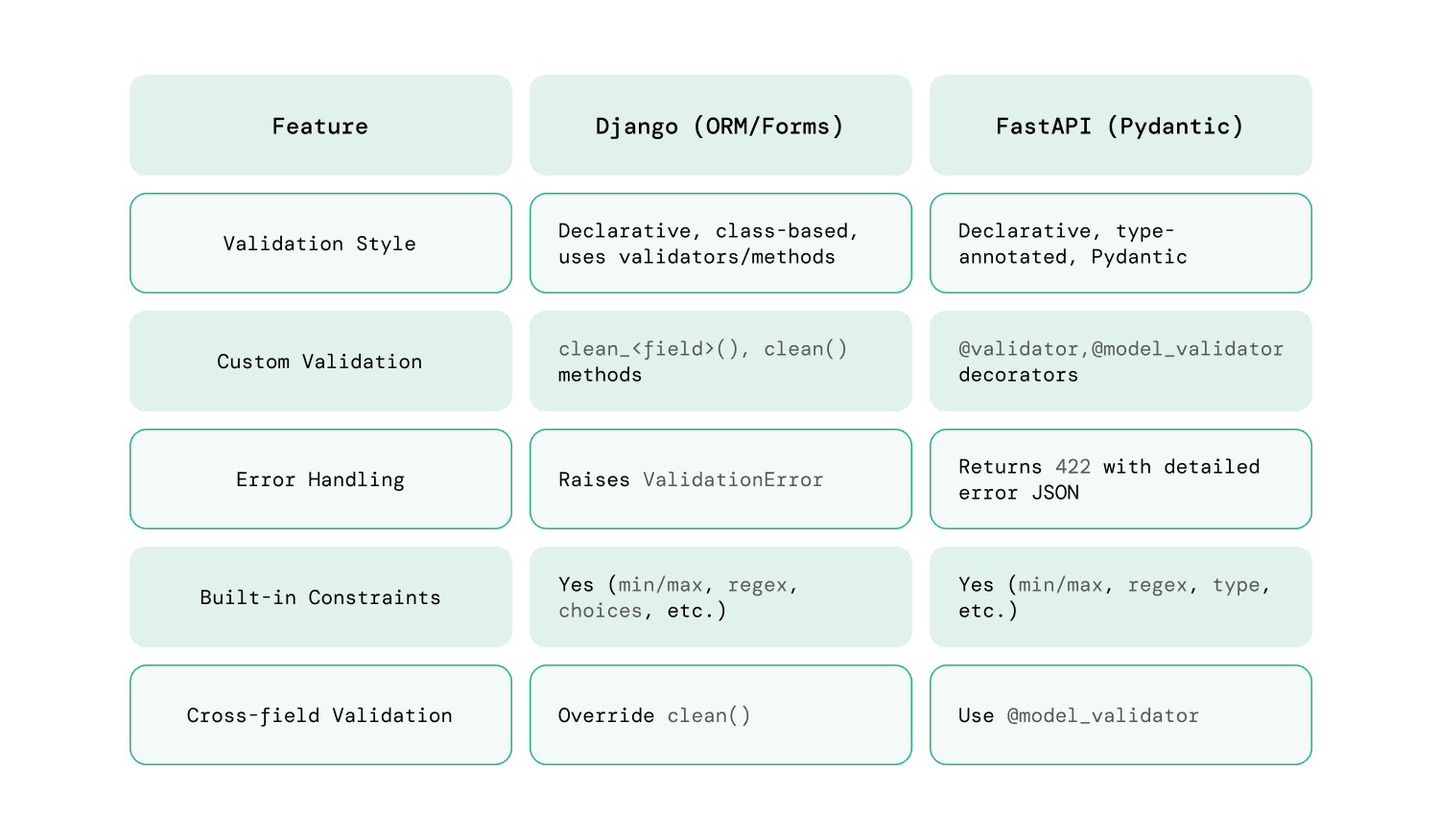
The secret sauce here is Starlette, a lightweight ASGI toolkit that powers FastAPI’s routing and middleware. Combined with Pydantic for data validation, the framework minimizes the overhead usually associated with request and response body parsing.
In benchmark tests, FastAPI often comes out on top, rivaling NodeJS and Go in specific scenarios. Why? Because it does less by default. It doesn’t come with a massive bundle of pre-loaded modules. It takes your code, validates it efficiently, and spits out a response with minimal friction. If your application is microservice-oriented or needs to handle a massive spike in traffic simultaneously, FastAPI’s architecture is inherently more efficient.
Django’s Hidden Bottlenecks
Django, on the other hand, is a monolithic, full-stack framework. It follows a "batteries-included" philosophy. When you install Django, you get an ORM, an admin panel, authentication, caching, and more, all pre-configured. While this is fantastic for development speed, it introduces overhead at runtime.
Most of Django’s core runs synchronously. This isn’t a flaw in itself, but it does mean that if your application needs to wait for a database query or an external service, that thread effectively sits idle. In high-concurrency scenarios, a synchronous server model can become a bottleneck compared to the asynchronous nature of FastAPI.
Furthermore, Django’s ORM, while incredibly powerful and flexible, adds a layer of abstraction between your Python code and the database. This abstraction is convenient but comes with a performance cost. For simple CRUD operations, this overhead is negligible. But for complex, high-volume queries, that extra layer can slow things down slightly compared to the raw SQL handling you might see in a lighter framework.
The "Time to Market" Speed Trade-off
Here is where the comparison gets interesting. If we redefine "fast" as "how quickly can we launch a product?", the scale tips heavily in Django’s favor.
Imagine you need to build an e-commerce platform with user accounts, product catalogs, order history, and an admin dashboard. With Django, you can scaffold this in days. The admin panel alone saves hundreds of hours of development time. The security features are baked in, reducing the time spent on vulnerability audits.
With FastAPI, you have to build all of that from scratch. You need to choose your authentication library, set up your ORM (usually SQLAlchemy), write your serializers, and build your admin interface or decide to use a separate frontend tool. This takes significantly longer. So, while FastAPI might serve individual requests faster, Django might get your entire application to the public faster.
When to Pick Which Framework
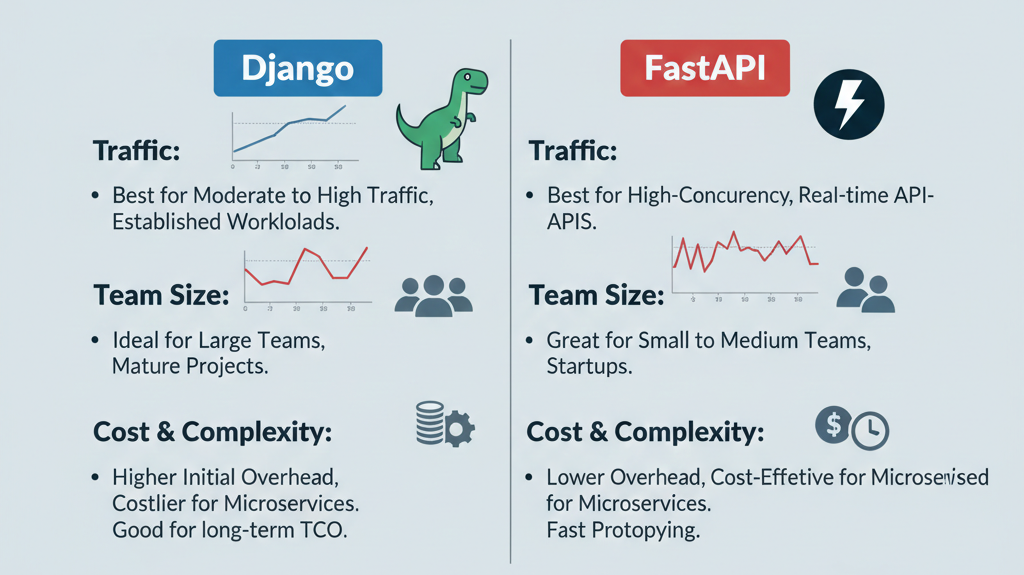
- Choose FastAPI if: you are building a high-performance API, real-time applications (like chat rooms or live notifications), microservices, or machine learning endpoints where low latency is critical. It’s also the better choice if your team is experienced with async Python and wants fine-grained control over every millisecond of request processing.
- Choose Django if: you are building a content-heavy website, an internal business tool, an e-commerce platform, or an MVP that needs to launch in weeks, not months. It’s ideal when rapid development, built-in security, and a robust ecosystem of plugins are more valuable than micro-optimizations in request handling.
FAQ
Is Django too slow for startups?
Django is definitely not too slow for most startups. In fact, many successful tech companies started with Django because it allowed them to develop features rapidly. Unless your specific use case involves extreme concurrency (like handling millions of requests per second for real-time trading), Django’s performance is more than sufficient for 90-95% of web applications.
Can Django use async capabilities?
Yes, starting from Django 3.0, the framework introduced asynchronous views and middleware. While this improves performance, Django remains primarily a synchronous framework. Its core components are still being slowly refactored for async compatibility, but it doesn’t offer the "async-first" simplicity and raw speed that FastAPI provides out of the box.
Is it necessary to choose one and discard the other?
Not necessarily. It’s a common pattern in modern architecture to use Django for the main application (handling user auth, business logic, and the admin interface) and have FastAPI running as a separate, high-performance microservice for computationally heavy tasks, such as data processing, real-time notifications, or intensive calculations.
Which framework has a better performance-to-learning-curve ratio?
If your team is already proficient in Python, FastAPI is easy to pick up due to its intuitive type-hinting and auto-generated documentation. However, Django has a steeper initial learning curve due to its sheer number of features and conventions. Once mastered, Django offers immense productivity gains that often outweigh the minor performance differences for general web applications.