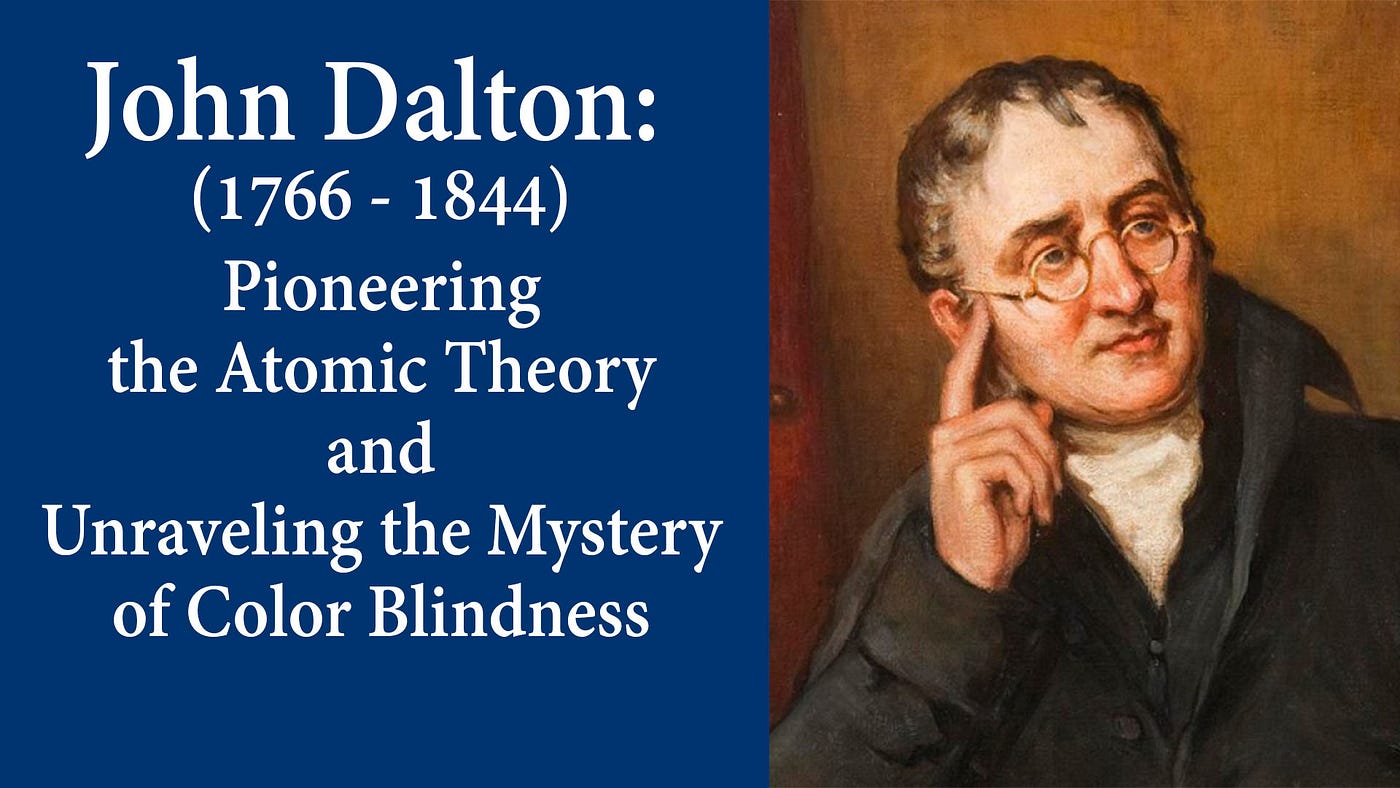
How John Dalton’s Discoveries Shaped Modern Science
When you hear the name John Dalton, thoughts of tiny, indivisible particles probably pop up. Yet his legacy stretches far beyond the simple image of a ball‑shaped atom. From gases hovering over the English countryside to the way chemists balance equations today, Dalton’s work still nudges our understanding of the natural world.
Dalton’s Atomic Theory: A New Framework
In 1803 Dalton published a bold hypothesis: every element consists of its own kind of atom, uniquely weighted and indivisible. At the time, chemistry was more alchemy than science; reactions were cataloged, but the underlying “why” was still mysterious.
Key points of his theory that still echo today:
- Elements are made of identical atoms. Two atoms of hydrogen are indistinguishable from each other.
- Compounds are assemblies of different atoms. Water, for instance, is a fixed ratio of hydrogen and oxygen.
- Simple ratios govern chemical combinations. This gave birth to the law of multiple proportions.
It wasn’t perfect—later discoveries showed atoms can split and share electrons—but the core idea gave scientists a language to discuss matter, paving the way for the periodic table and quantum mechanics.
Colorful Insights: The Study of Atmospheric Gases
Dalton grew up in a small Yorkshire village, where the sky’s ever‑changing hues sparked his curiosity. He began measuring the composition of the air, a pastime that turned into systematic analysis.
His most famous atmospheric experiment involved:
- Collecting rainwater in a leaden container to avoid contamination.
- Analyzing the water for dissolved gases using a simple eudiometer.
- Comparing the results with samples taken from different altitudes.
These humble measurements led him to articulate the law of partial pressures, stating that each gas in a mixture exerts pressure independently of the others. The principle is now a staple in everything from diving tables to the design of breathable habitats on Mars.
Law of Partial Pressures and Its Legacy
Picture a crowded room where each person speaks their own language. Despite the chatter, each voice contributes its own volume to the overall noise. Dalton’s law works much the same way for gases.
Why does this matter?
- It explains why carbonated drinks stay fizzed—CO₂ exerts its own pressure above the liquid.
- It underpins respiratory physiology; oxygen and nitrogen each push against lung tissue independently.
- It guides industrial processes, such as the separation of gases in cryogenic distillation.
Modern engineers still rely on equations derived from Dalton’s original formulation, tweaking them for high‑pressure environments or exotic gas mixtures. The law’s elegance lies in its simplicity, a reminder that profound ideas often spring from straightforward observation.
Beyond Atoms: Dalton’s Contributions to Meteorology
People tend to box Dalton into chemistry, but his curiosity didn’t stop at the laboratory bench. He kept detailed weather logs, noting temperature, humidity, and barometric pressure night after night.
From these notes emerged a surprisingly accurate temperature‑humidity relationship, hinting at the concept of dew point long before it was formally defined. Though later scientists refined his equations, Dalton’s data provided a crucial baseline for 19th‑century weather forecasting.
In a way, his meticulous record‑keeping mirrors today’s citizen‑science projects, where hobbyists upload local climate data to global databases. Dalton was, arguably, an early advocate for the idea that collective observation can reveal patterns hidden from any single observer.
Dalton’s Human Side: Lessons for Today’s Researchers
He wasn’t a lone genius hidden in a tower; Dalton was a schoolmaster, a friend of local physicians, and a fellow of the Royal Society. His willingness to share data, even when it contradicted his own expectations, set a standard for scientific humility.
Some takeaways for modern scientists and students:
- Question assumptions. Dalton’s atomic model challenged the prevailing notion that elements were indivisible.
- Embrace interdisciplinary work. His blend of chemistry, physics, and meteorology shows the power of crossing boundaries.
- Document everything. Detailed notes turned casual observations into lasting laws.
Whether you’re mixing chemicals in a high‑tech lab or simply watching clouds drift by, Dalton’s blend of curiosity and rigor offers a timeless roadmap.