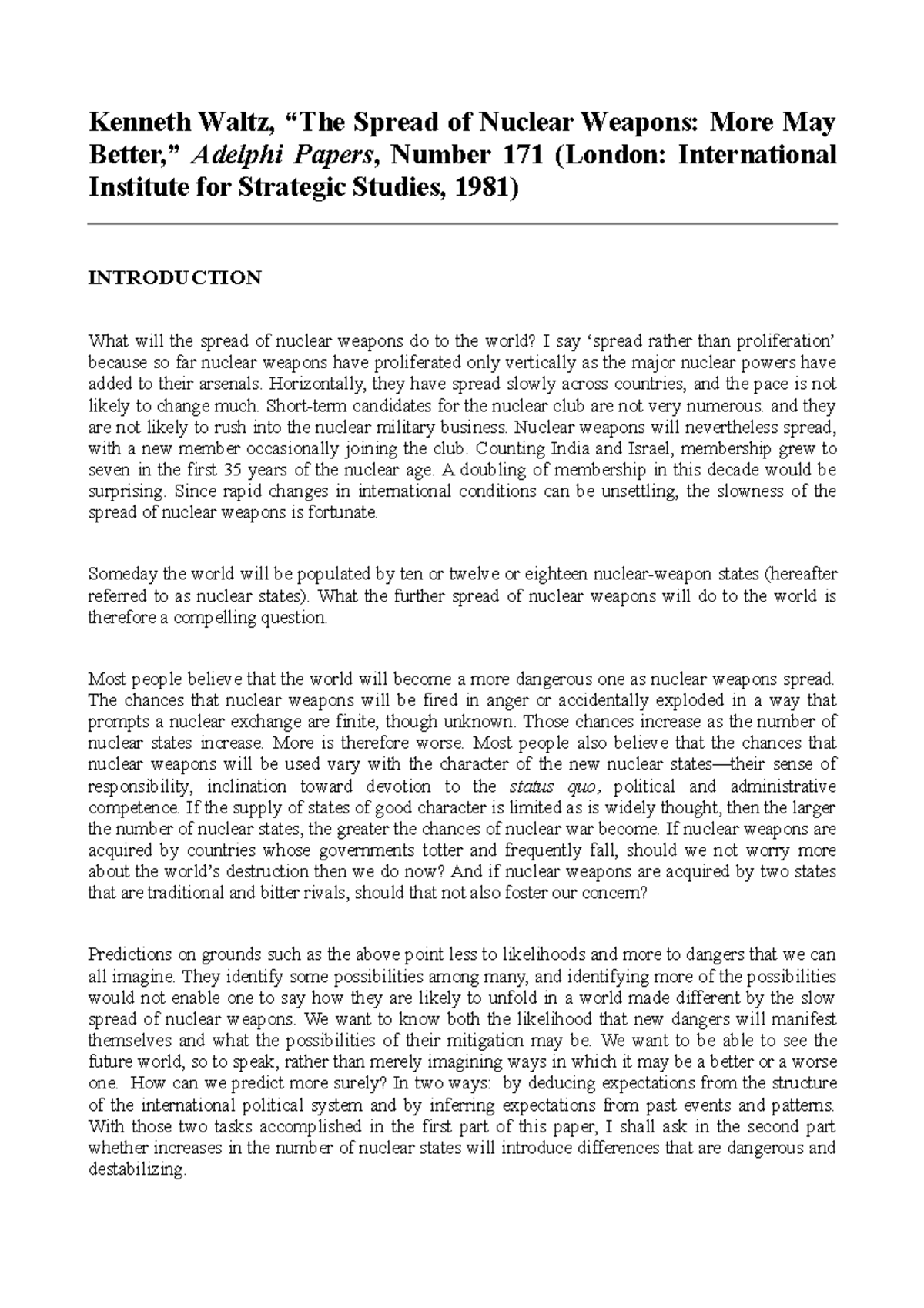
How Kenneth Waltz’s Nuclear Peace Theory Explains Deterrence
When you hear the phrase “nuclear peace,” you might picture a world held in balance by the mere presence of atomic weapons. That’s not a hopeful vision; it’s a cornerstone of the scholarly work of Kenneth Waltz, the realist who argued that nuclear arsenals can actually reduce the likelihood of war. Below we unpack the key ideas behind Waltz’s theory, look at the assumptions that make it work, and consider the criticisms that keep the debate lively.
The Core Premise: Balance Through Mutual Vulnerability
Waltz’s argument hinges on a simple, almost stark logic: when two or more states possess nuclear weapons, each knows that a full‑scale attack would trigger a devastating retaliatory strike. This “mutual vulnerability” creates a deterrent effect that is far more reliable than conventional military calculations.
- Credible retaliation: The ability to inflict unacceptable damage ensures that aggression is too risky.
- Strategic stability: Both sides adopt caution not because they trust each other, but because the cost of miscalculation is catastrophic.
- Reduced incentive for arms races: Paradoxically, once nuclear parity is reached, the pressure to out‑spend an opponent can lessen.
Key Assumptions Behind the Theory
Waltz does not claim that any nuclear arsenal automatically guarantees peace. His model rests on several assumptions that, if broken, can undermine the supposed stability.
Rational Actors
States must act rationally, weighing costs against benefits. If a leader were driven by ideology, personal vendetta, or misperception, the calculus changes dramatically.
Communication and Certainty
Both sides need clear signals that a retaliatory capability exists and will be used. Ambiguity can breed fear, but it can also provoke pre‑emptive strikes if one side doubts the other's resolve.
Second‑Strike Capability
Deterrence hinges on the survivability of a country’s nuclear forces. Submarines, mobile launch platforms, and hardened silos all contribute to a credible second‑strike posture.
Why Waltz’s Theory Remains Relevant
Decades after his seminal 1979 book *The Spread of Nuclear Weapons*, the theory still informs policy discussions. Here are a few contemporary contexts where his ideas echo.
- US‑Russia relations: Despite ongoing tensions, the two powers maintain large, secure arsenals that discourage direct conflict.
- North Korea’s development: The regime’s nuclear pursuit is often interpreted as a bid for deterrence against regime‑change attempts.
- Potential Indo‑Pacific nuclearization: Debates in South Asia frequently reference the stabilizing effect of mutual nuclear capability.
Common Critiques and Counter‑Arguments
No theory survives without pushback. Critics point out several blind spots in Waltz’s reasoning.
Accidents and Miscalculations
History shows that false alarms and technical glitches can bring nuclear powers to the brink. If an accidental launch were to occur, the “peace” premise collapses.
Non‑State Actors
Waltz focuses on state actors, but the modern security landscape includes terrorist groups and rogue entities that might not be deterred by the threat of retaliation.
Proliferation Risks
Encouraging more states to acquire nuclear weapons under the banner of deterrence could inadvertently increase the odds of nuclear use, especially if newer nuclear powers lack robust command‑and‑control systems.
Applying the Theory: A Pragmatic Framework
If policymakers want to use Waltz’s insights responsibly, they might follow a straightforward checklist.
- Confirm the survivability of national second‑strike assets.
- Maintain transparent communication channels to avoid misunderstandings.
- Invest in secure command structures to minimize accidental launches.
- Engage in confidence‑building measures that reinforce rational decision‑making.
Beyond Deterrence: The Broader Implications
Waltz’s nuclear peace theory does more than explain why wars between nuclear powers are rare; it raises questions about the nature of security itself. If peace can be bought with the threat of unimaginable destruction, what does that say about the moral calculus of international relations? Some scholars argue that the theory pushes us to re‑evaluate our reliance on hard power, while others see it as a pragmatic, albeit uneasy, foundation for a stable order.
In the end, Kenneth Waltz’s work offers a lens—a way to view the paradox that the most terrible weapons might, under very specific conditions, make the world a little safer. Whether that lens sharpens or clouds our understanding depends on how carefully we respect the assumptions that underpin it.