How Perpetuities Shape Financial Valuation: A Full Guide
What Exactly Is a Perpetuity?
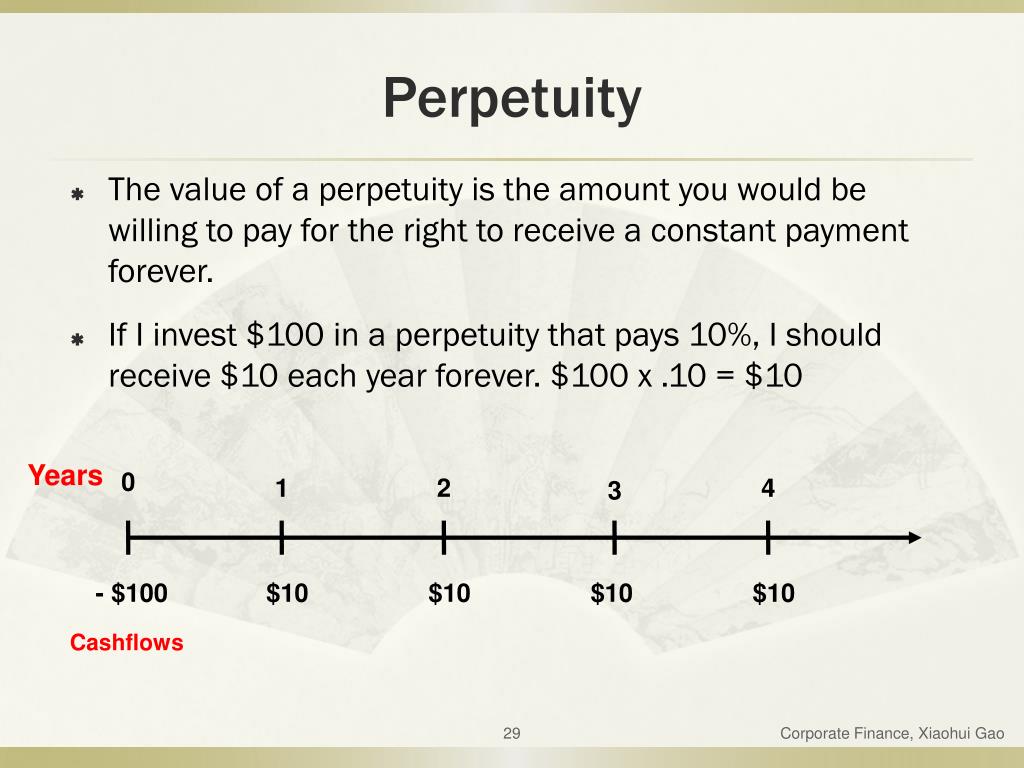
A perpetuity is a series of cash flows that continues forever. Imagine a bond that pays a fixed coupon every year and never matures – that’s the textbook example. Because the payments never stop, the present value can be calculated with a surprisingly simple formula, yet the concept underpins many valuation models.
Two Main Flavors
Not every endless stream is created equal. In practice, analysts distinguish between:
- Fixed‑amount perpetuity: each payment is identical (e.g., $100 annually).
- Growing perpetuity: each payment rises at a constant rate (often used for dividend forecasts).
The Core Formula (and Why It Works)
For a fixed‑amount perpetuity, the present value (PV) is simply the payment divided by the discount rate:
PV = C / r
Where C is the cash flow per period and r the required return or discount rate. The math rests on the geometric series sum; as the number of periods approaches infinity, the series converges to that tidy ratio.
When payments grow at a steady rate g, the formula adjusts to:
PV = C / (r – g)
Here g must be lower than r; otherwise the series would diverge and the valuation would become meaningless.
Where Perpetuities Appear in Real Finance
Even though true infinite cash flows are rare, the perpetuity concept shows up in several key areas:
- Valuing preferred stock, which typically pays a fixed dividend forever.
- Estimating terminal value in a discounted cash flow (DCF) model, often using a growing perpetuity assumption.
- Pricing certain types of annuities or pensions that are expected to last for the lifetime of a population cohort.
Step‑by‑Step Example: Valuing a Preferred Share
Suppose a preferred share pays $8 per quarter, and investors require a 6% annual return. First, convert the discount rate to a quarterly basis: 6% ÷ 4 = 1.5% (0.015). Then apply the formula:
PV = $8 / 0.015 ≈ $533.33
That single number tells you what a rational investor would be willing to pay today for a security that keeps disbursing $8 every three months forever.
Benefits of Using Perpetuity Models
They’re quick, transparent, and rely on few inputs, which makes them ideal for quick sanity checks or for scenarios where data is limited. Moreover, the growing perpetuity version captures the intuition that firms tend to expand cash flows over time, allowing analysts to embed realistic expectations without overly complex forecasting.
Limitations You Can’t Ignore
Despite their elegance, perpetuity models have blind spots:
- Assuming a constant discount rate forever is rarely realistic; market conditions shift.
- Growth rates above the discount rate create mathematical absurdities and signal a flawed premise.
- They ignore potential terminal shocks—regulatory changes, technological disruption, or outright bankruptcy.
Common Questions
Can a perpetuity be used for short‑term projects?
In theory, yes, but the longer the horizon, the more the model’s assumptions dominate the outcome. For a five‑year contract, a standard DCF with explicit cash‑flow forecasts is usually more appropriate.
What if the discount rate is uncertain?
Run a sensitivity analysis. Vary r by a few basis points and observe how the valuation swings. This simple exercise often reveals just how fragile the result can be.
Is the growing perpetuity only for dividends?
No. Any cash‑flow stream that is expected to grow at a stable rate—royalties, lease payments, even certain tax credits—can be modeled this way, provided the growth assumption is justified.
Practical Tips for Practitioners
- Always double‑check that r exceeds g. If not, revisit your growth assumptions.
- When working with annual data, keep the discount rate on an annual basis; mixing quarterly cash flows with an annual discount rate skews results.
- Document the source of your discount rate—whether it’s the company’s weighted average cost of capital, a required return for equity investors, or a market‑driven benchmark.
Perpetuities may feel like an abstract math exercise, but they’re a cornerstone of modern finance. By grasping the simple formulas, understanding their proper context, and recognizing their limits, you’ll be better equipped to value everything from preferred stocks to the “horizon value” of a full‑blown corporate projection.

/investment-concept--growth-plant-on-coins-three-step-in-clear-glass-bottle-on-wooden-table-with-green-blurred-background-and-light--conceptual-saving-money-for-growing-business-and-future-909645158-227be9818e2f48a8bdac2c21b57cde1a.jpg)