How Shakespeare Redefines Beauty in Sonnet 130: A Bold Analysis
When you first hear the opening line—“My mistress’ eyes are nothing like the sun”—you might expect a parody, a jab at the lofty courtly love poems of his time. Instead, Shakespeare offers a surprisingly sincere tribute that flips every conventional compliment on its head. Rather than praising an idealised, almost impossible maiden, he celebrates a real, imperfect woman. That daring choice makes Sonnet 130 one of the most compelling critiques of beauty in the entire canon.
Why Sonnet 130 Stands Apart
Most Elizabethan sonnets are built on a scaffold of hyperbolic imagery: roses that “smell more sweet,” lips “red as coral,” and eyes that “draw the heavens.” Shakespeare deliberately shatters that pattern.
- He refuses the “fairy‑tale” language, opting for blunt, almost earthy observations.
- His diction feels conversational, as if he’s whispering a private joke to the reader.
- The poem’s rhythm stays true to the Shakespearean sonnet form, showing that subversion can coexist with tradition.
Breaking the “Petrarchan” Mold
In Petrarch’s influence, the beloved is a distant, almost divine figure. Shakespeare’s “mistress” is human—her breath “smells” not “sweetly” but “like a garden,” her cheeks lack that “rosy” glow so often praised. The poet isn’t mocking her; he’s acknowledging that love doesn’t require mythic perfection.
Reading Between the Lines: What “Bold Beauty” Means
The phrase “bold beauty” isn’t a literal descriptor in the sonnet; it’s a modern label we attach to the poem’s underlying message. Below are a few ways that boldness surfaces.
- Honesty over ornamentation. By refusing to inflate his lover’s attributes, Shakespeare crafts a more authentic portrait.
- Defiance of societal norms. In an era when poets were expected to idealise, his candidness feels almost rebellious.
- Intimacy through realism. The reader senses a deeper connection when the beloved’s flaws are acknowledged.
What the “sun” and “snow” Really Convey
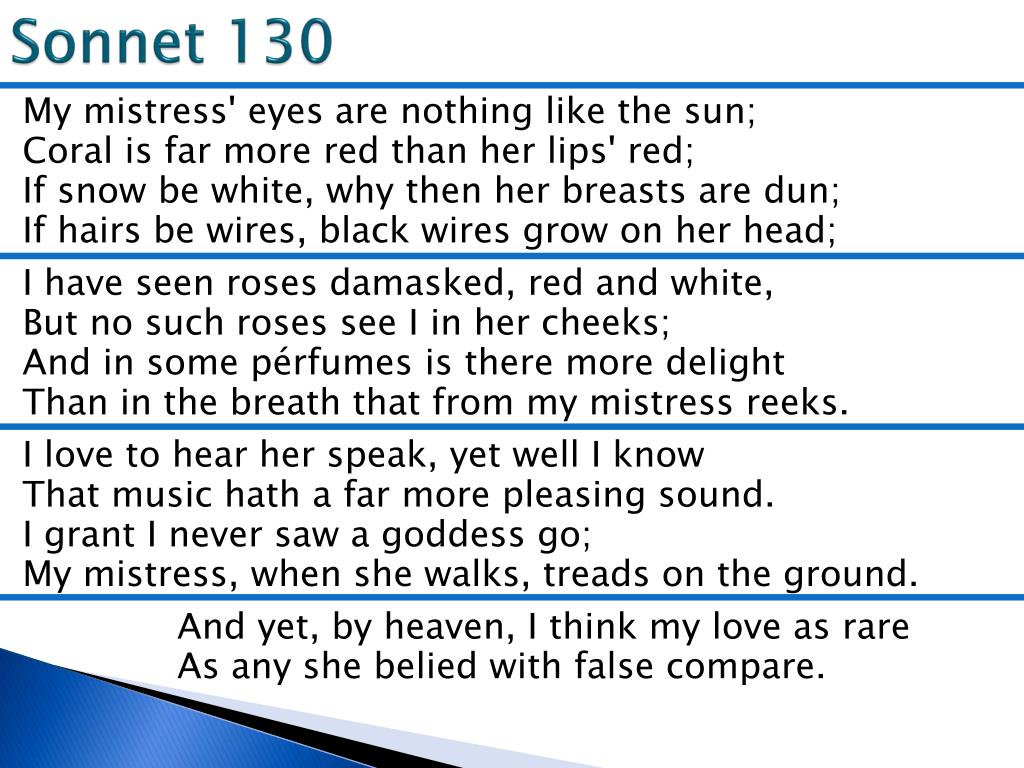
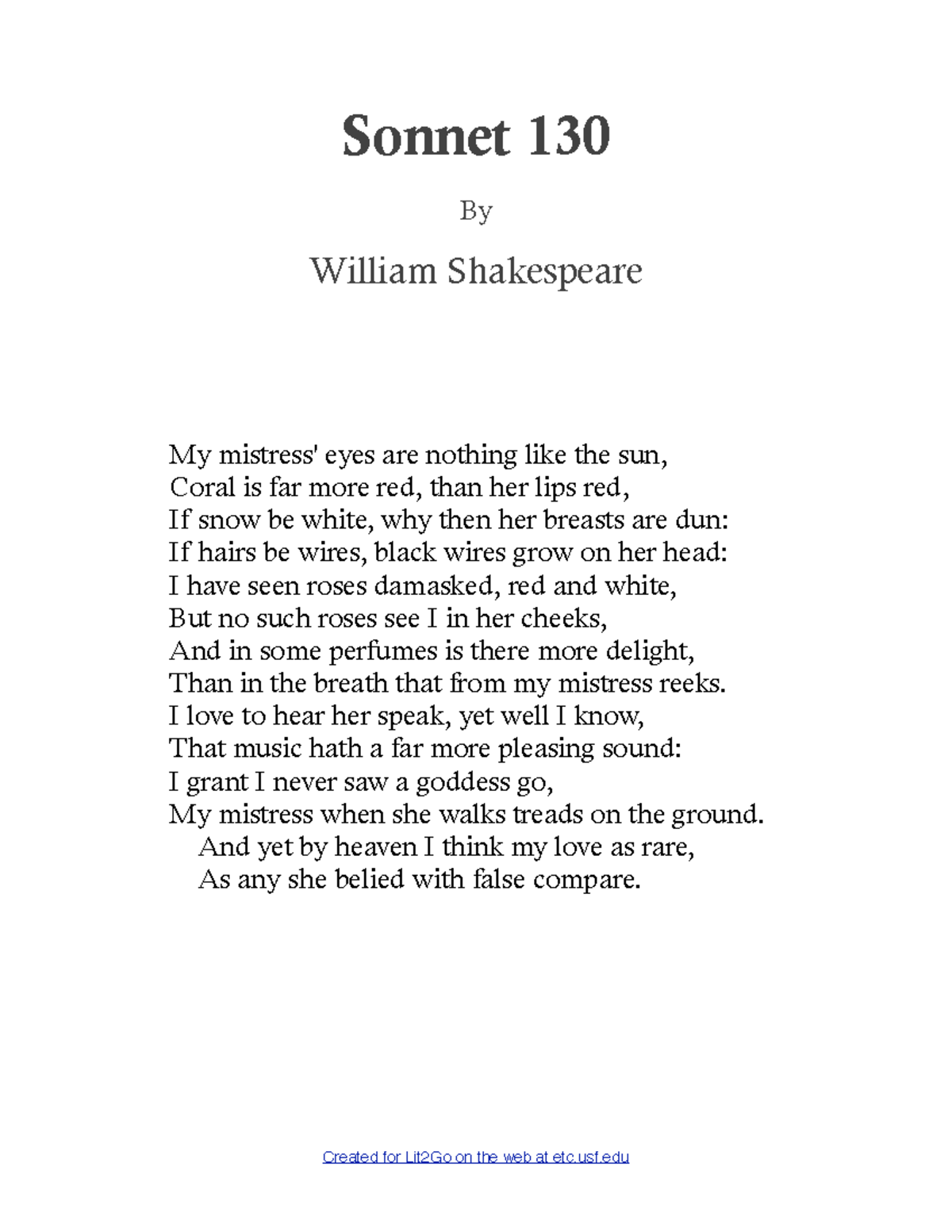
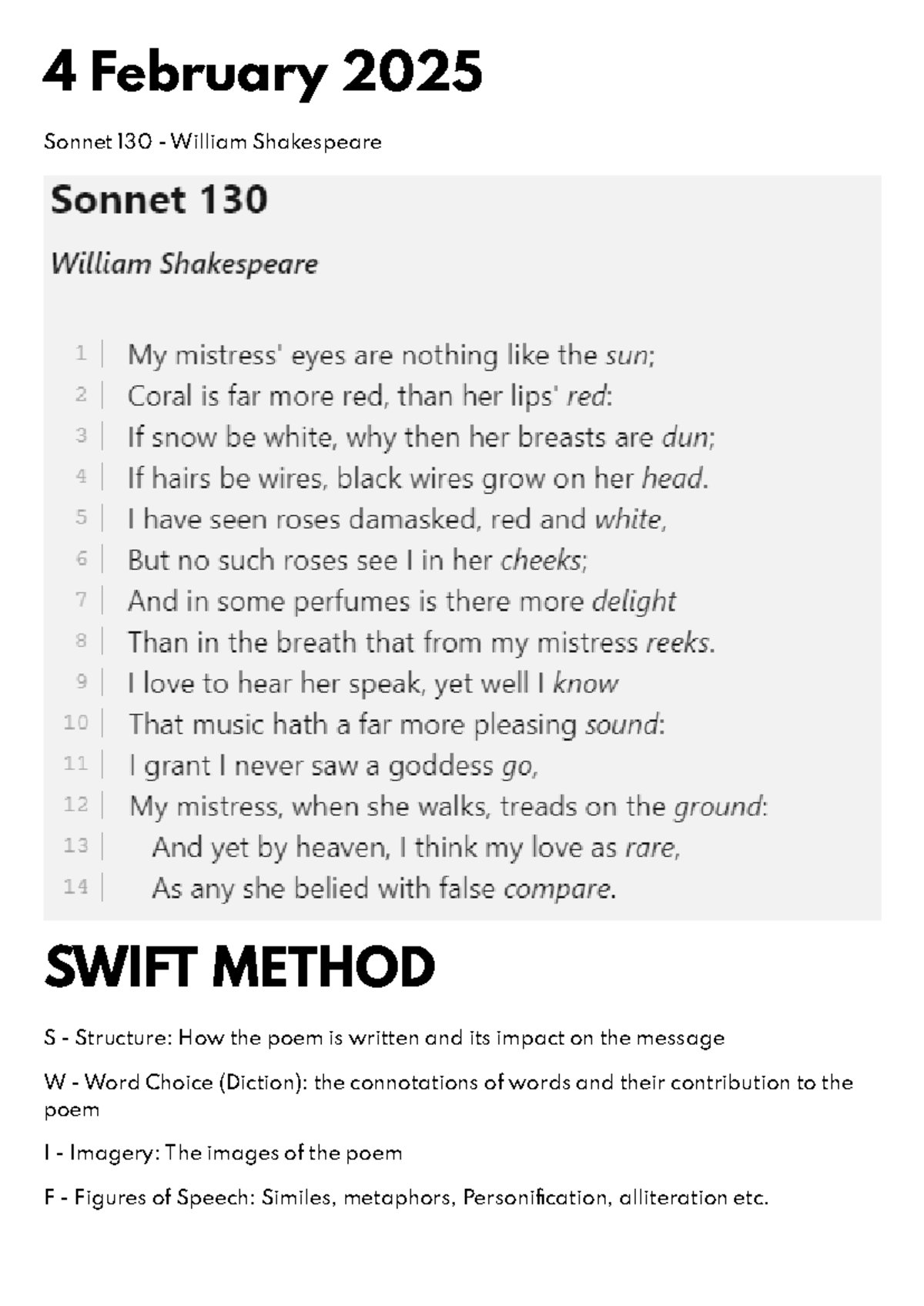
Consider the line “My mistress’ eyes are nothing like the sun.” Instead of a lofty simile, Shakespeare uses a stark negation. The comparison does two things: it highlights that his lover’s eyes lack a dazzling brilliance, and it underscores that she needn’t possess it to be worthy of love. Likewise, “If snow be white, why then her breasts are dun” (dun meaning a dull, earthy brown) flips the expectation that a woman’s complexion must be porcelain.
Contextual Clues: The Poem’s Place in Shakespeare’s Oeuvre
Sonnet 130 belongs to the “dark lady” sequence (Sonnets 127‑152). Those poems, unlike the bright‑skinned “fair youth” series, explore a more complex, sometimes unsettling attraction. The “dark lady” herself is described as having “black” hair and a “smoky” eye, traits that diverged from the era’s beauty standards. The “boldness” of Sonnet 130 lies in its refusal to gloss over those traits.
Furthermore, the final couplet—“And yet, by heaven, I think my love as rare / As any she belied with false compare”—delivers the punchline. After cataloguing all the ways she fails to match poetic conventions, Shakespeare affirms that his love is genuine precisely because it’s grounded in reality.
Modern Resonance: Why We Still Talk About This Sonnet
In a world saturated with filtered images and curated perfection, Sonnet 130 feels oddly contemporary. Its message—love thrives on authenticity, not on fitting a glossy template—resonates with readers across centuries. The poem invites us to question: are we more attracted to the idea of beauty or to the person behind it?
How to Apply Its Insight Today
Here are a few takeaways for anyone navigating relationships or creative expression:
- Don’t shy away from honest description; simplicity can be more powerful than grandiose metaphor.
- Recognise that authenticity often creates stronger emotional bonds than idealised fantasies.
- When critiquing art, consider whether the work challenges conventions intentionally, as Shakespeare does.
Closing Thought
Shakespeare’s Sonnet 130 may seem, at first glance, a short list of “what‑not‑to‑say” about a lover, but underneath it lies a daring affirmation of love’s resilience. By refusing the era’s ornamental praise, he gifts us a poem that feels both timeless and refreshingly candid—proof that true beauty often lies in the unembellished truth.