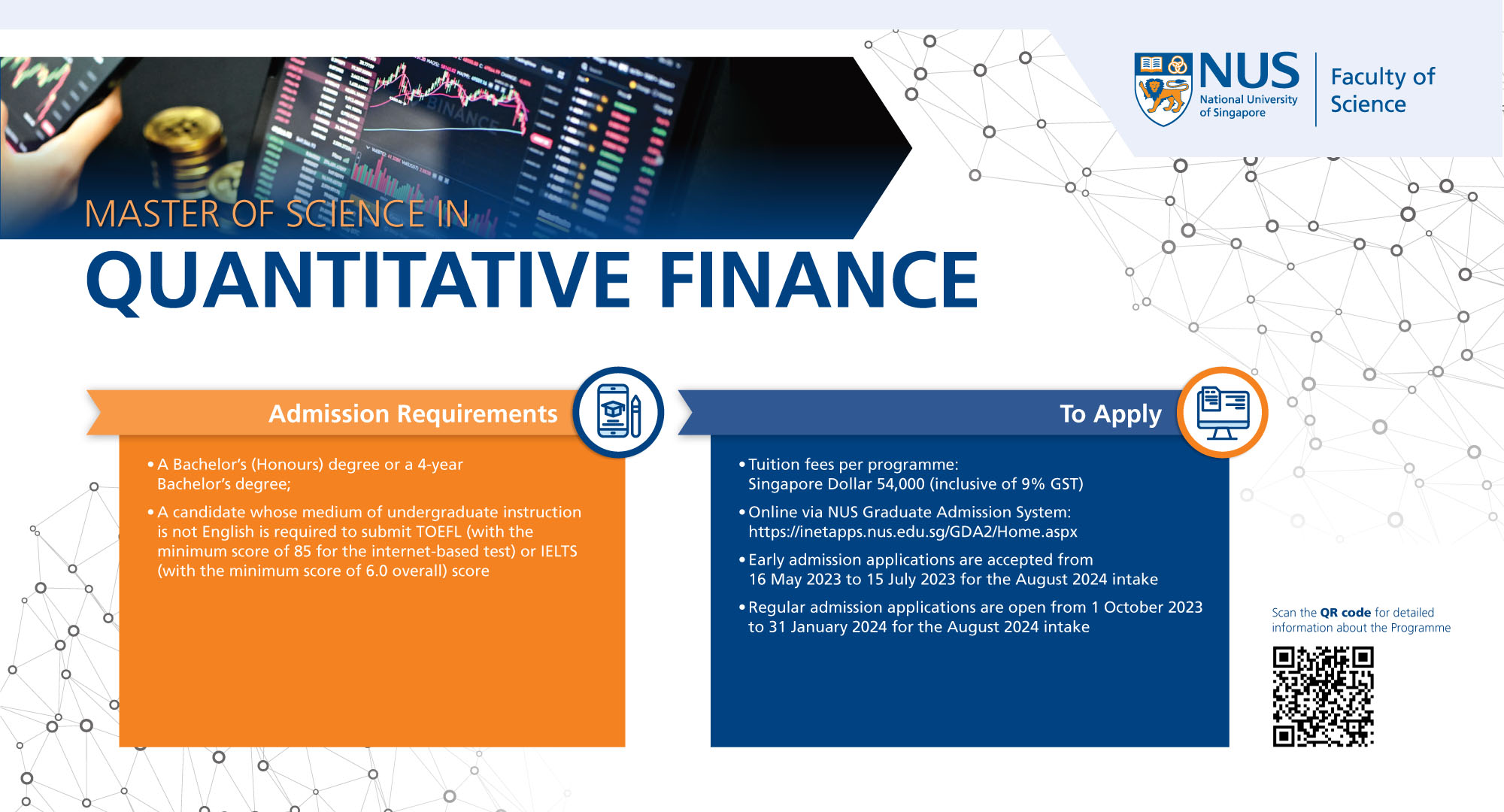
How to Decode the NUS Quantitative Finance Syllabus
If you’ve ever stared at the course list for NUS’s Quantitative Finance program and felt a pang of confusion, you’re not alone. The syllabus blends mathematics, programming, and finance jargon in a way that can seem intimidating at first glance. This guide walks you through the main components, highlights where you’ll spend most of your time, and offers a few practical tips for staying ahead of the curve.
What Makes the NUS Quantitative Finance Programme Unique?
Unlike a traditional finance degree that leans heavily on theory, NUS’s quantitative track is engineered for data‑driven decision‑making. Expect a heavy dose of stochastic calculus, machine‑learning algorithms, and real‑world case studies drawn from Singapore’s bustling financial hub.
- Interdisciplinary focus: Mathematics, computer science, and economics intersect throughout.
- Industry relevance: Partnerships with banks and fintech firms mean projects often mirror actual market challenges.
- Flexibility: Electives let you specialize in areas like risk analytics, algorithmic trading, or financial engineering.
Core Modules You’ll Encounter
These are the pillars most students spend the bulk of their semesters on. Think of them as the “must‑know” toolbox for any quant professional.
Stochastic Processes and Financial Modelling
This module dives into Brownian motion, Ito’s lemma, and the Black‑Scholes framework. You’ll learn how to model asset price dynamics and price derivatives accurately. Expect a mix of rigorous proofs and hands‑on coding assignments in Python or MATLAB.
Computational Methods in Finance
Here the theory meets the screen. Topics include Monte Carlo simulation, finite‑difference methods, and numerical optimisation. The coursework often involves building a pricing engine from scratch, which is surprisingly satisfying once the code finally converges.
Risk Management and Portfolio Theory
From Value‑at‑Risk (VaR) to Conditional VaR, this class tackles how institutions measure and mitigate risk. You’ll also see modern portfolio theory refreshed with factor models and robust optimisation techniques.
Data Science for Finance
Data wrangling, time‑series analysis, and machine‑learning pipelines are the focus. Expect to use libraries like pandas, scikit‑learn, and TensorFlow to predict market movements or detect anomalies.
Electives: Tailor Your Learning Path
After covering the core, you can choose electives that align with your career goals. A few popular picks include:
- Algorithmic Trading Strategies – design and back‑test high‑frequency trading bots.
- Financial Derivatives – deeper exploration of exotic options and structured products.
- FinTech Innovation – study blockchain, digital wallets, and regulatory tech.
Electives often involve a mini‑capstone, giving you a portfolio piece to show future employers.
How the Coursework Is Structured
Each semester typically follows a rhythm of lectures, weekly tutorials, and a major assignment. Lectures provide the mathematical backbone, while tutorials are where you wrestle with problem sets and code snippets. The major assignment—not just a paper but a functional prototype—usually accounts for 30‑40% of the module grade.
One quirk to note: some modules release lecture slides only after the class, so it’s wise to take diligent notes during the session itself.
Study Tips From Current Students
Below are practical insights gathered from students who’ve already navigated the syllabus.
- Start coding early. Even if you’re comfortable with the maths, the programming assignments can be a bottleneck.
- Form a study group. Discussing proof techniques or debugging code together often speeds up learning.
- Leverage the NUS library’s finance databases. Access to Bloomberg and Thomson Reuters data can give your projects a professional edge.
- Don’t ignore the “soft” modules. Courses on communication and ethics are surprisingly useful when presenting quantitative findings to non‑technical stakeholders.
Connecting Theory to the Real World
What sets the NUS program apart is its emphasis on applying abstract models to tangible market problems. For instance, in the Risk Management module you might be tasked with developing a stress‑testing framework for a simulated Singapore‑based bank. The resulting report mirrors the kind of deliverable you’d produce on the job.
Similarly, the Data Science for Finance class often partners with local fintech startups, letting you experiment with real transaction data under strict confidentiality agreements.
Preparing for a Career After Graduation
Quantitative finance roles in Singapore range from risk analyst at a multinational bank to algorithmic trader at a proprietary firm. Recruiters look for three things: solid quantitative foundations, proven programming ability, and the capacity to translate complex results into actionable insights.
To showcase these skills, consider the following steps before you walk across the stage:
- Build a GitHub portfolio with projects from each core module.
- Attend NUS‑hosted finance hackathons; they’re great networking venues.
- Seek an internship through the university’s career centre—many alumni are eager to mentor.
Final Thoughts on Navigating the Syllabus
Decoding the NUS Quantitative Finance syllabus is less about memorising a list of courses and more about understanding how each piece fits into the larger puzzle of modern finance. By focusing on the core modules, choosing electives that match your interests, and applying what you learn through real‑world projects, you’ll turn a daunting curriculum into a clear, purposeful roadmap.