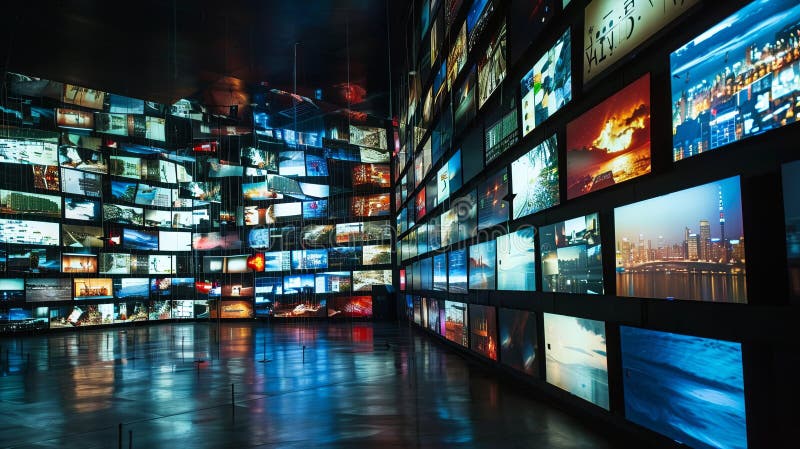
How Video Walls Are Revolutionizing News Broadcasts
Walk into any major newsroom today, and the first thing you’ll notice isn’t the chaos of the breaking news desk. It is the sheer scale of the screen. We used to rely on single monitors and cluttered control rooms. Now, floor-to-ceiling video walls dominate the space, turning data visualization into a visual spectacle. This shift isn’t just about looking cool on camera. These massive displays are fundamentally changing how we produce, edit, and consume news. They are blurring the line between the producer and the presenter, allowing for a level of interactivity that was previously impossible in live television.
The Shift From Flat Screens to Immersive Environments
For decades, news anchors sat in front of green screens or static physical backgrounds. The graphics were overlaid digitally, often feeling disconnected from the physical space. Video walls change this dynamic completely. By displaying real-time data, live feeds, and interactive maps on a seamless LED backdrop, the newsroom becomes an immersive environment. This technology allows graphics to feel like they are part of the room, not just floating in digital space.
This immersion has a psychological effect on both the viewer and the talent. For the audience, it lends credibility. When an anchor can physically interact with a weather map or a stock chart displayed behind them, the information feels more tangible and immediate. For the journalist, it reduces cognitive load. They don’t need to memorize every statistic; they can refer to the live data displayed in high definition right behind them.
Enhancing Storytelling Through Data Visualization
Modern news is driven by data. Whether it’s election results, economic indicators, or pandemic statistics, numbers tell the story. A single monitor struggles to present complex datasets clearly. A video wall, however, can split its display into multiple zones. One section might show a live map, another a rolling ticker of stock prices, and a third a video feed from a correspondent.
This multi-layered approach allows for sophisticated storytelling. Producers can build narratives visually before the anchor even speaks. Imagine a political debate. Instead of just showing the candidates, the background wall can display real-time fact-checks, poll numbers, or historical context relevant to the current statement. This turns the broadcast into a living, breathing document. It helps viewers process complex information faster because they are seeing the context and the content simultaneously.
- Real-time data integration allows for immediate updates to graphics.
- Split-screen capabilities enable comparative analysis without visual clutter.
- High-resolution displays ensure legibility of fine print and charts.
Bridging The Gap Between Control Room and Studio
One of the biggest challenges in broadcast news is latency. There is often a disconnect between what the producers are seeing in the control room and what is airing in the studio. Video walls help synchronize these spaces. Advanced systems allow producers to drag and drop elements directly onto the wall from the control room interface. This visual feedback loop speeds up decision-making during breaking news events.
Furthermore, these walls facilitate better collaboration. Journalists, producers, and directors can all stand in front of the display and discuss the layout of the segment. It becomes a shared workspace. This collaborative aspect is crucial in fast-paced news environments where seconds count. The ability to visualize the broadcast plan physically reduces errors and ensures that everyone is on the same page.
Technical Considerations And Cost Factors
Installing a professional-grade video wall is a significant investment. It requires not just the hardware but also robust software infrastructure to manage content sources and resolution. LED panels must have high refresh rates to avoid camera flicker, a common issue in broadcast environments. Additionally, the bezels—the frames around each panel—must be ultra-narrow to maintain visual continuity.
While the upfront cost is high, the long-term benefits often justify the expense. Traditional projection systems required dark rooms and frequent bulb replacements. LED video walls are brighter, more energy-efficient, and have longer lifespans. They also offer greater flexibility in content management. As newsrooms move toward hybrid work models, these walls can also serve as communication hubs for remote teams, displaying video feeds from distributed contributors with minimal lag.
The Future Of Visual News Consumption
As virtual production techniques advance, video walls are becoming more integrated with augmented reality (AR) tools. This means that the graphics displayed on the wall can interact with the anchor in 3D space. For example, a globe might rotate in sync with the anchor’s hand gestures, or data points might float in the air near their head. This level of interaction makes the news more engaging and accessible.
We are likely to see these technologies trickle down from major networks to local markets. As prices drop and software becomes more user-friendly, smaller newsrooms will adopt these systems. This democratization of high-end visual tools will raise the overall standard of news production across the industry. The goal is no longer just to report the news but to make it understandable and compelling through visual storytelling.
What Is The Main Advantage Of Video Walls In News?
The primary advantage is enhanced visual storytelling. By displaying multiple data sources simultaneously, video walls provide context and depth that single screens cannot match. This helps viewers understand complex stories more quickly and keeps them engaged.
Are Video Walls Cost-Effective For Small Newsrooms?
While initially expensive, LED video walls are cost-effective in the long run due to low maintenance and energy efficiency. Additionally, modular designs allow smaller outlets to start with a smaller setup and expand as budgets allow.
How Do Video Walls Improve Live Broadcasts?
They reduce latency and improve coordination between producers and anchors. Real-time updates to graphics can be made instantly, ensuring that viewers always see the most current information. The interactive nature of the displays also allows for spontaneous adjustments during live events.
What Technical Specs Are Most Important For News Video Walls?
High refresh rates are critical to prevent flickering on camera. Narrow bezels ensure a seamless image, and high brightness levels are necessary to combat studio lighting. Reliable content management software is also essential for handling multiple video feeds and data streams.