Inertial Confinement Fusion: A New Era Of Space Travel?
There is a persistent myth in science fiction that fusion power is always "30 years away." For decades, that joke held true. We waited for tokamaks to stop leaking plasma and magnetic bottles to hold together. But while magnetic confinement fusion has been the darling of Earth-based energy research, a different approach has been quietly maturing in the shadows. It doesn’t use giant magnets. It uses small, precise explosions.
We are talking about Inertial Confinement Fusion (ICF). For most of the public, ICF is known for three things: replicating star-like conditions in a lab, producing tiny amounts of nuclear weapons components without testing, and yes, breaking the record for net energy gain in 2022 at Lawrence Livermore National Laboratory.
Yet, when engineers look at ICF, they don’t just see a power plant component. They see a potential game-changer for propulsion. If we can harness the energy of tiny star bombs, can we fling humanity to Mars in weeks rather than months? The answer is a complicated "maybe," but the physics is finally starting to catch up with our ambition.
The Difference Between Magnetic and Inertial Confinement
To understand why ICF might be better suited for space than power plants, you first have to understand the fundamental difference in how it works.
Magnetic Confinement Fusion (MCF)—the kind used in Tokamaks—relies on strong magnetic fields to hold a hot, thin plasma in place for a long time. It’s like trying to hold a slippery ball of boiling water using invisible, wobbly hands. It requires massive infrastructure, superconducting magnets, and constant maintenance. Put that on a rocket, and the mass penalty makes the whole mission impossible.
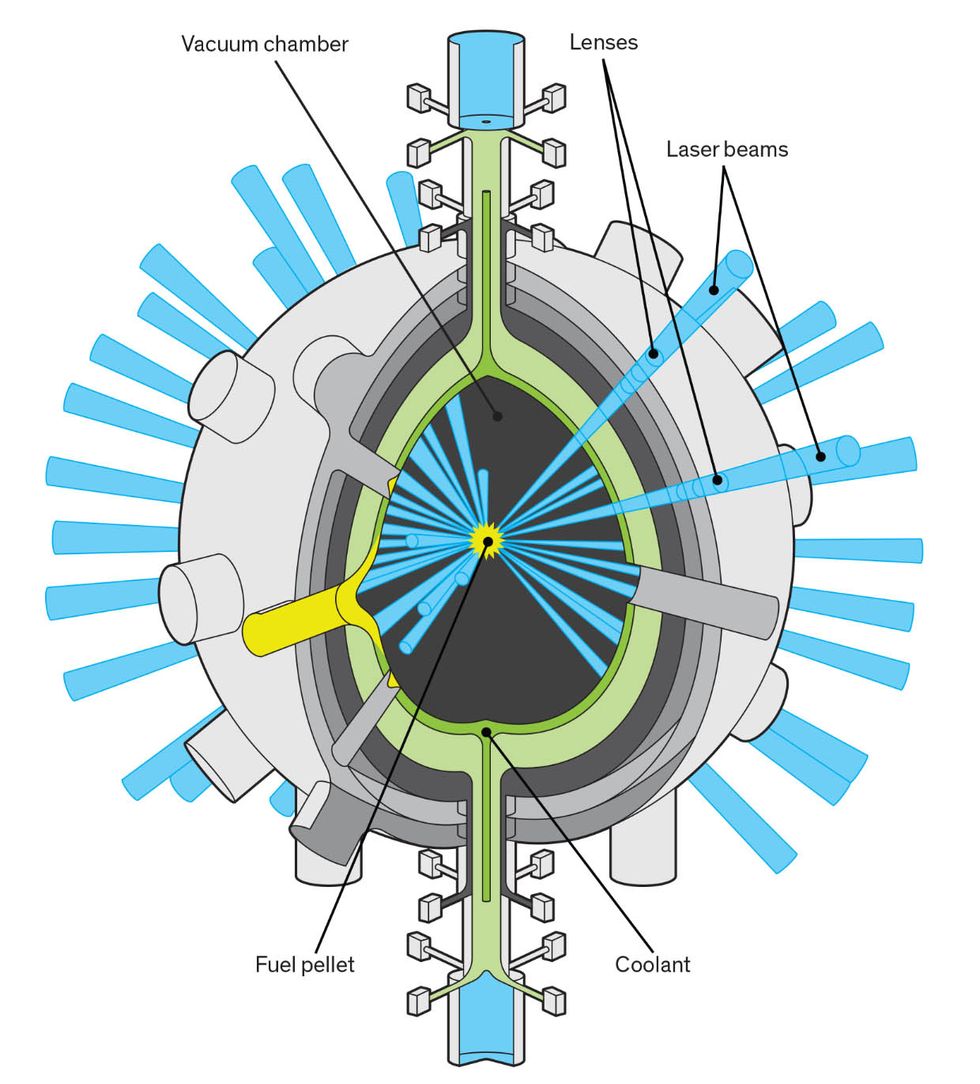
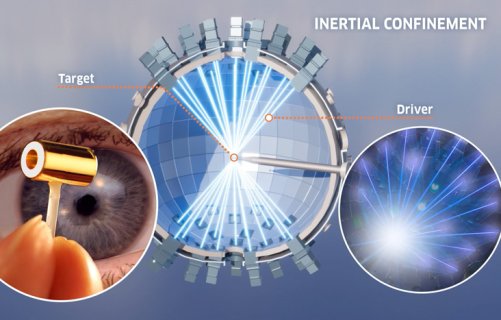
Inertial Confinement Fusion is the opposite. It’s brute force, but precise brute force. Instead of holding plasma in place, you crush it so fast that it fuses before it can fly apart. You take a tiny pellet of fuel—usually deuterium and tritium—and bombard it with high-energy lasers or particle beams. The outer layer explodes outward, driving the inner layer inward with such immense pressure that it ignites.
All of this happens in nanoseconds. That’s why it’s called "inertial" confinement—the inertia of the fuel itself holds it together long enough for fusion to occur.
Why MCF Is a Nightmare for Rockets
If you want to build a fusion rocket using magnetic confinement, you are stuck with the mass problem. A Tokamak reactor weighs hundreds of tons. Even the most advanced conceptual designs for magnetic fusion rockets struggle to achieve a thrust-to-weight ratio that allows them to leave Earth’s gravity well. They are essentially terraferm-bound power stations.
Spacecraft, by contrast, thrive on specific impulse and lightness. We need engines that produce high thrust with minimal mass. This is where Inertial Confinement Fusion excels. Because ICF pellets are small and the reaction is pulsed, the engine architecture can be radically simpler.
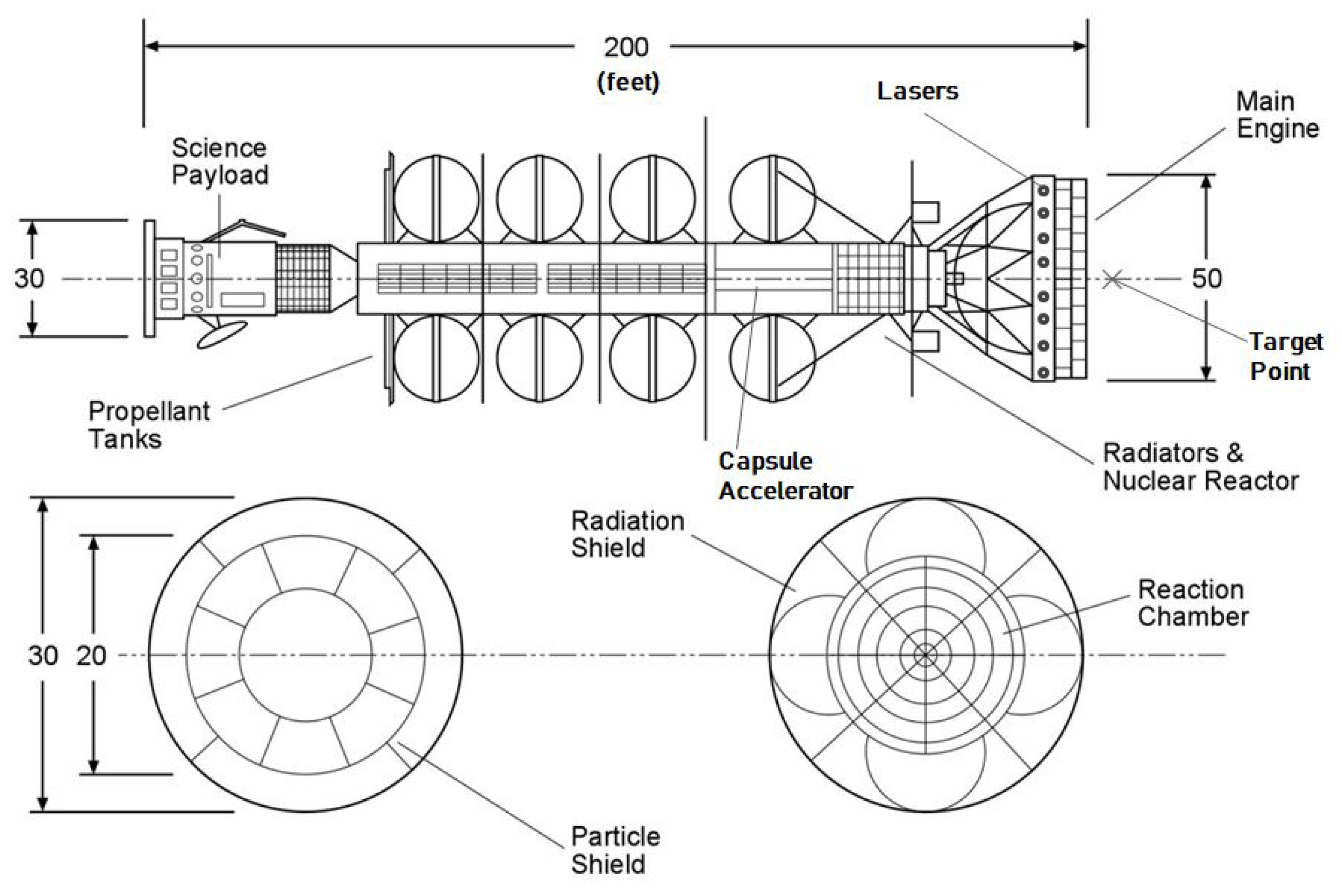
Imagine a series of small reaction chambers. A fuel pellet enters the chamber. High-energy lasers or electron beams hit it. It explodes. The resulting plasma expands into a magnetic nozzle, creating thrust. This concept, often referred to as Direct Drive ICF or Laser Nucleogenesis, has been studied since the 1970s.
Project Daedalus and the Legacy of Fusion Rockets
You might remember Project Daedalus, a famous 1970s study by the British Interplanetary Society. Daedalus proposed a starship capable of reaching Barnard’s Star without human crew. Its engine? Inertial Confinement Fusion.
Daedalus used pellets of deuterium-helium3, compressed by pulsed fusion drives. It wasn’t lasers—it was simpler particle beams—but the principle remains. The study proved that if you can drive fusion efficiently and repeatedly, interstellar travel is physically possible within a human lifetime. The dream didn’t die; it just got sidelined by budget cuts and the complexity of laser tech.
Today, however, high-energy laser technology is advancing rapidly. Techniques used in hydrodynamic stabilization for nuclear weapons are applicable to rocketry. The idea is to create a "fusion pulse" engine that fires dozens of times per second.
The Hard Constraints: Lasers and Fuel
Let’s be clear about the hurdles. This isn’t ready for next Tuesday. There are two massive challenges keeping ICF rockets in the realm of theoretical physics rather than blueprints.
First, the laser system. In Earth-based experiments like the National Ignition Facility, lasers are the size of entire buildings to compress a pellet the size of a peppercorn. Getting that footprint down to fit inside a spacecraft—and making it light enough to launch—is a materials science nightare. We need high-efficiency, solid-state lasers that weigh kilograms, not tons.
Second, the fuel cycle. You need a continuous supply of deuterium and tritium. Tritium is rare, radioactive, and difficult to handle. While helium-3 is often touted as a cleaner fusion fuel, harvesting it from the Moon is currently more expensive than building an entirely new colony.
And then there’s the engineering of the reaction chamber. Imagine hitting a pellet with enough energy to create a micro-nova, dozens of times a second, and having the chamber survive for years without melting or warping. It requires materials that can withstand thermal shocks that would vaporize steel.
Why We Should Keep Looking
So why bother? The difference between a chemical rocket and a fusion rocket is the difference between a bicycle and a jet plane. Chemical rockets offer specific impulse in the range of 400-450 seconds. Inertial Confinement Fusion could theoretically offer tens of thousands, if not hundreds of thousands, of seconds of specific impulse.
With that kind of efficiency, a trip to Mars could drop from seven months to three weeks. A mission to Jupiter could be done in a few months. We could carry heavier payloads, including radiation shielding and life support systems that actually function like a home rather than a cardboard box.
Recent breakthroughs in laser efficiency and plasma physics suggest we are no longer staring at an impossible wall. The science of ignition is solved. The engineering of miniaturization is the current battleground.
Perhaps Inertial Confinement Fusion will never power our cities. The economics might never make sense for grid electricity compared to wind or solar. But for space? The stakes are different. In the vacuum of deep space, where there is no fuel, no maintenance team, and no atmosphere to drag you down, the ability to carry your own star inside your ship is the only way forward.
Frequently Asked Questions
- Is Inertial Confinement Fusion safe for space travel?It is nuclear, but unlike fission reactors, fusion produces minimal long-lived radioactive waste. The primary risk is radiation shielding for the crew, which requires dense mass (like water or regolith) between the engine and the habitat.
- Does this technology currently exist?No. We have demonstrated net energy gain in a lab, but we do not have a repeatable, efficient, miniaturized ICF engine ready for flight. Current progress is in concept design and component testing.
- How does ICF compare to nuclear fission propulsion?Fission is heavier and produces long-term radioactive waste. ICF offers higher specific impulse (efficiency) and uses fuel (deuterium/tritium) that is far more abundant and less hazardous than uranium.