Mastering the DB2 CONCAT Function: A Complete Guide
The DB2 CONCAT function is a simple yet powerful tool for merging text values inside IBM’s relational database. Whether you’re building a report, formatting a log entry, or stitching together dynamic SQL, understanding how CONCAT works—and when to use it—can save you time and headaches. In this guide we’ll walk through the syntax, edge‑case behavior, performance tips, and real‑world examples so you can apply it confidently in your own queries.
What CONCAT Actually Does
At its core, CONCAT takes two character expressions and returns a single string that places the second argument directly after the first. It’s the DB2 equivalent of the “+” operator in some other databases, but with clearer handling of data types and NULLs.
Typical use cases include building full names from first and last columns, creating file paths, or preparing CSV rows on the fly.
Basic Syntax and Data Types
The function’s signature is straightforward:
CONCAT(string‑expression1, string‑expression2)
Both arguments must be of a character type—VARCHAR, CHAR, CLOB, or even a numeric literal that DB2 can implicitly cast. If the result could exceed the length of the target column, DB2 will truncate according to the column’s definition.
How NULL Values Are Treated
One quirk that trips newcomers is NULL handling. Unlike the “||” operator, which returns NULL if any operand is NULL, CONCAT treats a NULL as an empty string. This means:
CONCAT('ABC', NULL) → 'ABC'CONCAT(NULL, 'XYZ') → 'XYZ'
While convenient for some scenarios, you still need to be deliberate when NULLs represent missing data rather than “nothing”. Wrapping arguments in COALESCE lets you decide the fallback value.
Combining CONCAT With Other String Functions
DB2’s rich string library plays nicely with CONCAT. A common pattern is to trim whitespace before joining:
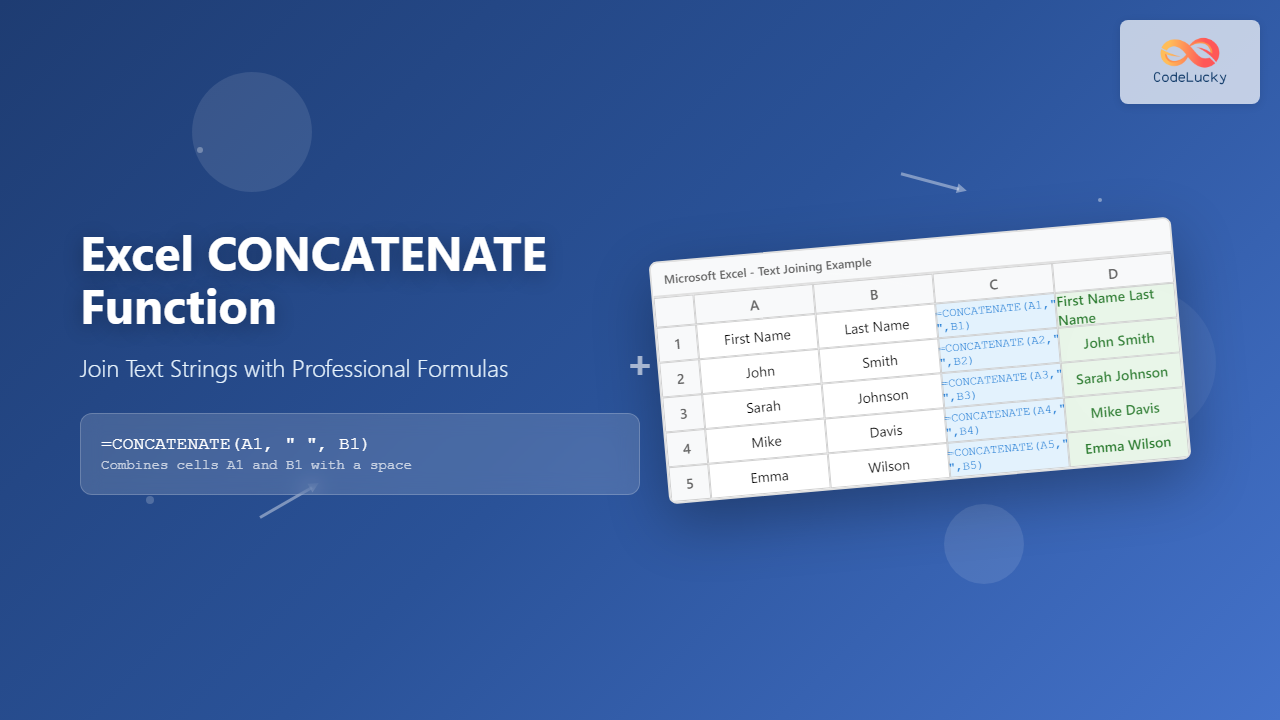
SELECT CONCAT(TRIM(first_name), CONCAT(' ', TRIM(last_name))) AS full_nameFROM employees;
Notice the nested CONCAT that inserts a space between the trimmed names. You could also use SUBSTR, UPPER, or REPLACE inside the arguments to shape the output.
Performance Considerations
When you concatenate columns in a large table, DB2 must allocate intermediate memory for each row. The overhead is usually negligible, but two practices can keep the cost low:
- Prefer VARCHAR over CHAR for columns that will be concatenated; fixed‑length CHAR forces DB2 to pad each operand before joining.
- Avoid concatenating inside a WHERE clause if you can rewrite the predicate using separate conditions—this prevents unnecessary string construction for rows that will be filtered out.
In OLTP environments, testing the query plan with EXPLAIN will confirm whether CONCAT introduces a bottleneck.
Common Pitfalls and How to Avoid Them
Even seasoned DB2 developers stumble over a few recurring issues:
- Implicit truncation: If the target column is defined as VARCHAR(20) and you concatenate three 10‑character fields, DB2 silently chops the result at 20 characters. Explicitly cast the expression to a larger length if you need the full string.
- Mixed encodings: Concatenating a UTF‑8 column with a LATIN1 column can yield unexpected characters. Align the code page of all inputs, or cast them to a common encoding.
- Using CONCAT for large CLOBs: For megabyte‑scale text, repeated CONCAT calls can degrade performance. In those cases, consider the
||operator or theXMLAGGfunction, which are optimized for big objects.
Practical Example: Building a Dynamic File Path
Suppose you store a base directory in a configuration table and need to generate a full path for each report file. The following query demonstrates a clean approach:
SELECTCONCAT(
config.base_dir,
CONCAT('/', reports.report_id, '.csv')
) AS full_path
FROM reports
JOIN config ON config.id = 1;
Here the base directory never ends with a slash, so we explicitly add one between the components. If base_dir could be NULL, wrap it in COALESCE(base_dir, '/tmp') to ensure a sane default.
When to Use “||” Instead of CONCAT
DB2 supports both CONCAT and the ANSI‑standard concatenation operator ||. The operator is shorter, but it inherits the NULL‑propagation behavior: any NULL operand yields NULL. Choose || when you want that strictness; stick with CONCAT when you prefer NULL‑as‑empty.
Testing Your CONCAT Logic
Before deploying to production, write a few SELECT statements that cover edge cases—NULL values, maximum lengths, and different character sets. Sample test harness:
SELECTCONCAT('A', NULL) AS case1,
CONCAT(NULL, 'B') AS case2,
CONCAT('LongString', SUBSTR('XYZ', 1, 2)) AS case3
FROM sysibm.sysdummy1;
Inspect the output to verify that the function behaves exactly as you expect.
FAQ
Can CONCAT concatenate more than two strings at once?
No. The built‑in function accepts exactly two arguments. To join three or more values you nest calls or combine it with the || operator.
Does CONCAT work with numeric columns?
Yes, DB2 will implicitly cast numeric literals to VARCHAR before concatenation. However, it’s good practice to use VARCHAR or CHAR casts explicitly for clarity.
Is there a limit to the length of the result?
The maximum length depends on the data type of the result expression. For VARCHAR it’s 32672 bytes; for CLOB it can be much larger, limited only by the database’s LOB settings.
How does CONCAT differ from the XMLAGG function?
XMLAGG aggregates XML fragments into a single XML document, which can be cast to a string. It’s optimized for large collections, whereas CONCAT is designed for simple, row‑by‑row string assembly.