Percentage Point Vs. Basis Point: What’s the Real Difference?
When you skim a financial headline, you’ll often see numbers tweaked by “percentage points” or “basis points.” At first glance they seem interchangeable, but the nuance matters—especially if you’re weighing loan offers or tracking market moves. Let’s untangle the two, pepper in some real‑world scenarios, and give you a handy cheat sheet you can actually use.
What Is a Percentage Point?
A percentage point is simply the difference between two percentages. If an interest rate climbs from 4% to 5%, that’s a one‑percentage‑point jump, not a 1% increase of the original 4%.
- 4% → 5% = +1 percentage point
- 5% → 5.5% = +0.5 percentage point
- 10% → 12% = +2 percentage points
Notice the arithmetic: a move from 4% to 5% is a 25% increase relative to the 4% base, but we call it a “one‑percentage‑point rise” because that’s how most analysts speak.
What Is a Basis Point?
A basis point (bp) is one‑hundredth of a percent, or 0.01%. It’s the language of the bond market, central banks, and any place where tiny shifts have big consequences.
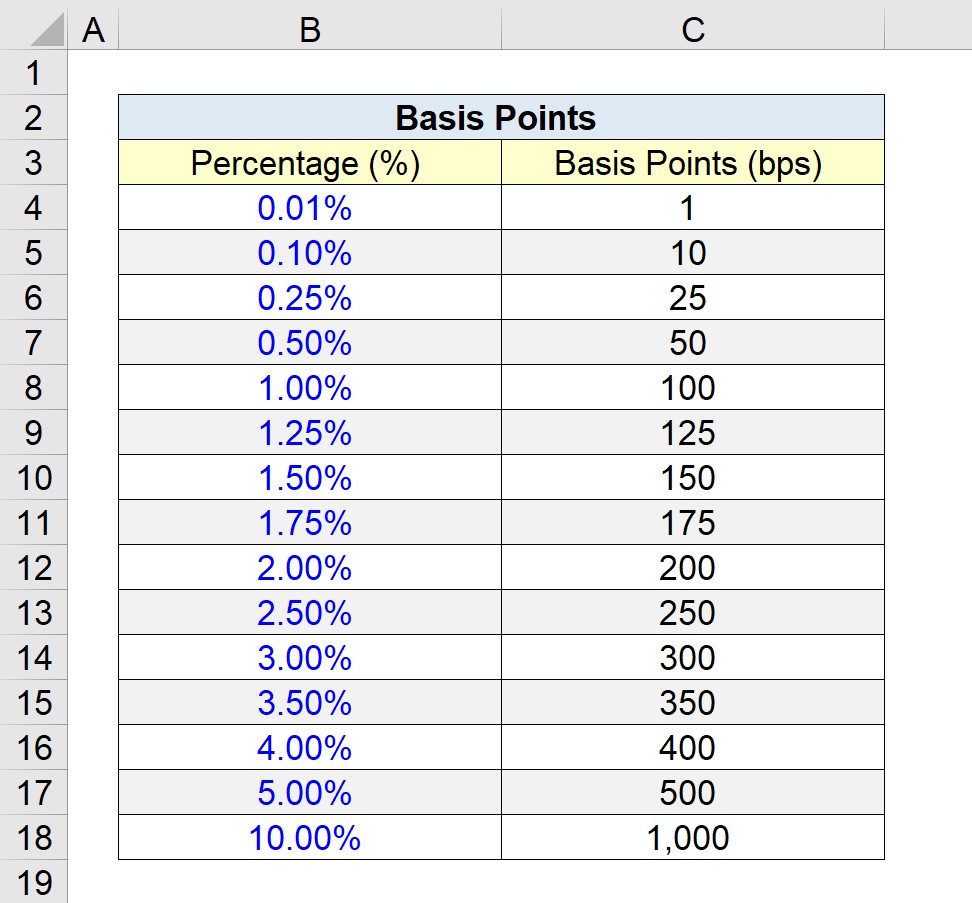
- 1 bp = 0.01%
- 25 bp = 0.25%
- 100 bp = 1%
So when the Fed says “rates up 25 bp,” that’s a quarter‑percentage‑point hike, not a quarter of the existing rate.
Why the Two Systems Co‑exist
Both units aim to avoid confusion, but they serve slightly different audiences. Percentage points speak to the layperson: “Our mortgage jumped two points.” Basis points cater to precision‑obsessed professionals who need to differentiate a 0.01% tweak from a 0.10% tweak without writing extra zeros.
In practice, mixing them up can lead to mispricing. Imagine quoting a loan at “3 bp higher” when you meant “3 percentage points”—the borrower would be shocked by the reality.
Quick Conversion Guide
Here’s the math you’ll need on the fly:
- 1 percentage point = 100 basis points
- 0.01 percentage point = 1 basis point
- To go from basis points to percentage points, divide by 100.
- To turn percentage points into basis points, multiply by 100.
For example, a 0.75‑percentage‑point change equals 75 basis points.
When to Use Which Term
Percentage points work best when the change is visually sizeable—think interest rates, tax brackets, or survey results where whole‑number jumps are common.
Basis points shine when the move is minute but significant, such as yield spreads, money‑market rates, or central‑bank policy adjustments.
In a conversation with a non‑financial friend, you’d say “the rate went up two points.” In a boardroom discussing the 10‑year Treasury, you’d likely hear “the yield slipped 15 bp.”
Real‑World Examples
Consider a homeowner refinancing at 3.75% versus a previous 3.50% rate. That’s a 0.25‑percentage‑point reduction, or a 25‑bp improvement. The borrower saves roughly $50 per $100,000 loan each year—enough to matter over a 30‑year term.
Now look at a corporate bond that trades at a yield of 5.23% when the benchmark is 5.00%. The spread is 23 bp, signaling a modest premium for credit risk.
Common Mistakes to Dodge
- Mixing units. Saying “the Fed raised rates by 0.25% (or 0.25 points)” when the official statement used “25 bp.”
- Over‑rounding. Treating 0.5 percentage points as “½%” is fine, but converting it to 50 bp without clarification can confuse readers.
- Assuming linearity. A 10‑bp move in a 0.5% rate isn’t the same impact as 10 bp in a 5% rate; the absolute dollar effect varies with the base.
Practical Tip: The “Rule of Thumb” Chart
Keep this miniature chart on your desk or phone notes:
- 1 bp = 0.01% = 0.0001 in decimal form
- 10 bp = 0.10% = 0.001
- 25 bp = 0.25% = 0.0025
- 1 percentage point = 100 bp = 0.01 in decimal
When you see “rates up 0.75%,” just think “75 bp” and you’ll avoid the usual slip‑ups.
Why It Still Matters in a Digital Age
Even with calculators at our fingertips, the language shapes perception. A “quarter‑percentage‑point” hike feels more substantial than “25 bp,” yet the latter conveys precision that regulators and traders demand. Mastering both terms lets you navigate press releases, mortgage offers, and market data without second‑guessing.
So next time you encounter the numbers, pause for a second: are we talking whole percentages or those tiny basis‑point nudges? A quick mental conversion can save you from costly misunderstandings.