SCP Object Classes Explained & Demystified
If you’ve wandered into the depths of the SCP Foundation wiki, you’ve likely been greeted by a dizzying array of terminology. Thaumiel, Keter, Safe. Apollyon, Archon. It feels less like a containment protocol and more like a secret cabal’s greeting phrase. For newcomers, the object class system is often the first hurdle. It’s not just a label; it tells you how dangerous the anomaly is, how much it costs to keep it locked up, and whether the facility is likely to survive the night.
But here’s the thing that trips people up: these classes aren’t rigid scientific categories. They are bureaucratic shorthand. They tell you about the *effort* required to manage an anomaly, not necessarily its raw power. A tiny paperclip that cannot be destroyed might be harder to contain than a city-sized entity that just wants to be left alone. Let’s break down what these labels actually mean, because the real horror isn’t just the monster—it’s the paperwork.
The Big Three: Safe, Euclid, and Keter
When people talk about SCP classes, they’re usually referring to the standard triad. These are the bread and butter of containment procedures, and they follow a specific logic regarding predictability and resource cost.
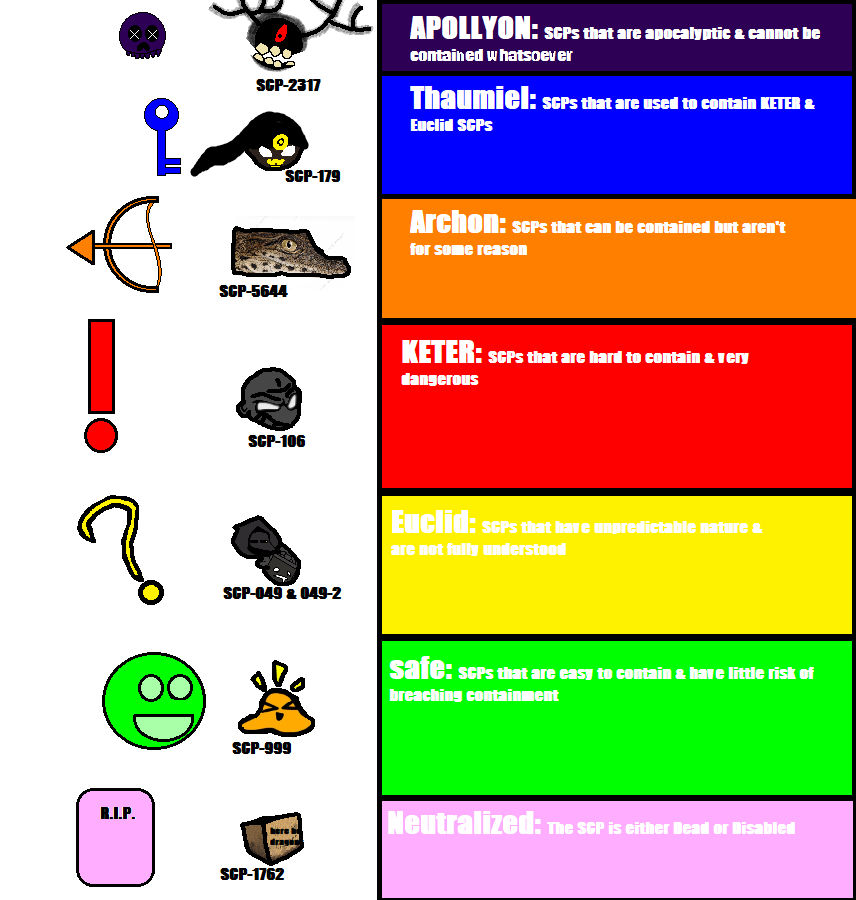
Safe is often misunderstood. Most people assume Safe means "harmless." It doesn’t. It means "predictable and easy to contain." SCP-173, the infamous concrete head that moves when you blink, is a Keter in spirit but has a Safe-ish containment procedure because it’s small and immobile. If you know exactly what to do, and that thing doesn’t decide to change its mind, it’s Safe. A bomb that is currently disarmed and sitting in a lead box is Safe. A volcano that hasn’t erupted in 1,000 years is Safe. The key is stability.
Euclid is the messy middle ground. This class is reserved for anomalies that are semi-sentient, unpredictable, or require active human monitoring. If an SCP requires a team of guards to watch it 24/7 because it might wake up and try to escape, it’s Euclid. If it’s a creature that can understand language and lies, it’s Euclid. Euclid is where most "animals" and "entities" live. They aren’t necessarily trying to kill you, but they aren’t playing by the rules of physics, so you can’t just lock them in a box and forget about them. They need attention.
Then there is Keter. Keter is the nightmare scenario. These are anomalies that are extremely difficult, costly, or dangerous to contain. A Keter might be impossible to kill, constantly shifting location, or actively trying to breach containment. SCP-682, the hard-to-destroy reptile, is the poster child for this class. It doesn’t mean Keter is more powerful than Euclid in terms of raw strength; it means the Foundation is constantly losing ground. Keter requires excess manpower, advanced technology, and often, tragedy, to keep at bay. If your containment procedure starts with "Do not provoke," it’s probably a Keter waiting to happen.
The Exceptions: When the Rules Break Down
The Foundation is a massive bureaucracy, and like all bureaucracies, it has exceptions for things that don’t fit the mold. These classes are rarer but equally critical to understanding the lore.
- Thaumiel: This is the wildcard. A Thaumiel-class SCP is one that the Foundation *uses* to contain other SCPs. It’s a monster we’ve wrapped around our finger. SCP-2747 is a prime example, serving as a containment mechanism for high-level threats. Thaumiel objects are dangerous, but we’ve found a way to exploit their nature. It’s the ultimate power move.
- Archon: This class is for anomalies that are so well-hidden or so mundane that containing them would reveal the Foundation’s existence to the public. An Archon might be a secret society, a piece of media, or a historical event. The "containment procedure" for an Archon is often simply "no information given" or "continue normal operations." They are hidden in plain sight.
- Explained: Sometimes, an anomaly is investigated and found to have a mundane explanation. It’s not magic; it’s just a hoarding disorder, a chemical leak, or a mass hysteria event. The anomaly is "solved," so the case is closed. It’s a relief class, though often a boring one.
- Neutralized: The thing is dead, destroyed, or gone. The containment chamber is still there, but the threat is over. This is the end of the line for most SCPs, for better or worse.
The Rare and Notorious: Not!Euro, Apollyon, and Beyond
There are other classes that appear frequently in high-stakes stories or specific branches of the Foundation. These often reflect a failure of containment or a limitation of human knowledge.
Apollyon is perhaps the most misunderstood class after Keter. It does not mean "the most dangerous." It means "containment is not only currently impossible, but permanent containment is arguably impossible." An Apollyon object is often treated as a reality-ending event that cannot be stopped, only prepared for. It’s a backup plan for the apocalypse. SCP-3125 is often cited as an Apollyon-class threat because it fundamentally breaks the concept of containment.
Not!Euclid (sometimes written as NOT!EUCLID) is a class for anomalies that defy the normal rules of classification entirely. They are paradoxical, unclassifiable, or so weird that they break the Foundation’s data handlers. It’s a "we don’t know what this is, and it’s breaking our computers" label. It’s a placeholder for the unknown.
Then there are meta-classes like Catastrophic Memetic Hazard or Interdimensional, which aren’t official Foundation classes but are often used in community projects to denote specific threats. The beauty of the SCP universe is that the Foundation is a collective effort, so new classes are occasionally proposed and debated. This reflects the chaotic nature of dealing with the unknown. You can’t put a square peg in a round hole, especially if the peg is made of screaming geometry.
Why Does This Matter?
Understanding object classes isn’t just about memorizing labels. It’s about understanding the Foundation’s philosophy. They are not heroes; they are custodians. Their goal is normalcy, not justice. A Safe class object might still kill hundreds of people if it escapes, but if it’s unlikely to escape, it’s Safe. A Keter might be a friendly entity that just loves to party, but if that party destroys a city, it’s Keter.
The classes reveal the tension between control and chaos. In a world where the laws of physics are suggestions, the Foundation imposes order through bureaucracy. The object class is their way of quantifying the unquantifiable. It’s a desperate attempt to put a price tag on the impossible. And for the researchers reading the files, that tag often determines whether they get a coffee break or a burial plot.
FAQ
Is a Keter always more dangerous than a Safe?
No. A Keter is harder to *contain*, not necessarily more lethal. A paperclip that can cut through diamond is harder to keep in a box than a stationary bomb, even if the bomb is more explosive. Containment difficulty is the metric.
What is a Thaumiel Class?
Thaumiel anomalies are used by the Foundation to contain other SCPs. They are essentially weapons or tools leveraged for containment purposes, turning a threat into an asset.
Why are some SCPs classified as 'Archon'?
Archon-class SCPs are anomalies that are publicly known or easily discoverable, where containment would require revealing the Foundation’s existence. Their "containment" is often just monitoring or ignoring them to maintain normalcy.
Can an SCP change its object class?
Yes. As researchers learn more about an anomaly, its class may change. A Euclid might become a Safe once a reliable containment method is discovered. Conversely, a Safe object might redesignate to Keter if it begins to exhibit unpredictable behavior.