Unveiling Solubility: What Dissolves Polar Compounds?
Imagine watching a sugar cube vanish into a cup of hot coffee. It’s a simple, everyday magic trick, but the science behind it is anything but simple. You’ve likely heard the phrase “like dissolves like,” but what does that actually mean in practice? When we talk about solubility, we are really discussing the delicate dance between molecules at a microscopic level. Specifically, when it comes to polar compounds—substances with uneven electron distribution—the rules of engagement change dramatically compared to non-polar substances like oil or grease.
Understanding what dissolves polar compounds is fundamental not just for chemistry students, but for anyone interested in how our bodies process medicine, how detergents clean laundry, or why salt disappears in water. The short answer is that polar solvents are the key, but the long answer involves electronegativity, hydrogen bonding, and the energetic trade-offs of molecular separation.
The Chemistry of “Like Dissolves Like”
To understand why polar compounds dissolve in certain substances, we first have to look at what makes a molecule “polar.” In a polar molecule, electrons are not shared equally between atoms. Instead, one atom hogs the electrons more tightly than the other, creating a partial negative charge on one end and a partial positive charge on the other. Water is the classic example of this. Its oxygen atom pulls electrons away from its hydrogen atoms, giving it a distinct dipole moment.
When you throw a polar solute, like table salt (sodium chloride) or ethanol, into a solvent, something specific needs to happen for dissolution to occur. The solvent molecules must be able to surround the solute particles and stabilize them. If the solvent is non-polar, like hexane or oil, it lacks the necessary charge differences to interact with the polar solute. The polar molecules would rather stick to each other than mingle with the non-polar crowd. This is why oil and water separate; they are chemically incompatible in terms of intermolecular forces.
Water: The Universal Solvent
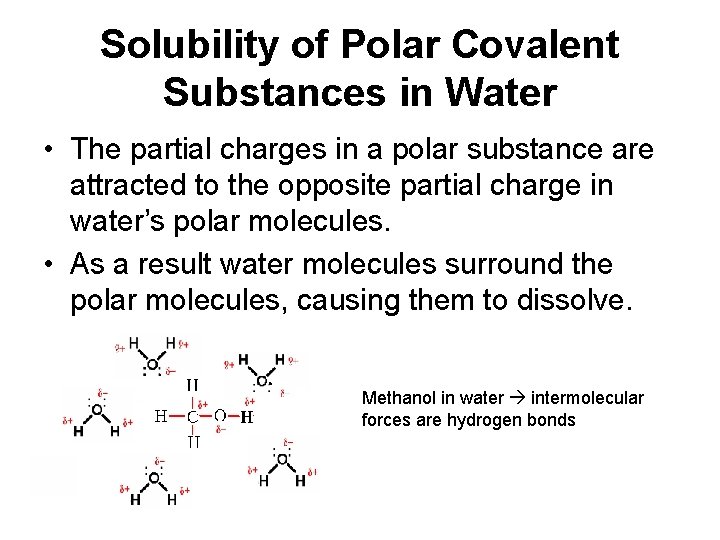
Water is often called the “universal solvent” for a reason, though it certainly doesn’t dissolve everything. It is exceptionally good at dissolving polar compounds because of its small size and strong polarity. When a polar compound enters water, the water molecules orient themselves around the solute. The positive hydrogen ends of the water molecules are attracted to the negative parts of the solute, while the negative oxygen ends are attracted to the positive parts.
This process, known as hydration (or solvation in a general sense), effectively pulls the solute particles apart. For ionic compounds like sodium chloride, water molecules surround the sodium ions with their oxygen-facing sides and the chloride ions with their hydrogen-facing sides. This electrostatic attraction is strong enough to overcome the ionic bonds holding the crystal lattice together. The result? The solid breaks down into individual ions, dispersed evenly throughout the liquid.
Beyond Water: Other Polar Solvents
While water is the most common polar solvent, it isn’t the only one. In industrial and laboratory settings, chemists often rely on other polar liquids to dissolve specific compounds that water might not handle well, or that might react violently with water. Some of these include:
- Ethanol and Methanol: These alcohols are polar because of their hydroxyl (-OH) groups, similar to water. However, they also have non-polar carbon chains, making them amphiphilic. This dual nature allows them to dissolve many polar substances that are slightly too oily for water.
- Acetone: A powerful organic solvent used in everything from nail polish remover to industrial cleaning. Its carbonyl group makes it polar, allowing it to dissolve resins, plastics, and various polar organic compounds.
- Dichloromethane (DCM): While less polar than water, DCM is still polar enough to dissolve many organic compounds that water repels. It’s frequently used in extraction processes.
- Dimethyl Sulfoxide (DMSO): Known for its ability to penetrate skin and carry various substances with it, DMSO is a highly polar aprotic solvent capable of dissolving a wide range of polar materials.
Each of these solvents has a specific polarity index, which helps chemists predict whether they will dissolve a given compound. The closer the polarity of the solute and solvent, the higher the likelihood of successful dissolution.
The Role of Temperature and Agitation
Solubility isn’t just about the type of solvent; external factors play a significant role. Temperature often increases the solubility of solid polar compounds in liquids. Heat adds kinetic energy to the molecules, helping to break the strong intermolecular forces holding the solute together. Think of stirring hot tea; the heat helps the sugar dissolve faster and often in greater quantities than it would in iced tea.
However, gases behave differently. The solubility of polar gases like ammonia in water actually decreases as temperature rises. This is why carbonated drinks go flat when they sit out in the heat. Agitation, or stirring, also helps by bringing fresh solvent into contact with the solute, speeding up the process but not necessarily changing the maximum amount that can dissolve.
Why This Matters in Real Life
Understanding solubility principles is crucial in pharmaceuticals. Many drugs are polar molecules. For a drug to be effective, it must dissolve in the body’s fluids to be transported to the target site. If a drug doesn’t dissolve well, it won’t be absorbed efficiently. This is why pharmacists often formulate medicines with specific solvents or carriers to enhance solubility.
In environmental science, solubility dictates pollution spread. Polar pollutants dissolve in rainwater and groundwater, potentially contaminating wells and rivers. Non-polar pollutants, like oil spills, sit on top of the water, creating a different set of ecological problems. Knowing what dissolves what helps us predict how contaminants move through ecosystems.
FAQs About Solubility
Does oil dissolve in water?
No, oil is non-polar, while water is polar. Because “like dissolves like,” these two substances do not mix. Oil molecules are hydrophobic, meaning they repel water molecules instead of bonding with them.
What makes a solvent polar?
A solvent is polar if its molecules have an uneven distribution of electron density, creating a dipole moment. This usually happens when atoms with different electronegativities bond together, such as oxygen and hydrogen in water.
Can polar compounds dissolve in non-polar solvents?
Generally, no. Polar compounds tend to stick together due to strong intermolecular forces and do not interact favorably with non-polar solvents. There are rare exceptions, but usually, a polar solute requires a polar solvent.
Why does sugar dissolve in water but not in oil?
Sugar is a highly polar molecule with many hydroxyl groups that form hydrogen bonds with water. Oil lacks these polar groups, so it cannot interact with sugar molecules effectively, leaving the sugar undissolved.