What Counts as a Good Salary in the Netherlands in 2024?
Understanding the Dutch Pay Landscape
When you hear “good salary” in a Dutch context, you’re really asking how much income lets you live comfortably while still saving for the future. In 2024, the benchmark shifts with inflation, tax reforms, and changing housing costs. For most expats and locals, a gross annual wage of €55,000–€70,000 sits in the sweet spot, translating to a net monthly pay of roughly €2,800–€3,600 after taxes and mandatory contributions.
How Dutch Taxes Shape Your Take‑Home Pay
The Netherlands employs a progressive tax system, meaning higher earnings face higher rates. In 2024 the first €37,149 is taxed at 36.93 %, and anything above that jumps to 49.5 %. Social security contributions—covering pensions, unemployment, and health—are bundled into these percentages, so the “gross‑to‑net” gap can feel steep.
Luckily, the tax authorities offer a few reliefs: the 30 % ruling for highly skilled migrants, mortgage‑interest deductions, and childcare allowances. If you qualify for the 30 % ruling, half of your salary is tax‑free, dramatically boosting net income.
Cost of Living: Where Your Money Goes
Salary alone tells only half the story. Housing, transport, and daily expenses vary widely between Amsterdam, Rotterdam, and smaller towns like Groningen.
- Housing: In Amsterdam, a one‑bedroom apartment in the city centre averages €1,600 per month, while the same space in a peripheral suburb drops to €1,200. Outside the Randstad, prices can dip below €900.
- Transport: A monthly OV (public transport) pass costs €100–€130 in major cities, but many employers subsidise it or provide a company car.
- Groceries & dining: Expect to spend €250–€350 per month per person on groceries; dining out a couple of times a week adds €150–€250.
When you line up these basics, a net monthly income of €3,200 comfortably covers rent, bills, and a modest leisure budget in most Dutch regions.
Sector‑Specific Benchmarks
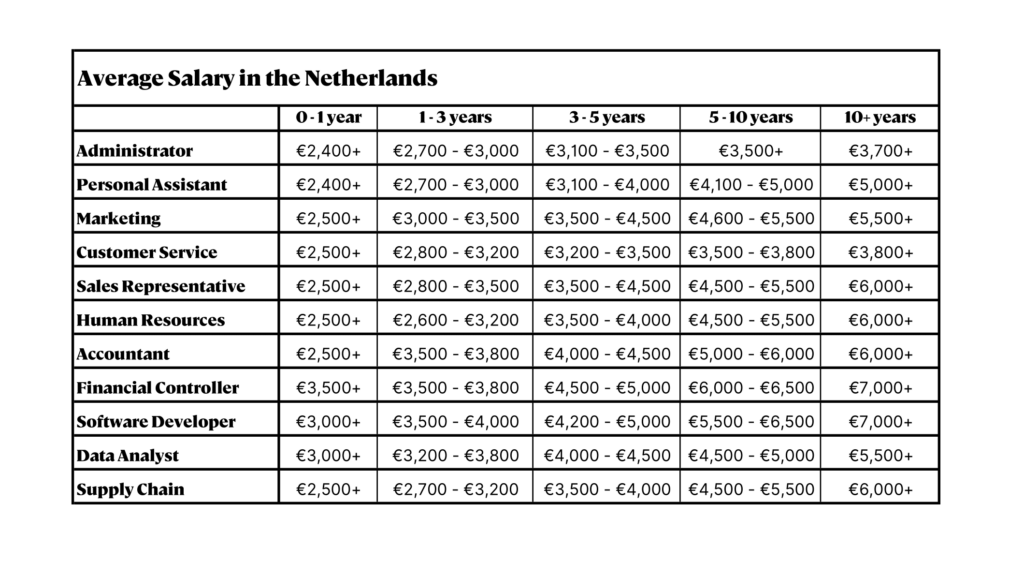
Not all industries pay alike. Tech, finance, and engineering tend to sit at the top, while hospitality and retail cluster near the lower end of the “good salary” range.
- Technology: Senior software engineers often command €80,000–€95,000 gross, especially with Dutch‑English startups that offer equity.
- Finance & Consulting: Mid‑level consultants earn €65,000–€78,000, with bonuses pushing total compensation higher.
- Healthcare: Experienced nurses see €45,000–€55,000, while specialist doctors exceed €100,000.
- Creative & Media: Salaries hover around €40,000–€55,000, though freelance rates can vary dramatically.
Knowing where your profession sits helps you gauge whether a specific offer is truly “good” or merely average for the sector.
Regional Nuances: Beyond the Randstad
The Randstad—Amsterdam, Rotterdam, The Hague, and Utrecht—offers the highest wages but also the steepest housing costs. In contrast, provinces like Limburg or Zeeland present lower salaries (often €5,000–€10,000 less) but also cheaper rent, sometimes allowing a higher disposable income despite a smaller paycheck.
If you value work‑life balance over a bustling metropolis, targeting jobs in cities like Eindhoven (tech hub) or Groningen (student town) can yield a favourable net‑to‑cost ratio.
Negotiating the Right Package
When you receive an offer, look beyond the headline number. Ask about:
- Eligibility for the 30 % ruling or other expat tax benefits.
- Company pension contributions (often 15–20 % of gross salary).
- Annual bonus structures and profit‑sharing schemes.
- Relocation assistance, especially for housing deposits.
Present market data—salary surveys from the Dutch Central Bureau of Statistics (CBS) or industry reports—to justify your expectations. Employers respect well‑researched arguments, and many are willing to adjust base pay or boost benefits.
Future Outlook: What 2025 Might Bring
Economists project modest wage growth of 2–3 % annually, tempered by inflation hovering around 2 %. However, the push for digital talent may accelerate salaries in tech and data science beyond the average. Keep an eye on government announcements regarding the 30 % ruling, as any changes could swing net earnings significantly.
Quick Reference: Salary Ranges by Lifestyle
- Basic Comfort (rent, utilities, modest leisure): Net €2,800–€3,200 / gross €45,000–€55,000.
- Comfortable Lifestyle (central city rent, regular travel, savings): Net €3,300–€4,000 / gross €60,000–€75,000.
- Affluent (spacious home, frequent dining out, sizable investments): Net €4,500+ / gross €90,000+.
FAQ
What is the 30 % ruling and who qualifies?
The 30 % ruling exempts half of an employee’s gross salary from Dutch income tax for up to five years. It applies to highly skilled migrants recruited from abroad, provided they meet salary thresholds and have expertise scarce in the local market.
How does a Dutch salary compare to other EU countries?
Net earnings in the Netherlands are generally higher than in Spain or Italy but comparable to Germany and Belgium when adjusted for tax and living costs. The strong social security system and robust benefits often tip the balance in favor of the Dutch package.
Are bonuses common in Dutch contracts?
Yes, especially in finance, consulting, and tech. Annual bonuses typically range from 5 % to 15 % of base salary, though they may be tied to individual or company performance metrics.
Can I negotiate remote‑work allowances?
Increasingly, Dutch employers offer home‑office stipends for equipment and internet. Bring up these details during salary talks; a modest €150–€300 per month can offset commuting costs and improve overall compensation.