Convex vs Concave Polygons: Difference Explained Quickly
Understanding the Basics
When you picture a polygon, you probably imagine a clean, closed shape made of straight lines. Whether it looks like a textbook triangle or a sprawling star, the classification “convex” or “concave” tells you a lot about its hidden geometry.
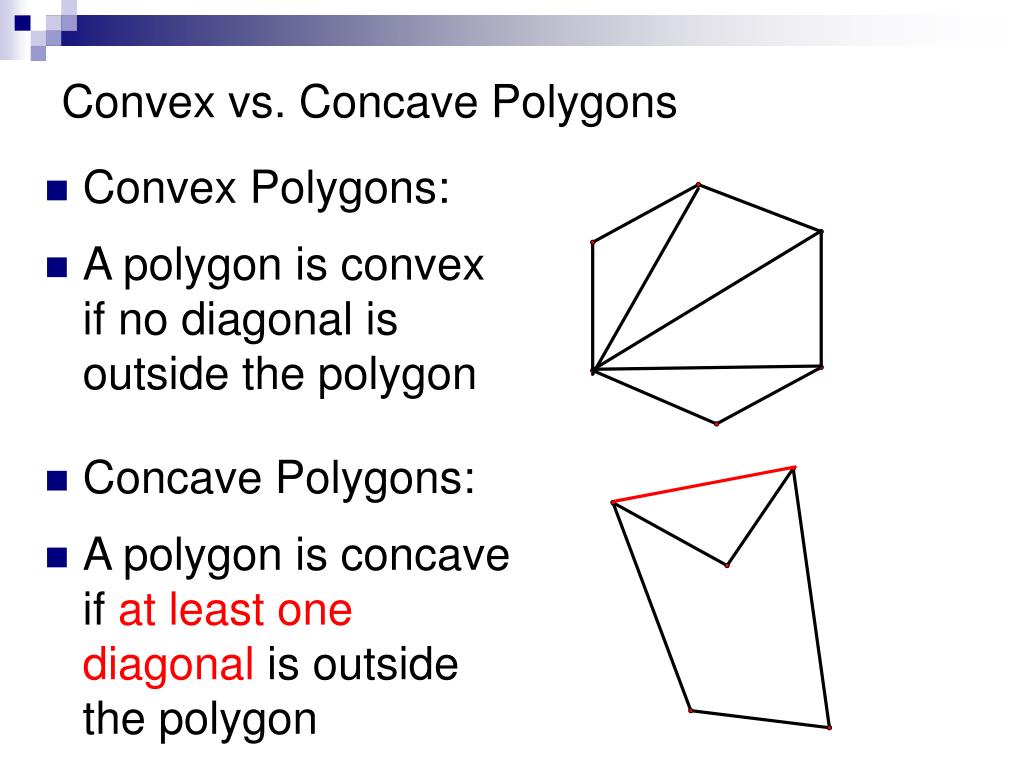
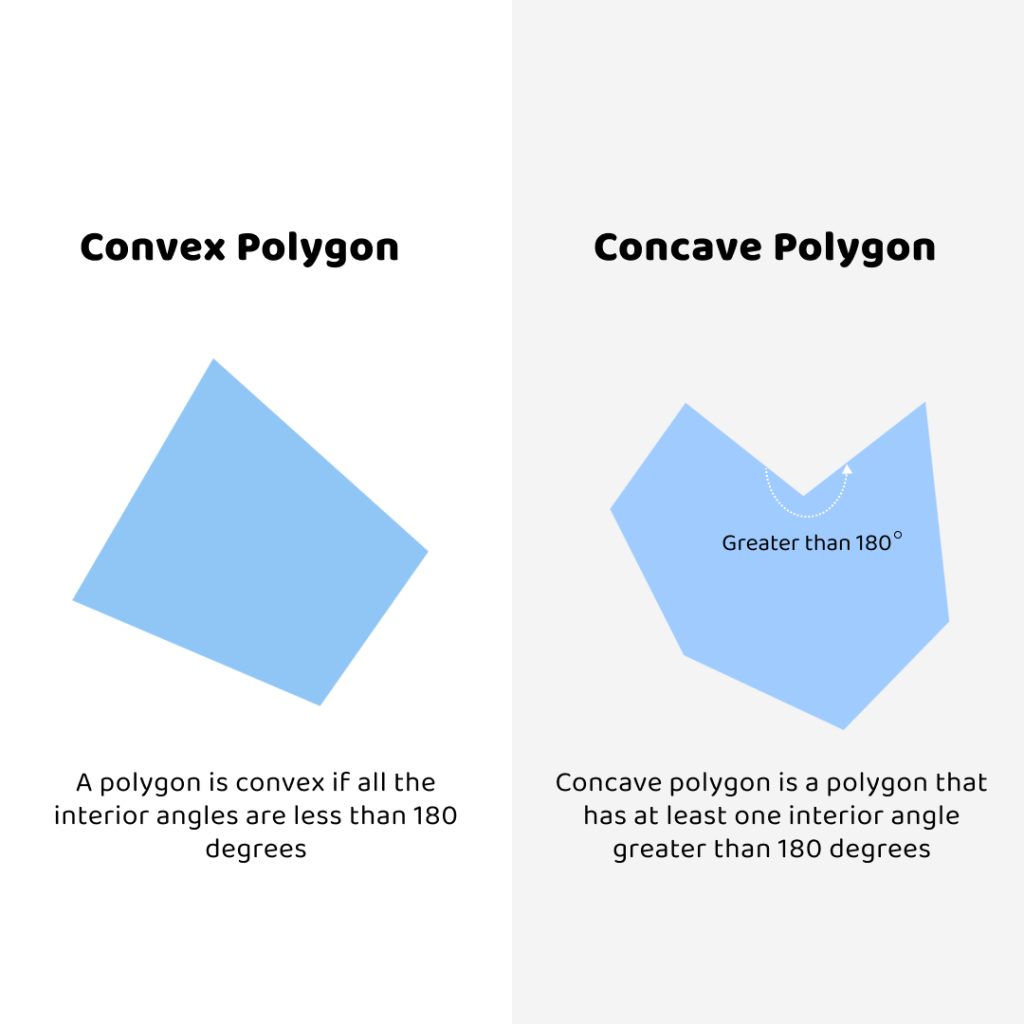
In a convex polygon, every interior angle is less than 180°, and any line drawn between two interior points stays inside the shape. Think of a regular pentagon—a perfect, outward‑facing figure.
A concave polygon, by contrast, has at least one interior angle greater than 180°, creating a “dent” or inward notch. Picture a simple arrowhead or a classic house‑shape roof.
Key Differences at a Glance
- Angles: Convex → all < 180°; Concave → one or more > 180°.
- Line Segment Rule: Connect any two interior points; the segment stays inside for convex, but may cross the exterior for concave.
- Visibility: From any vertex, you can see the whole interior of a convex polygon; a concave vertex hides part of the shape.
- Triangulation Simplicity: Convex polygons split neatly into triangles without extra steps; concave ones often need a “ear‑cutting” approach.
How to Tell If a Polygon Is Convex
Spotting convexity in the field—or on a screen—doesn’t require a protractor. A few quick tests usually do the trick.
1. Angle Check
Measure each interior angle. If any creep past 180°, you’ve got a concave shape. In practice, you can estimate by looking for a sharp inward point.
2. Cross‑Product Test (for the technically inclined)
When vertices are listed in order, compute the cross product of successive edge vectors. Consistent sign (all positive or all negative) indicates convexity. Mixed signs reveal a dent.
3. Visual Line Test
Pick two points inside the polygon. Draw a mental straight line. If that line ever leaves the boundary, the polygon is concave. It’s a handy mental exercise for architects sketching floor plans.
Practical Applications
Why does the difference matter? Because convex and concave polygons behave quite differently in real‑world scenarios.
Computer Graphics
Most rendering engines favor convex polygons for collision detection—simple math, no surprises. Concave shapes often get broken into convex pieces before the engine even sees them.
Geographic Information Systems (GIS)
When mapping land parcels, convex hulls provide the smallest convex polygon containing a set of points. It’s a quick way to estimate boundaries, even if the actual plot is concave.
Structural Engineering
Trusses and frames rely on convex shapes to distribute forces evenly. A concave joint can create stress concentrations, demanding extra reinforcement.
Art and Design
Graphic designers love the drama of concave shapes for logos and icons—they draw the eye inward. Convex forms, on the other hand, convey stability and balance.
Common Misconceptions
It’s easy to assume that any “irregular” polygon must be concave, but that’s not true. A wobbly hexagon with all angles under 180° remains convex. Conversely, a seemingly simple shape like a five‑pointed star is definitively concave because of those inner points.
Another myth: “Convex polygons are always regular.” Nope. A scalene triangle with three unequal sides is convex, just not regular.
Edge Cases and Nuances
What about polygons that sit right on the border between the two categories? If an interior angle is exactly 180°, the shape is technically neither convex nor concave—it’s a degenerate case, often ignored in everyday design.
Self‑intersecting polygons (think of a figure‑eight) introduce another layer of complexity. They’re usually classified as “complex” rather than purely convex or concave, because the interior isn’t well‑defined.
Quick Reference Cheat Sheet
- All interior angles < 180° → Convex.
- At least one interior angle > 180° → Concave.
- Any line connecting interior points stays inside → Convex.
- Line may exit the shape → Concave.
- Useful for: collision detection, hull calculations, stress analysis.
So the next time you glance at a polygon, ask yourself: does it hold everything inside, or does it bite back with a hidden groove? That simple question unlocks a cascade of geometric insight—and, often, a better solution for whatever problem you’re tackling.