Demystifying the Longest Common Subsequence Problem
If you have ever used a tool to compare two versions of a document or checked the differences between two files in Git, you have indirectly encountered one of the most elegant challenges in computer science: the Longest Common Subsequence, or LCS. It sounds dry, like something reserved for dusty textbooks, but the logic behind it is surprisingly intuitive once you strip away the algorithmic jargon.
At its core, the LCS problem asks a simple question: given two sequences, what is the longest sequence of elements that appear in both, in the same relative order? The catch? They do not need to be contiguous. This distinction is crucial. We are not looking for a common substring, which requires characters to sit side-by-side. We are looking for a subsequence, where gaps are allowed.
Sequence vs. Substring: The Critical Difference
To really grasp why LCS matters, you have to understand how it differs from a standard substring match. Think of a substring as a block of text copied and pasted exactly. If you search for "cat" in "concatenate", you find it because the letters c-a-t appear consecutively.
Now consider the words heart and hate. There is no common substring of length three here. The 'r' and 'e' in heart disrupt any direct block match. However, if you look at the subsequences, you can pull out h-a-e from both words. In heart, the letters h, a, and e appear in that order, even though 'e' and 'a' are swapped in terms of adjacency compared to hate? Actually, wait. In heart, the order is h-e-a-r-t. So h-a-e is not a subsequence of heart because 'a' comes after 'e'. Let's try hate and heat. The common subsequences are h-e-t or h-a-t. The longest is length three.
Visualizing it helps. Imagine you have two strings: ABCBDAB and BDCABA. Your goal is to find the longest chain of characters that exists in both, preserving their original rhythm. You might pick out B-C-B-A. In the first string, these appear in order. In the second, they also appear in order, despite other letters interfering. That is the magic of LCS.
Why Dynamic Programming Saves the Day
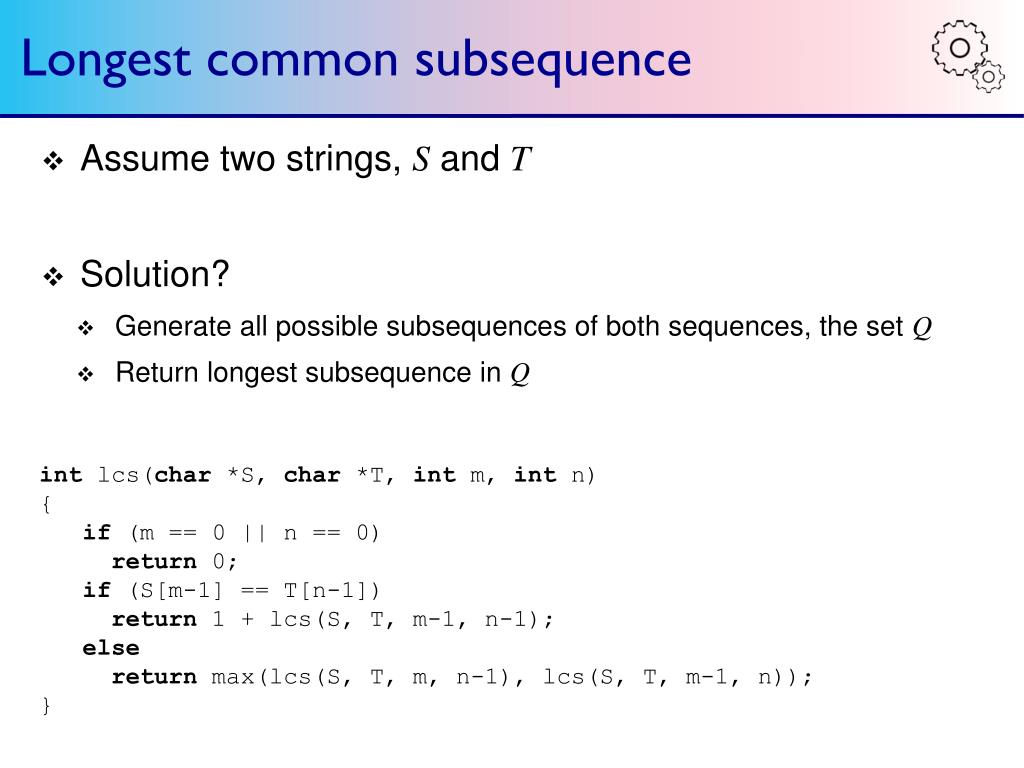
Your instinct might be to use recursion. "Check if the first characters match. If yes, add one to the LCS of the rest. If no, try skipping the first character of string A, then try skipping the first character of string B, and take the maximum." Sounds logical, right?
Except it is painfully inefficient. This brute-force approach has an exponential time complexity. As the strings grow even slightly longer, the number of redundant calculations explodes. You end up solving the exact same sub-problem over and over again.
This is where dynamic programming enters the stage. Instead of recalculating, we remember. We build a table, typically a 2D grid, where each cell represents the length of the LCS for the prefixes of the two strings up to that point. If the characters match, we take the value from the diagonal neighbor and add one. If they do not match, we take the maximum value from either the top or the left neighbor. By filling this table from top-left to bottom-right, we ensure that when we need a previous result, it is already computed and ready.
The Anatomy of the Grid
- Initialization: Start with a grid filled with zeros. The dimensions are (length of string A + 1) by (length of string B + 1). This extra row and column handle empty string base cases.
- Matching: When characters at indices i and j match,
grid[i][j] = grid[i-1][j-1] + 1. - Mismatch: When they do not match,
grid[i][j] = max(grid[i-1][j], grid[i][j-1]).
The final cell in the bottom-right corner contains the length of the LCS. To reconstruct the actual sequence, you backtrack from that corner, following the path of matches and maximums.
Real-World Applications Beyond Theory
It is easy to dismiss LCS as an academic exercise, but it is the backbone of several tools you likely use daily. Git, the version control system, relies on similar diff algorithms to show you what changed between commits. When you see green lines for additions and red for deletions, an LCS-like algorithm determined which lines stayed the same and which shifted.
Bioinformatics uses LCS extensively for DNA sequence alignment. Scientists compare genetic strings from different organisms to identify similarities, evolutionary relationships, and mutations. The sequences are not identical, but long common subsequences reveal shared ancestry or function. Similarly, plagiarism detectors compare documents by finding significant common passages, ignoring minor rephrasing or formatting changes.
Even spell-checkers benefit. When you mistype a word, the system might compare your sequence of keystrokes against a dictionary entry. Finding the longest matching subsequence helps determine if the error is a simple omission or transposition, allowing for intelligent correction suggestions.
Limitations and Variations
While powerful, standard LCS has constraints. It assumes that insertion and deletion errors are equally costly. In some contexts, this isn't true. Deleting a rare word might be more significant than deleting a common "the." This leads to variations like the Edit Distance algorithm, which assigns different weights to operations.
Furthermore, LCS can be computationally expensive for massive datasets. Comparing two entire chromosomes requires optimized algorithms or approximations. Standard dynamic programming takes O(n*m) time and space. For huge inputs, space can become a bottleneck, requiring clever optimizations to only store the current and previous rows of the grid.
Frequently Asked Questions
Is LCS the same as Edit Distance?
No, they are related but distinct. LCS finds the longest matching subsequence. Edit Distance calculates the minimum number of operations (insertions, deletions, substitutions) to transform one string into another. You can derive Edit Distance from LCS, but they solve slightly different optimization problems.
Can LCS handle more than two strings?
Yes, but the complexity increases dramatically. While two-string LCS is polynomial time, the Multiple Sequence Alignment problem is NP-hard. Algorithms must use heuristics or approximations to find a near-optimal solution within a reasonable timeframe.
What is the time complexity of the standard LCS algorithm?
The standard dynamic programming approach runs in O(n*m) time, where n and m are the lengths of the two strings. The space complexity is also O(n*m), though it can be reduced to O(min(n, m)) if you only need the length, not the sequence itself.
Does order matter in LCS?
Absolutely. The defining characteristic of a subsequence is that the relative order of elements must be preserved. If you reverse one string, the LCS will likely change completely, as the "flow" of matching elements is disrupted.