How Governments Handle Budget Deficits &
When you hear politicians debate the budget, they almost always end up circling the same drain: the deficit. It’s a term that feels heavy, often carrying a connotation of failure or fiscal irresponsibility. But if you peel back the political rhetoric, understanding budget deficits and how governments finance them is less about moral judgment and more about basic arithmetic and macroeconomic strategy.
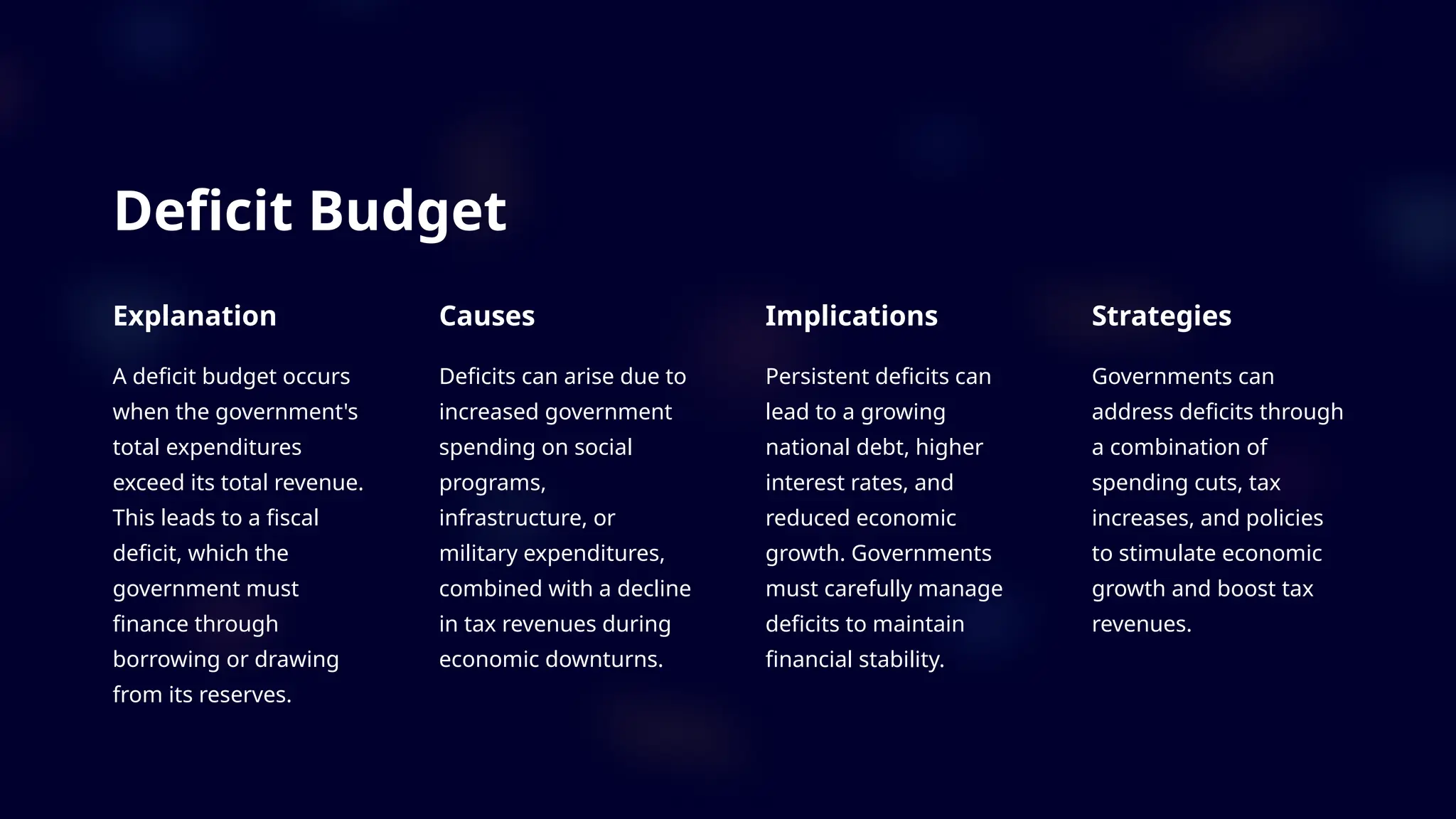
Simply put, a budget deficit happens when a government spends more money in a given fiscal year than it collects in revenue. Think of it like a household budgeting for a big renovation. You have your monthly income (taxes) and your expenses (public services, infrastructure, debt payments). If the renovation costs exceed your paycheck, you have a deficit. For a country, this isn’t immediately catastrophic, but the method used to cover that gap defines its economic future.
The Mechanics of Financing the Gap
If the government doesn’t have the cash in the bank, it needs to find it. It doesn’t have a credit card with a limit. Instead, it issues debt. This is where the concept of financing becomes crucial. Governments don’t just borrow from a single bank; they sell securities to a wide array of investors.
The primary vehicle for this is the government bond. When you buy a government bond, you are essentially lending money to the state. In return, the government promises to pay you back the principal amount on a specific date, plus periodic interest payments. These bonds come in different flavors. Short-term bills might mature in a few months, while Treasury bonds can last for thirty years or more.
Who buys these? It’s a diverse mix:
- Foreign governments: Central banks of countries like China or Japan often hold large portions of US Treasury debt to manage their own currency exchanges and trade balances.
- Institutional investors: Pension funds, mutual funds, and insurance companies buy bonds because they are generally considered safe, steady assets.
- The Federal Reserve: The central bank can buy these bonds through what is known as quantitative easing, effectively creating new money to finance government spending.
This dynamic creates a complex web of dependency. If investors lose confidence in a government’s ability to repay, they demand higher interest rates to compensate for the perceived risk. This raises the cost of borrowing for everyone, from the government to home-buyers.
Deficit vs. Debt: Clearing the Confusion
One of the most common mistakes people make is conflating the deficit with the national debt. They are related, but distinct. The deficit is a flow variable; it represents the shortfall in a single year. The national debt is a stock variable; it is the cumulative total of all past deficits minus any surpluses.
Imagine a bathtub. The deficit is the water flowing out of the faucet. The national debt is the water sitting in the tub. If the faucet runs faster than the drain can handle the water levels, the tub fills up. If you stop the faucet (run a surplus), the tub drains down. Most Western economies have been running deficits for decades, meaning the tub is steadily rising.
Is this bad? Economist opinions vary wildly. Some argue that during a recession, running a deficit is actually necessary. Government spending stimulates the economy, creating jobs and demand when the private sector isn’t. This is the Keynesian view. Others, adhering to austere fiscal conservative principles, argue that any deficit crowds out private investment and burdens future generations with repayments they didn’t agree to.
The Risk of Financing: Monetary Policy Collisions
The real tension arises when financing deficits intersects with monetary policy. If a government needs to borrow heavily, it increases the supply of bonds. Basic supply and demand dictates that as supply goes up, prices go down, and yields (interest rates) go up. High interest rates are a double-edged sword. They make borrowing expensive for businesses, which can slow down economic growth.
This is where central banks step in. If the Federal Reserve wants to keep interest rates low to stimulate growth, they might buy these government bonds. This lowers the yield for the government, making it cheaper to finance its deficit. However, if they do this too aggressively, it risks inflation. You have essentially printed more money to pay for goods and services without an increase in productivity.
We saw this dynamic play out recently. Post-pandemic, many governments ran massive deficits to support their citizens. When central banks tightened policy to combat the resulting inflation, the cost of servicing that old debt skyrocketed. Suddenly, a significant portion of the budget went just to pay interest on existing debt, leaving less room for new spending.
Is There a Limit?
There is a hard limit, but it’s not a specific number on a chart. The limit is credibility. A sovereign government that prints its own currency (like the US, UK, or Japan) can technically never run out of money. It can always create more. However, it cannot create more credibility.
If investors believe that a government’s spending is uncontrollable, they will demand exorbitant interest rates or refuse to buy their bonds altogether. This is a debt crisis. Greece experienced this in 2010s. Argentina and other emerging markets face it frequently. For the US, the risk is more subtle. It involves the slow erosion of confidence in the dollar as the global reserve currency.
Understanding budget deficits isn’t about declaring them inherently evil or good. It’s about recognizing them as a tool. Like any tool, the problem isn’t the tool itself, but how it’s used. Financing that deficit through broad-based debt securities allows a government to smooth out economic shocks, fund long-term infrastructure that pays dividends for decades, and stabilize society during crises. But it requires disciplined management.
The conversation shouldn’t be about eliminating the deficit entirely, which is economically unrealistic. It should be about ensuring that the spending funded by that deficit generates enough value—whether through growth, security, or social stability—to justify the interest payments down the line. That is the true challenge of modern fiscal policy.
Frequently Asked Questions
What is the difference between a budget deficit and a trade deficit?
A budget deficit is specific to government finances—when spending exceeds tax revenue. A trade deficit occurs when a country imports more goods and services than it exports. While they are linked through macroeconomic identity equations, they measure two different aspects of the economy.
Can a country go bankrupt because of its deficit?
If a country borrows in its own currency, it is highly unlikely to go bankrupt in the traditional sense because it can print money to pay debts. However, this leads to hyperinflation, which destroys the economy’s value. Countries that borrow in foreign currencies (like dollars or euros) face a real risk of default if they run out of foreign reserves.
Why do governments issue bonds instead of just raising taxes?
Raising taxes is politically difficult and can discourage work and investment if done abruptly. Bonding allows governments to borrow against future revenue. It spreads the cost of large projects (like highways or bridges) over the people who will use them in the future, rather than taxing only current residents.
:max_bytes(150000):strip_icc()/budget-deficit-4200237-d8ecc02a1c694f6f810610367f657daf.jpg)