How Minsky’s Instability Theory Explains Booms and Busts
When economists talk about “financial cycles,” many of them are really referring to the ideas first sketched by Hyman Minsky. His theory doesn’t promise a crystal‑ball forecast, but it does offer a surprisingly intuitive map of why periods of optimism can suddenly turn sour. Below we walk through the core concepts, the stages of his “financial instability hypothesis,” and a few practical take‑aways for anyone watching markets today.
What Underlies Minsky’s Hypothesis?
At its heart, Minsky argued that the financial system is inherently pro‑cyclical. In good times, lenders and borrowers become increasingly comfortable with risk; in bad times, the same actors scramble to cut exposure. This dynamic creates a self‑reinforcing loop that can amplify both growth and contraction.
- Risk tolerance shifts: Confidence rises during expansions, prompting more leverage.
- Balance‑sheet fragility: As debt piles up, even modest shocks can tip the system.
- Feedback loops: Falling asset prices raise default risk, which in turn forces further price declines.
The elegance of the model lies in its simplicity: no need for exotic mathematics, just a keen observation of human behavior under different economic climates.
The Three Stages of the Minsky Cycle
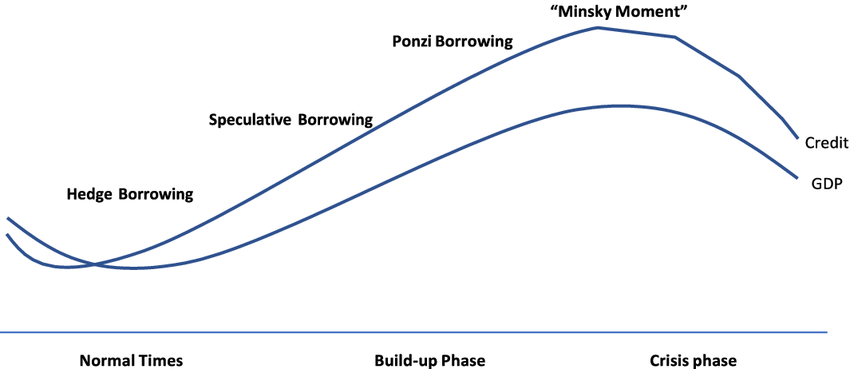
1. Hedge Finance
In the early phase, borrowers can comfortably meet both interest and principal payments from cash flow. Lenders view these loans as low‑risk, and credit growth is modest. Think of a small business whose revenues comfortably cover a bank loan.
2. Speculative Finance
As optimism spreads, firms and households start taking on debt that they can service only if interest rates stay low or asset prices keep climbing. The focus shifts from “can I pay the loan?” to “can I refinance later?” This is the classic “buy‑now‑sell‑later” attitude that fuels many real‑estate booms.
3. Ponzi Finance
In the final stretch, cash flow no longer covers interest. Borrowers rely entirely on rising asset values to refinance or sell at a profit. Any hint of a market slowdown can trigger a cascade of defaults, because the underlying cash‑flow story simply doesn’t exist.
It’s worth noting that not every economy passes cleanly through each stage. Some sectors may linger in speculative finance while others already tip into Ponzi territory. The overall system, however, tends to drift toward the most fragile point if left unchecked.
Why Does the Theory Matter Today?
Modern policymakers often cite “macro‑prudential” tools—such as counter‑cyclical capital buffers—to curb the very dynamics Minsky described. Understanding the stages helps answer two pressing questions:
- When should regulators tighten credit? – Typically when speculative finance becomes pervasive, signaling that borrowers are leaning on rising asset prices.
- How can investors spot the shift? – Look for rising debt‑to‑income ratios, widening spreads on corporate bonds, and a sudden surge in loan‑to‑value metrics.
In practice, the signals are messy. A booming tech sector might still be in hedge finance, while a housing market could already be flirting with Ponzi dynamics. The key is to compare debt growth against underlying cash‑flow fundamentals.
Real‑World Illustrations
Consider the U.S. housing bubble of the mid‑2000s. Initially, most mortgages were affordable (hedge). As home prices rose, lenders introduced adjustable‑rate and interest‑only loans, nudging borrowers into speculative finance. By 2007, a substantial share of mortgages required refinancing based solely on continued price appreciation—classic Ponzi behavior. The inevitable correction revealed the fragility of that structure.
Contrast that with the post‑COVID corporate debt surge. Many firms issued bonds at historically low rates, confident they could service the debt from strong earnings—an example of speculative finance that has not yet slipped into Ponzi territory, thanks largely to sustained demand and low interest rates.
Practical Takeaways for Different Audiences
Investors: Monitor leverage ratios and the composition of debt (fixed vs. floating). A sudden shift toward floating‑rate debt in a sector can hint at a move from hedge to speculative finance.
Policymakers: Deploy stress tests that assume a rapid transition from speculative to Ponzi finance. This helps surface hidden vulnerabilities before they become systemic.
Business Leaders: Diversify cash‑flow sources. Relying on asset sales or refinancing to meet debt obligations is a risky bet, especially when market sentiment can swing quickly.
Critiques and Limitations
No theory is without its detractors. Some critics argue that Minsky’s framework is overly deterministic, downplaying the role of innovation and structural reforms. Others point out that the model doesn’t fully explain why certain economies avoid severe busts despite high leverage.
Nevertheless, even skeptics concede that the three‑stage lens offers a useful heuristic for spotting vulnerabilities early. The theory shines brightest when combined with granular data and a healthy dose of skepticism about “permanent” market trends.
Bottom Line
Minsky’s financial instability hypothesis remains a cornerstone for anyone trying to make sense of economic cycles. By recognizing the progression from hedge to speculative and finally to Ponzi finance, you can better gauge where an economy—or a specific market—might be headed. While the model won’t give you a precise timetable, it does provide a roadmap for spotting the warning signs that precede a downturn.

:max_bytes(150000):strip_icc()/minskymoment.asp-final-dd166d923bfe46f1974994d1863771fc.png)
