How Nickel Tetracarbonyl’s Hybridization Shapes Its Magnetism
Nickel tetracarbonyl, Ni(CO)4, may look like just another organometallic compound, but its electronic choreography is anything but ordinary. Understanding why it is diamagnetic and how its bonds form requires a quick dive into hybridization theory, molecular orbital (MO) reasoning, and a sprinkle of crystal‑field logic. Below we untangle the steps, point out common pitfalls, and highlight the bigger picture for anyone curious about transition‑metal carbonyls.
What Makes Ni(CO)4 Special?
The molecule is famously volatile—a clear liquid at room temperature that evaporates with a faint, sweet smell. Its most striking feature, however, is its perfect tetrahedral symmetry and the fact that it shows no magnetic moment despite nickel’s d‑electron count. In other words, all its electrons are paired.
- Electron count: Nickel contributes 10 valence electrons (3d⁸4s²), each carbonyl ligand donates 2 electrons, giving a total of 18 electrons—a classic “18‑electron rule” sweet spot.
- Geometry: Four CO ligands occupy the corners of a tetrahedron, leading to equivalent Ni–C bonds.
- Magnetism: The compound is diamagnetic; it does not attract a magnet.
Why the 18‑Electron Rule Matters
Transition‑metal complexes that reach 18 electrons tend to be especially stable because their valence shell mimics a noble‑gas configuration. For nickel tetracarbonyl, this rule is not just a bookkeeping trick—it directly informs the hybridization scheme that underpins the observed magnetism.
Hybridization in Ni(CO)4
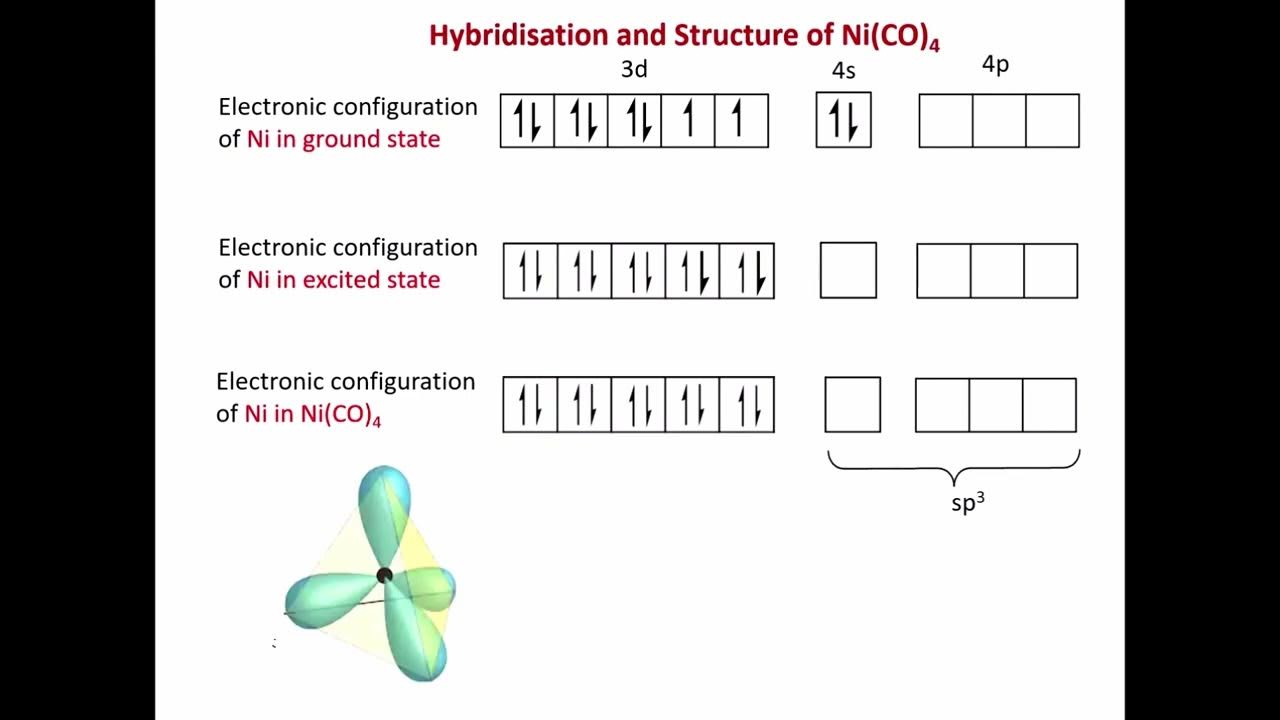
Traditional sp³ hybridization, familiar from methane, cannot be applied straight away to a metal centre with d‑orbitals at its disposal. Instead, we invoke sp³d hybridization, where one s, three p, and one d orbital combine to produce five equivalent hybrid orbitals. In a tetrahedral complex, only four of these hybrids are used, pointing toward the four CO ligands.
Here’s a step‑by‑step sketch:
- Start with the metal’s valence set: 4s, 4pₓ, 4p_y, 4p_z, and one of the 3d orbitals (typically the 3dz²).
- Form four sp³d hybrids: Linear combinations of these orbitals generate four equivalent lobes directed toward the ligand positions.
- Overlap with CO: Each carbonyl’s lone pair on carbon (the σ‑donor) overlaps with a hybrid, creating a σ bond.
- Back‑bonding: The metal can also donate electron density from its filled 3d orbitals into the CO’s vacant π* orbitals, strengthening the metal‑ligand bond and reinforcing diamagnetism.
The result is a set of four σ bonds that are all equivalent, explaining the uniform Ni–C bond lengths observed experimentally.
Magnetic Properties Unpacked
Magnetism in transition‑metal complexes arises from unpaired electrons. In Ni(CO)4, the 18‑electron count ensures that all d‑electrons are paired after bonding.
- The nickel atom begins with a d⁸ configuration. Two of these electrons occupy the d orbitals that participate in back‑bonding, while the remaining six fill the lower‑energy d set.
- When the four CO ligands bind, the metal’s d orbitals split under tetrahedral symmetry, but the energy gap is modest. Nonetheless, the strong σ‑donation and π‑acceptance from CO push electrons into the bonding framework leaving no room for unpaired spins.
- Consequently, the compound shows a magnetic susceptibility close to zero—hence “diamagnetic.”
It’s worth noting that if fewer ligands were present, or if a weaker π‑acceptor replaced CO, the situation could flip, yielding a paramagnetic species with an observable magnetic moment.
Back‑Bonding’s Double Role
Besides stabilizing the complex, back‑bonding subtly influences magnetism. By delocalizing electron density from the metal into the CO π* orbitals, the metal’s d‑electron count effectively drops, reinforcing electron pairing. In a sense, the CO ligands act as both donors and sinks, orchestrating a neat electronic balance.
Beyond the Basics: Why Chemists Care
Nickel tetracarbonyl isn’t just a textbook example; it paved the way for modern organometallic catalysis. Its clean, predictable behavior makes it a benchmark for studying:
- Ligand field effects: How varying ligand strength reshapes d‑orbital energies.
- Electron counting: The reliability of the 18‑electron rule across different metals.
- Safety protocols: Despite its utility, Ni(CO)₄ is toxic, reminding labs to respect even the most “stable” compounds.
In catalytic cycles, for instance, a nickel centre often toggles between 16‑ and 18‑electron states, borrowing concepts first clarified with Ni(CO)₄.
Key Takeaways
- The tetrahedral geometry of Ni(CO)4 stems from sp³d hybridization involving one d orbital.
- Strong σ‑donation from CO and complementary π‑back‑bonding fill the metal’s valence shell to 18 electrons, leaving no unpaired electrons.
- This electronic arrangement explains the compound’s diamagnetism and its remarkable stability compared to many other nickel complexes.
So, the next time you encounter a metal carbonyl, remember that a subtle mix of hybrid orbitals and back‑bonding can turn a potentially magnetic metal into a perfectly quiet, diamagnetic marvel.
![Ni(CO)4, [Ni(CN)4]2-, [NiCl4]2-Structure-Hybridization-diamagnetic-VBT ...](https://i.ytimg.com/vi/r_C4yyTUSjM/maxresdefault.jpg)
![Among [Ni(CO)4],[Ni(CN)4]2- and [NiCI4]2- species the hybridisation ...](https://edurev.gumlet.io/ApplicationImages/Temp/4659990_55076df8-8e6c-4ef3-b609-8b62956dbb8e_lg.png)
![The geometry and magnetic behaviour of the complex [Ni(CO)4] are](https://d10lpgp6xz60nq.cloudfront.net/physics_images/ERRL_CHM_V02_C18_E01_242_S02.png)
