How to Find Vector AB: A Visual Step-by-Step Guide
If you’ve ever stared at two points on a graph and wondered how to turn them into a vector, you’re not alone. It’s one of those concepts that sounds intimidating until you break it down. Once you get the hang of it, finding the vector from point A to point B is less about complex math and more about tracking direction and distance.
Whether you’re tackling high school physics or brushing up on linear algebra for college, the logic remains the same. You’re essentially asking: how do I get from A to B?
Let’s walk through the process together, avoiding the usual robotic formulas and focusing on what’s actually happening on the coordinate plane.
The Core Concept: Head Minus Tail
Before diving into coordinates, it helps to visualize what a vector is. Unlike a simple point, which just exists in space, a vector has both magnitude (length) and direction. When we talk about Vector AB, the order matters immensely.
We are starting at point A and ending at point B. This makes A the "tail" and B the "head." The mathematical operation is elegant in its simplicity:
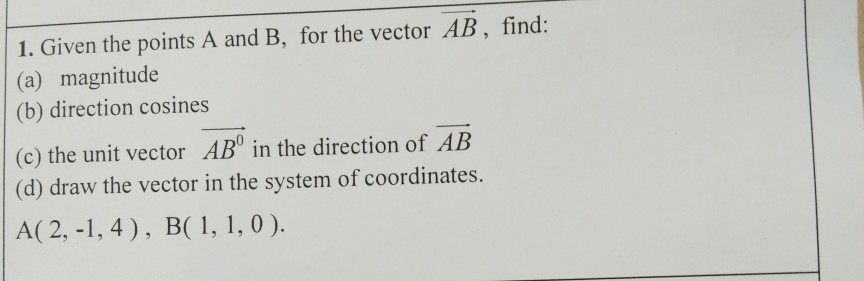
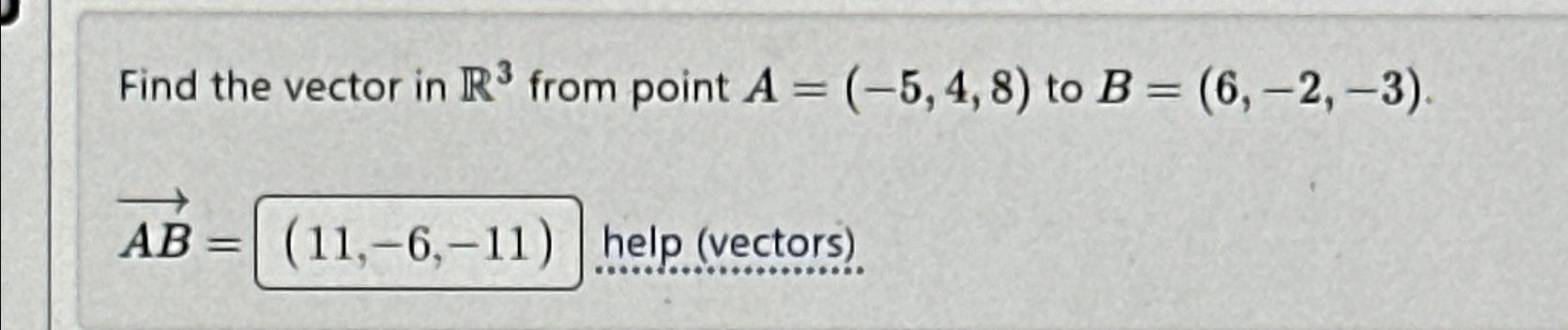
Vector AB = Coordinates of B minus Coordinates of A.
It feels counterintuitive at first. Why subtract the start from the end? Think of it like a bank account. If you start with \$10 and end with \$25, your change is +\$15. You calculate the movement by taking your final state and subtracting your initial state. Vectors work the exact same way. They describe the displacement.
Step-by-Step Calculation
Let’s make this concrete. Imagine we have two points on a standard Cartesian plane:
- Point A: (2, 5)
- Point B: (7, 3)
Here is how you find Vector AB without memorizing a rigid algorithm.
1. Identify the x-coordinates
First, look at the horizontal movement. We want to know how far right or left we need to travel to get from A to B. We take the x-value of B and subtract the x-value of A.
$$ 7 - 2 = 5 $$
This tells us we are moving 5 units in the positive x-direction. Easy enough.
2. Identify the y-coordinates
Next, we handle vertical movement. We take the y-value of B and subtract the y-value of A. Be careful here, because direction flips matter.
$$ 3 - 5 = -2 $$
That negative sign is crucial. It indicates we are moving down two units. If we had flipped the order (A minus B), we’d get a positive 2, which would incorrectly suggest moving up. That’s why "Head minus Tail" is the golden rule.
3. Combine into Vector Notation
Now, package those two components into vector form. Depending on your textbook or instructor, this might look like an arrow over a bracket or a column matrix. In standard component form, it looks like this:
$\vec{AB} = \langle 5, -2 \rangle$
That’s it. You’ve just calculated the displacement.
Common Pitfalls to Avoid
Even when the math is simple, small errors creep in. Here are the most frequent mistakes students make, and how to sidestip them.
Mixing Up A and B
This is the big one. Calculating Vector AB is not the same as Vector BA. Vector BA would be (2-7, 5-3), resulting in $\langle -5, 2 \rangle$. These vectors have the same magnitude but opposite directions. They are additive inverses. Always double-check which point is the start and which is the end before you subtract.
Ignoring Negative Signs
When you subtract a negative number, signs can get messy. For example, if Point A is at (-3, -4) and Point B is at (1, 2), your y-calculation becomes $2 - (-4)$. This equals $2 + 4 = 6$. It’s easy to accidentally calculate $2 - 4 = -2$, which completely breaks the vector. Taking a moment to add parenthesis around the negative coordinate values can save you from this algebraic trap.
Confusing Position Vectors with Displacement
A position vector starts at the origin (0,0) and points to a specific location. A displacement vector (like $\vec{AB}$) connects two arbitrary points. Don’t just list the coordinates of B as the vector. You must account for the starting position of A. If A is the origin, then sure, Vector AB equals the coordinates of B. But in most real-world scenarios, A is somewhere else entirely.
Visualizing the Result
Does your answer make sense? A quick visual check can catch errors before they compound. In our example, we moved 5 units right and 2 units down. If you draw an arrow from (2,5) to (7,3), does it point down and to the right? Yes. If your vector was $\langle -5, 2 \rangle$, it would point up and left. That visual contradiction tells you something is wrong immediately.
Geometry is inherently visual. If the math feels abstract, plot it. Even a rough sketch on a napkin can clarify whether your horizontal and vertical movements align with reality.
Why This Matters Beyond the Classroom
You might wonder why we bother with vectors if we can just measure distance. Distance is a scalar; it has no direction. Vectors provide the "how" and "where," not just the "how much."
In physics, this difference is life-or-death for understanding forces. Velocity isn’t just speed; it’s speed in a specific direction. In computer graphics, vectors determine how light bounces off an object. In game development, they calculate where a character lands after a jump. Understanding how to derive a vector from two points is the foundational step for all of these applications.
Once you internalize the "Head minus Tail" logic, you stop seeing points and start seeing relationships between them. You’re no longer just plotting dots; you’re mapping movement. And that shift in perspective is what turns a rote calculation into a powerful tool.

![[Maths Class 12] The vector equation of a line AB is given by r = x1](https://d1avenlh0i1xmr.cloudfront.net/large/8f9cf7e2-9950-400c-ae0d-39a300ebcec8/slide33.jpg)
