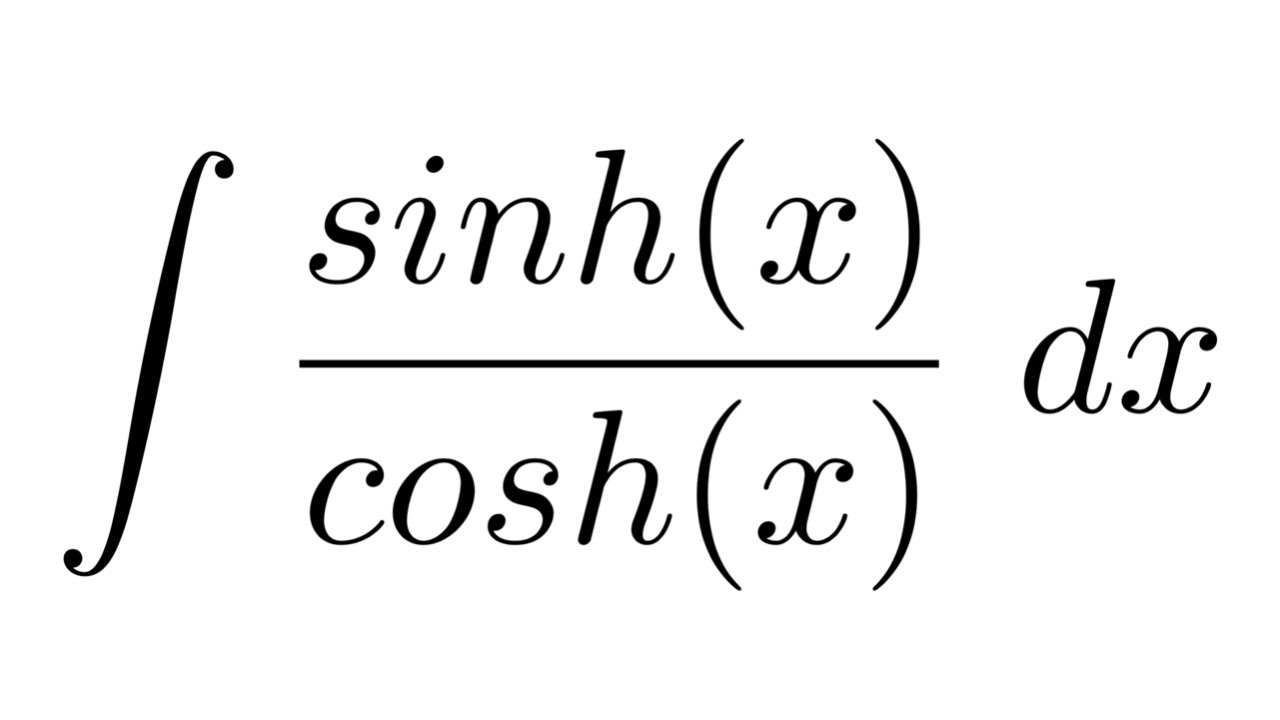
How to Master the Integral of cosh(x)
Why the Hyperbolic Cosine Matters
Most students first meet cosh(x) in a calculus class and file it away as “just another trig function.” In reality, hyperbolic functions pop up in physics, engineering, and even finance—anywhere exponential growth and decay mingle. Getting comfortable with their integrals opens the door to solving differential equations that describe hanging cables, heat flow, and relativistic motion.
The Basic Antiderivative
The starting point is simple: the derivative of sinh(x) is cosh(x). By the fundamental theorem of calculus, the reverse is equally straightforward:
∫ cosh(x) dx = sinh(x) + C
Here, C stands for the constant of integration, reminding you that any vertical shift still satisfies the original derivative.
When the Argument Isn’t Just x
Things get a little trickier when the inside of the hyperbolic cosine is a more complicated expression, say u(x). The chain rule tells us:
∫ cosh(u)·u' dx = sinh(u) + C
In practice, you look for a factor that looks like the derivative of the inner function. If it’s missing, a simple substitution can create it.
Example: A Linear Argument
Consider ∫ cosh(3x) dx. Let u = 3x; then du = 3 dx, or dx = du/3. Substituting gives:
∫ cosh(u)·(1/3) du = (1/3) sinh(u) + C = (1/3) sinh(3x) + C
Example: A Quadratic Argument
For ∫ x·cosh(x²) dx, set u = x². Then du = 2x dx, so x dx = du/2. The integral becomes:
(1/2)∫ cosh(u) du = (1/2) sinh(u) + C = (1/2) sinh(x²) + C
Integrals Involving Powers of cosh(x)
When cosh appears with an exponent, you can often exploit the identity cosh²(x) = (cosh(2x) + 1)/2. This reduces the problem to a sum of simpler integrals.
- Step 1: Rewrite the power using the identity.
- Step 2: Split the integral into separate terms.
- Step 3: Integrate each term—most will be basic
∫ cosh(kx) dxforms.
For instance, ∫ cosh²(x) dx becomes ∫ (cosh(2x)+1)/2 dx = (1/4) sinh(2x) + x/2 + C.
Mixed Hyperbolic–Trigonometric Integrals
Sometimes a problem mixes cosh with ordinary trig functions. A useful trick is to express everything in exponentials:
cosh(x) = (e^x + e^‑x)/2 and sin(x) = (e^{ix} – e^{-ix})/(2i).
Although the algebra can get messy, the exponential form often reveals cancellations that aren’t obvious in the original notation.
Quick Illustration
Integrate ∫ cosh(x)·sin(x) dx. Write each function in exponential terms, multiply, and collect like terms. The result simplifies to:
∫ cosh(x)·sin(x) dx = (1/2)[cosh(x)·(–cos(x)) + sinh(x)·sin(x)] + C
While a few steps are required, the method is systematic and works for many hybrid integrals.
Common Pitfalls to Watch
Even seasoned students slip up. Here are a few red flags:
- Forgetting the
+ Cwhen the antiderivative isn’t definite. - Misidentifying the inner function in a substitution—double‑check that the differential matches exactly.
- Applying the power‑reduction identity to odd powers; it only works cleanly for even exponents.
Practice Problems (No Answers, Just a Challenge)
- ∫ cosh(5x + 2) dx
- ∫ x³·cosh(x²) dx
- ∫ cosh²(3x)·sinh(3x) dx
- ∫ e^{x}·cosh(x) dx
When to Reach for a Table
In a pinch, integral tables still have value. Look for entries that match ∫ cosh(ax + b) dx or ∫ coshⁿ(x) dx. Modern calculators also include hyperbolic functions, but understanding the underlying steps prevents blind reliance.
Wrapping Up the Thought Process
Mastering the integral of cosh(x) is less about memorizing formulas and more about recognizing patterns: the derivative relationship with sinh, the power‑reduction identity, and the utility of substitution. Keep a notebook of the few key tricks, test them on the practice set above, and soon the hyperbolic world will feel as familiar as the ordinary sine and cosine.