Main Battle Tanks: The Ultimate Guide
When the ground shakes and the horizon fills with smoke, one vehicle type usually dominates the strategic conversation. The main battle tank, or MBT, is the centerpiece of modern armored warfare. It’s not just a metal box with a gun. It is a complex integration of firepower, armor, and mobility designed to survive and conquer on the open battlefield. If you are looking to understand what makes these machines tick, you have come to the right place.
History has evolved from heavy tanks and light scouts into this single, unified category. Today’s MBTs are engineering marvels. They carry the punch of a battleship with the maneuverability of a truck. But what exactly defines an MBT, and why are they still relevant in an age of drones and precision missiles? Let’s break it down.
What Defines a Main Battle Tank?
The term “main battle tank” emerged in the 1950s. Before that, armies relied on separate heavy and medium tanks. Heavy tanks had thick armor but moved slowly. Medium tanks were faster but couldn’t take a direct hit. The MBT concept merged these roles. It aimed to create a vehicle that could do everything reasonably well, rather than excelling in one area and failing in another.
So, what are the three pillars of an MBT?
- Firepower: A large coaxial cannon, usually 120mm or 125mm, capable of penetrating heavy armor at long ranges.
- Protection: Multi-layered armor that deflects or absorbs kinetic energy penetrators and explosive shaped charges.
- Mobility: A high-power engine and advanced suspension system allowing the tank to move quickly across varied terrain.
It’s a delicate balance. Add more armor, and the tank gets too heavy. Add a bigger engine, and fuel consumption spikes. Designers are constantly walking this tightrope.
The Evolution of Armor Technology
If you look at a tank from the 1940s, it looks thick. But by modern standards, it’s paper thin. Early MBTs like the T-54 or the M48 Patton relied on homogeneous steel. Just really thick slabs of metal. It worked against early anti-tank weapons, but it added massive weight.
Then came composite armor. Inspired by the Chobham armor introduced by Britain in the 1960s, modern tanks use layers of different materials. You have steel, aluminum, ceramics, and even plastic. These layers work together. The ceramics shatter the incoming projectile, while the steel layers stop the fragments. It’s like wearing a vest with both hard plates and soft padding.
Today, we also see reactive armor. You’ve probably seen those boxy spoilers on the sides of Russian or German tanks. These are Explosive Reactive Armor (ERA) blocks. When a projectile hits them, they explode outward. This explosion disrupts the shaper charge of an anti-tank missile or deflects the kinetic penetrator. It’s active defense in its simplest form.
Some newer designs even incorporate passive active protection systems. Sensors detect an incoming threat, and the tank shoots a counter-measure to destroy the missile before it touches the hull. It’s becoming less about being an unbreakable wall and more about being an untouchable target.
Firepower: The Long Gun
Armor keeps you alive. The gun ensures the enemy stays down. The main weapon on an MBT is a smoothbore cannon. Unlike rifled barrels, which spin the projectile for stability, smoothbore cannons fire fin-stabilized rounds. This allows for a larger diameter and heavier projectiles without the mechanical limits of rifling.
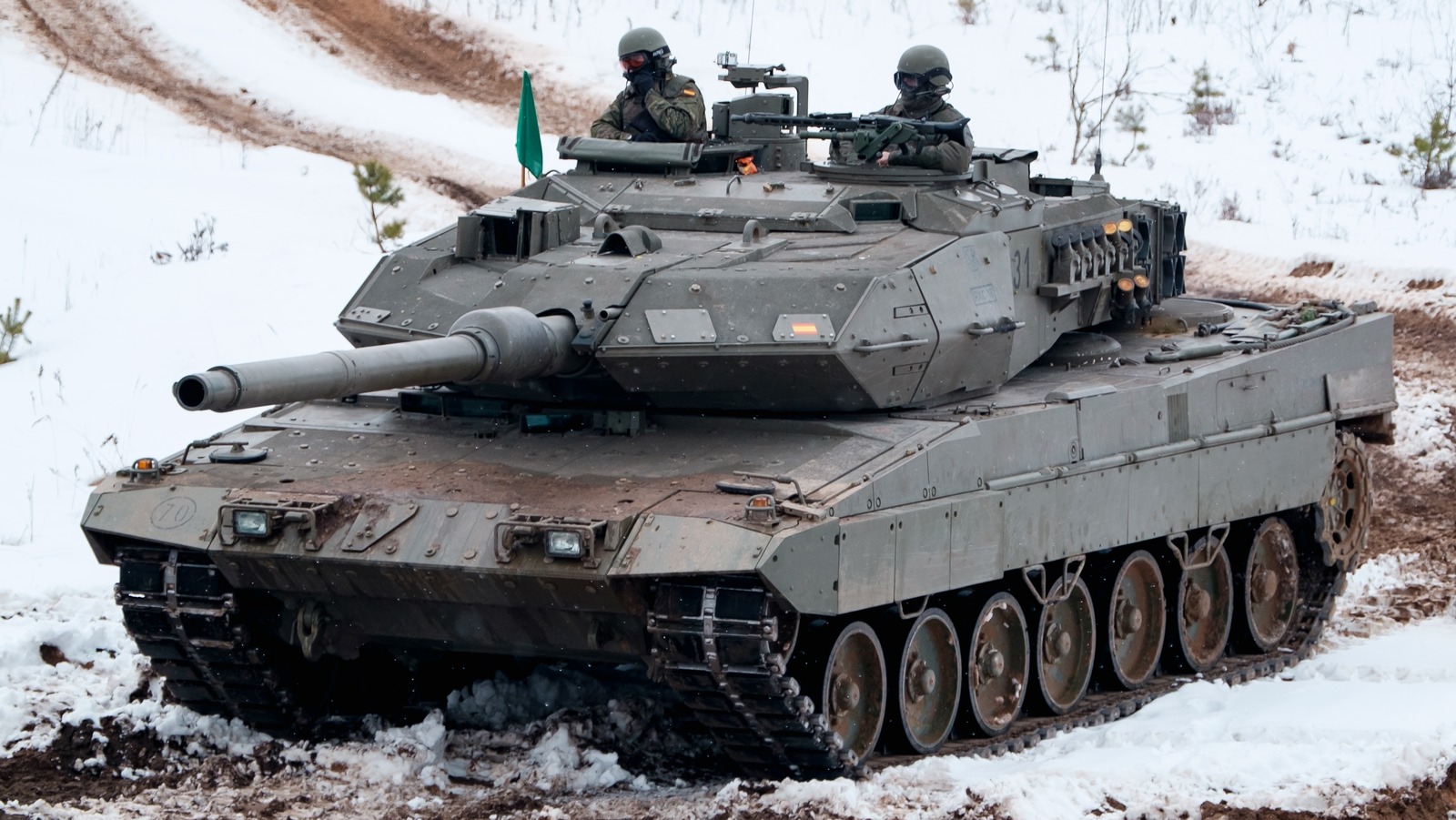
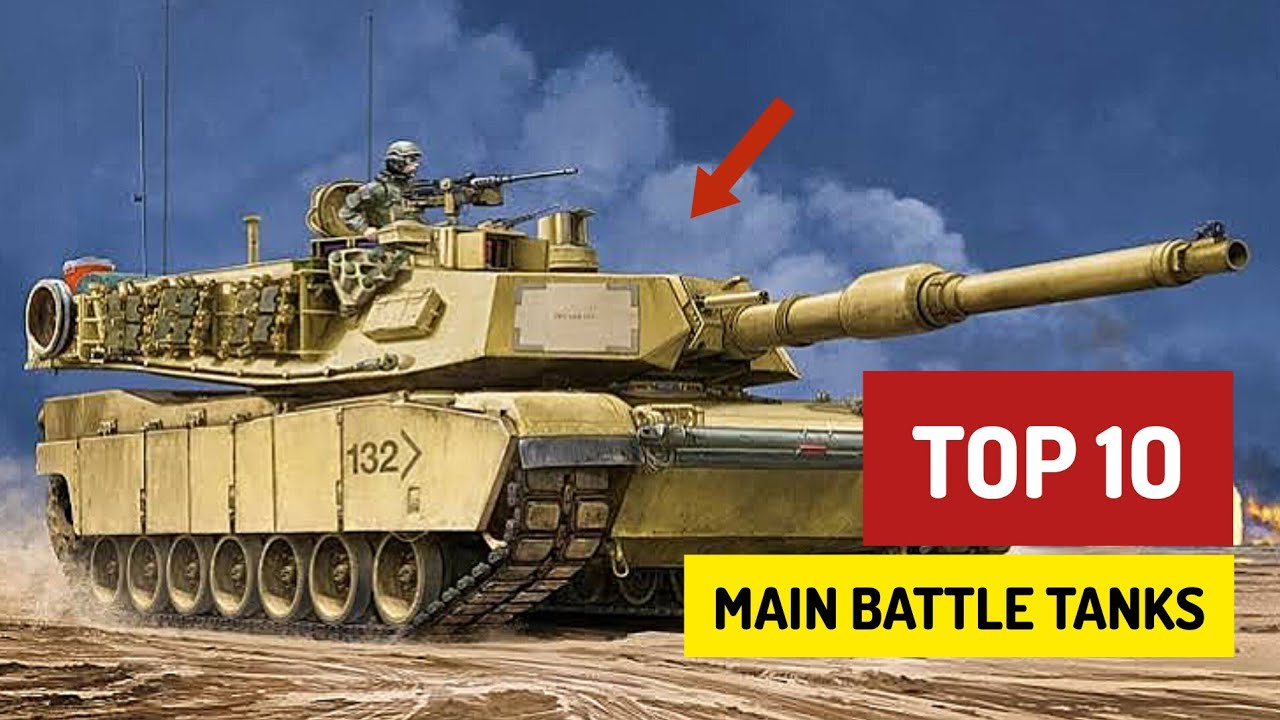
The two dominant calibers are the 120mm smoothbore (used by NATO forces like the US M1 Abrams and German Leopard 2) and the 125mm smoothbore (used by Russia and its allies, like the T-90 and T-14). The 125mm can fire slightly larger rounds, including guided anti-tank missiles through the gun barrel. The 120mm tends to have superior accuracy and penetration capabilities with modern depleted uranium rounds.
Let’s not forget the secondary armament. Tanks usually carry a coaxial machine gun linked to the main cannon and a remote-controlled weapon station on the turret roof. These deal with infantry, light vehicles, and low-flying drones. In recent conflicts, we’ve seen tanks mounting anti-drone guns or even small missile systems specifically to counter UAV swarms.
Mobility and Logistics
A stationary tank is a dead tank. MBTs need to keep moving to survive. This requires immense power. The M1 Abrams uses a gas turbine engine. It’s loud, it burns fuel like crazy, but it provides incredible power-to-weight ratio. It can stay running for long periods without overheating. Most other tanks use diesel engines. They are more fuel-efficient and less thermally visible, which matters when trying to hide from infrared seekers.
The suspension is equally critical. Modern tanks use hydropneumatic or torsion bar suspensions. These allow the tank to traverse rough terrain at high speeds while keeping the gunner’s sight relatively stable. You need to be able to fire on the move, or at least stop, fire, and move again within seconds. This is known as shoot-and-scoot.
Logistics is the hidden enemy of the MBT. These things are heavy. They weigh between 60 and 70 tons. Bridges can collapse under them. Fuel trucks need protection. Recovery vehicles are essential. An MBT is only as good as its support network. If you can’t move it, repair it, or fuel it, it’s just a static bunker.
The Future of the Main Battle Tank
Is the MBT dead? You hear that every few years. Drones seem to prove that heavy armor is vulnerable. But history shows that for every attack technology, a defense technology emerges. The MBT is evolving.
We are seeing a shift toward networked warfare. Modern tanks are nodes in a larger digital battlefield. They share targeting data with infantry, helicopters, and other tanks in real-time. The crew can see what others see. Artificial intelligence is helping with threat prioritization and ballistic calculations.
Armor is getting smarter. We are seeing the integration of active protection systems as standard, not optional. Guns are getting longer and more precise. Some concepts propose drone swarms launched directly from the tank to scout ahead. The MBT isn’t disappearing. It’s adapting. It remains the king of the armored landscape because it offers a combination of deterrence and firepower that no other single platform can match.
Frequently Asked Questions
What is the difference between an MBT and a light tank?
An MBT is designed for direct confrontation with other heavily armored vehicles. It has heavy armor and a large main gun. Light tanks are smaller, faster, and have much less armor. They are used for reconnaissance and infantry support in terrain where heavy tanks cannot operate.
Can a tank survive a direct hit from an anti-tank missile?
It depends on the missile and the armor. Modern MBTs with composite armor and active protection systems have a high chance of surviving a top-attack or flank hit. However, a direct hit to the turret’s weak points or an older model without reactive armor can result in catastrophic failure.
Why do some countries prefer 125mm cannons over 120mm?
The 125mm cannon, common in Russian designs, allows for the firing of larger ammunition and guided anti-tank missiles through the gun tube. NATO’s 120mm is often preferred for its superior penetration capabilities and accuracy with conventional kinetic energy penetrators.
How many people are in the crew of a modern MBT?
Most modern MBTs, like the M1 Abrams or Leopard 2, have a crew of four: commander, gunner, loader, and driver. Some newer designs, like the German Leopardo 2A7 or the Russian T-90, have automated loaders, reducing the crew to three. Next-gen concepts aim for two-man crews with full automation.