Master Average Rate of Change: Formulas & Examples
Calculus can feel like a foreign language until you break it down into manageable pieces. One of those foundational concepts is the average rate of change. At its core, it’s just a fancy way of saying “how fast something changes on average” over a specific period. You’ve likely calculated this in real life a hundred times without realizing it, like averaging your speed on a road trip. It doesn’t matter if you sped up on the highway and slowed down in the city; the average gives you the big-picture view.
Understanding this concept is crucial whether you are tackling high school algebra or diving into college-level calculus. It serves as the stepping stone to understanding derivatives, which deal with instantaneous change. But before we get to the complex stuff, let’s look at the straightforward math behind the average.
The Simple Formula
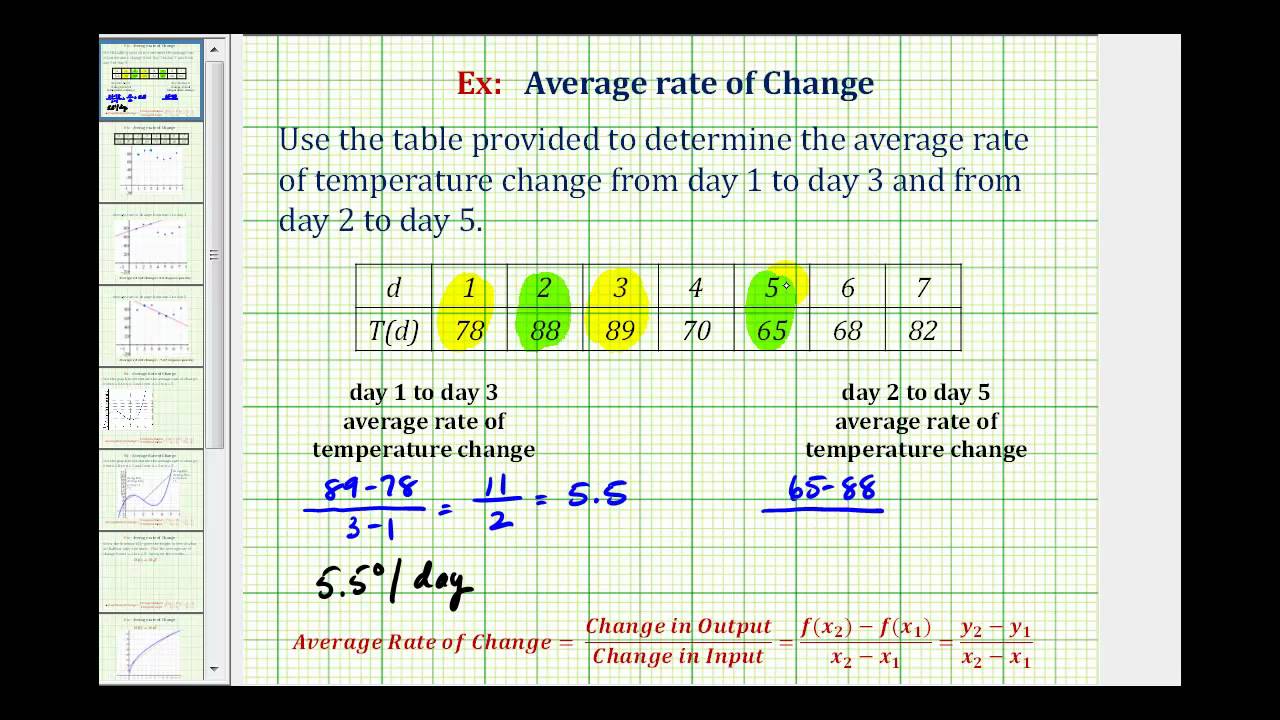
You don’t need a magic wand to calculate this. The formula is essentially the slope of the line connecting two points. If you remember the slope formula from algebra, you are already halfway there. It is the change in the output variable divided by the change in the input variable.
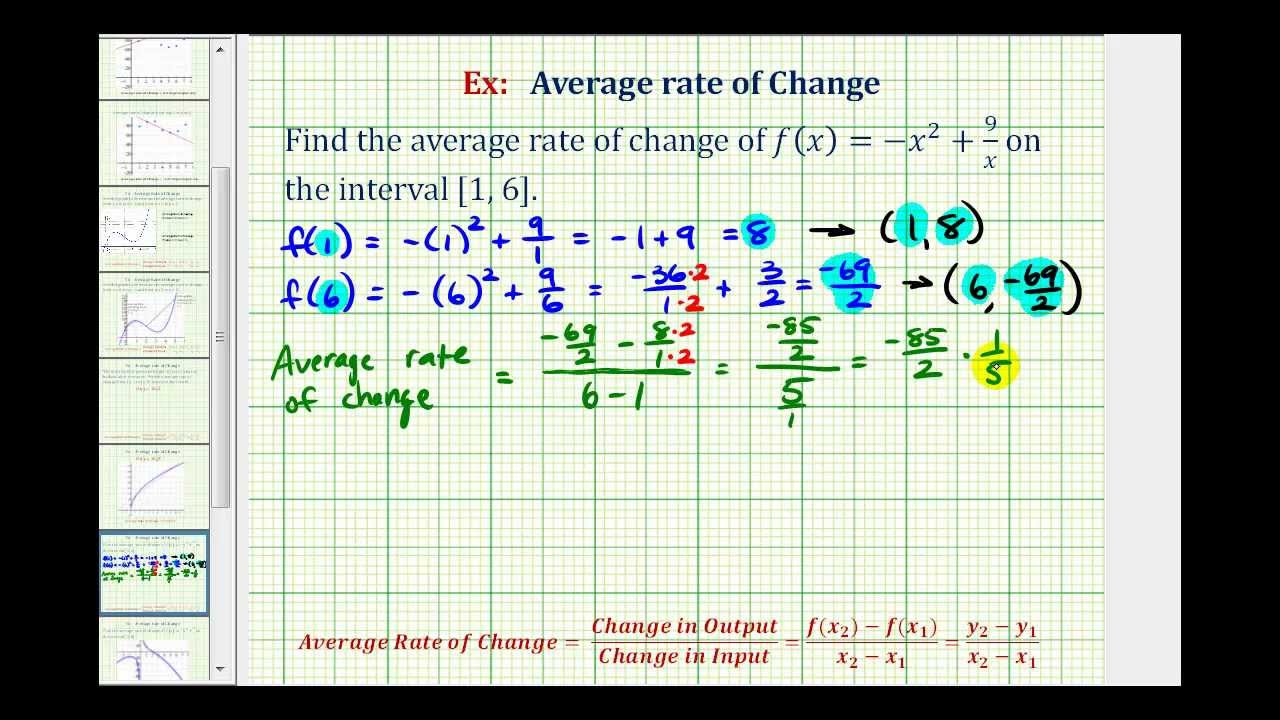
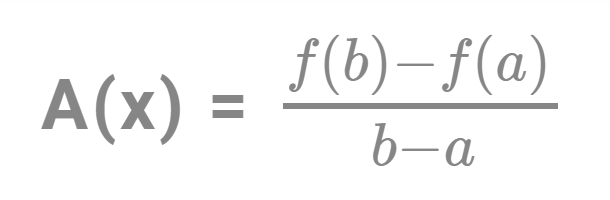
Mathematically, if you have a function f(x), the average rate of change on the interval from a to b is:
- Formula: f(b) – f(a) / b – a
It looks intimidating with all those letters, but it’s really just asking two questions: What was the final value? What was the starting value? Do the same for the time or input period, and then divide the difference in values by the difference in time. That’s it. No hidden tricks.
A Real-World Example: Car Travel
Let’s ground this in reality. Imagine you are driving from New York to Philadelphia. You leave at 12:00 PM and arrive at 2:30 PM. The distance between the two cities is roughly 95 miles. You stopped for gas, hit some traffic, and maybe picked up a sandwich. Your speedometer needle was bouncing around, but what matters for the "average rate" is the total distance over total time.
Here is how you break it down:
- Total Distance (Change in y): 95 miles
- Total Time (Change in x): 2.5 hours
So, 95 divided by 2.5 equals 38 miles per hour. That is your average rate of change. It doesn’t tell you that you were doing 70 mph on the highway or 10 mph in traffic. It just tells you the overall efficiency of the trip. This distinction is vital. Many students confuse average speed with instantaneous speed. The former uses the formula above; the latter requires calculus derivatives.
Working With Functions
In math class, you won’t always be given a story about a car. You’ll often get a function, like f(x) = x² + 1, and an interval, say from x = -2 to x = 2. Let’s plug those numbers into our formula.
First, find f(b). If b is 2, then f(2) = 2² + 1 = 5. Next, find f(a). If a is -2, then f(-2) = (-2)² + 1 = 5. Now, subtract the outputs: 5 – 5 = 0. Then subtract the inputs: 2 – (-2) = 4. Finally, divide the change in y by the change in x. Zero divided by four is zero.
Does that make sense? The function x² is symmetric around the y-axis. If you start at -2 and end at 2, you are at the same height. Therefore, your average vertical change is zero. You went up and came back down to the same level, so on average, you didn’t move vertically at all. It’s a neat visual way to check your work.
Common Mistakes to Avoid
Even simple concepts have traps. The most frequent error is swapping the order of subtraction. You must subtract the starting value from the ending value consistently for both x and y. If you do b – a for the denominator, you must do f(b) – f(a) for the numerator. Mixing them up leads to negative signs where they shouldn’t be, or worse, completely wrong magnitudes.
Another pitfall is ignoring the units. If x is in seconds and y is in meters, your answer is meters per second. If you forget to label your answer, you lose context. In a physics exam, a number without units is often considered incomplete. Always ask yourself: What is changing, and what is it changing over?
Why It Matters Beyond The Classroom
You might wonder why this matters if you aren’t pursuing a degree in mathematics. The average rate of change is everywhere in finance and economics. Investors use it to calculate compound annual growth rates (CAGR). Economists look at the average rate of inflation over a decade. Even fitness trackers use it to show your average heart rate or speed during a workout.
It provides a smoothed-out view of data that is otherwise noisy. In a world full of fluctuating stock prices or inconsistent performance metrics, the average gives you a baseline. It helps in predicting future trends, albeit roughly. If a company’s revenue has grown at an average rate of 10% per year for five years, you can make an educated guess about its trajectory, assuming conditions hold steady.
Bridging to Calculus
Here is the cool part. The average rate of change is the precursor to the derivative. In calculus, you shrink the interval between a and b until it is infinitesimally small. When that gap closes, you stop looking at the average and start looking at the instantaneous rate of change at a single point. This shift from "average" to "instant" is what makes calculus so powerful.
But you can’t build that house without a foundation. Until you are comfortable calculating the slope between two points, jumping to limits and derivatives will feel like trying to run before you can walk. Take your time with the basic formula. Practice it with quadratic functions, linear equations, and even tables of data.
Start with simple intervals. Check your signs. Visualize the graph. Once you see that the formula is just connecting the dots and measuring the steepness of the line, the mystery disappears. It becomes less about memorizing letters and more about understanding relationships between variables. That shift in perspective is what turns a struggling student into a confident problem solver.