Mastering Prepositional Phrases: Clear Definition, Usage Rules, And Examples
In the architecture of English syntax, prepositional phrases act as the glue that holds sentences together. They might seem like minor details, but they are actually responsible for providing critical context about time, place, and direction. Without them, our language would feel hollow and directionless. Imagine saying "The book is on the table." Suddenly, a prepositional phrase clarifies exactly where the book is. That tiny bit of language has immense power.
Understanding how to use prepositional phrases correctly is a skill that separates average writers from proficient ones. It is not about memorizing rigid rules. It is about learning how these small syntactic units function within a broader sentence structure. Whether you are writing an email, an academic paper, or a novel, mastering this concept will improve clarity and flow.
What Is A Prepositional Phrase?
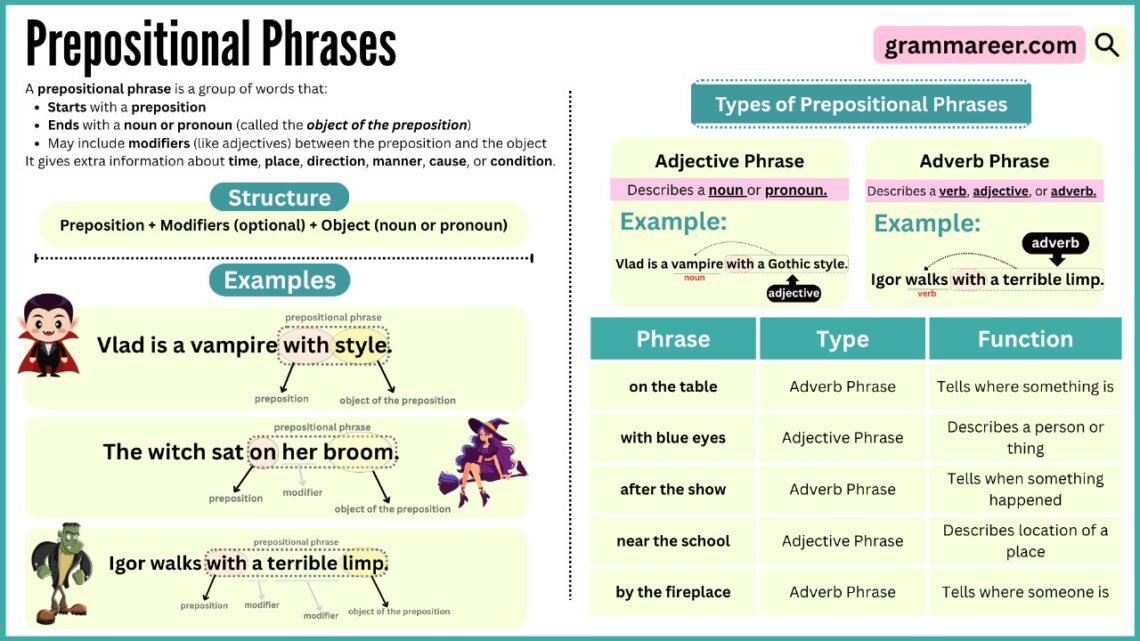
At its most basic level, a prepositional phrase is a group of words beginning with a preposition and ending with a noun, pronoun, or noun phrase called the object of the preposition. This object, along with its modifiers, makes up the entire phrase.
The pattern is consistent. You have the preposition, followed by a buffer of words, and finally the object. Consider the phrase "under the red umbrella." The word "under" is the preposition. The words "the red" are modifiers that describe the object, "umbrella." Together, they function as a single unit within a sentence. You can treat the entire chunk as a descriptive element.
It is important to note that not every phrase starting with a preposition is a prepositional phrase. You need the object to complete the thought. If you just say "around," it is just a preposition. But once you add "around the house," it becomes a complete prepositional phrase that serves a grammatical purpose in the sentence.
Identifying The Object
Finding the object is usually the trickiest part for beginners. The object is always in the objective case if it is a pronoun. That means you use "him" instead of "he," "her" instead of "she," and "them" instead of "they." If you have the phrase "with me," "me" is the object because it is in the objective case. Recognizing this pattern helps you quickly identify where the phrase begins and ends.
Functions And Usage In Sentences
Prepositional phrases are incredibly versatile. They can function as adjectives or adverbs within a sentence. This dual nature is what gives them their descriptive power. When they function as adjectives, they modify nouns. When they function as adverbs, they modify verbs, adjectives, or other adverbs.
Think about the difference between these two sentences:
- The bird on the roof was singing loudly. (Adjective function)
- The bird was singing loudly on the roof. (Adverb function)
In the first example, "on the roof" tells us which bird we are talking about. It modifies the noun "bird." In the second example, "on the roof" tells us where the singing was happening. It modifies the verb "was singing." This subtle shift in placement entirely changes the meaning of the sentence.
Most common prepositions indicate spatial relationships, such as "in," "on," "under," "above," and "between." However, there is a growing trend to use them metaphorically. We say things are "under pressure" or "in control." These are still prepositional phrases, but they describe abstract states rather than physical locations. Mastering this metaphorical usage is key to sounding natural in English.
Adverbial Nuances
When a prepositional phrase acts as an adverb, it often answers specific questions. It tells the reader when, where, or why something happened. If you ask "when did you leave?" and answer "after dinner," you are using a prepositional phrase as an adverb. This clarity is essential for effective communication. It removes ambiguity from the statement.
Common Examples And Patterns
Let’s look at some common patterns in action. These are categories of prepositional phrases that appear frequently in both spoken and written English. Recognizing them will help you parse complex sentences more efficiently.
Time: Phrases like "during the meeting," "before noon," and "after the war" provide temporal context. They anchor the action to a specific point or duration. If you write a report, using precise time phrases prevents confusion about when events occurred or will occur.
Place: Phrases such as "in the box," "near the park," and "between the trees" locate objects or people in space. These are often more complex than they appear. You might say "in the room next to the kitchen." Notice how one prepositional phrase "next to the kitchen" modifies the noun within another prepositional phrase? This nesting is common and adds detail.
Manner: Some phrases describe how an action is performed. "With great care," "at high speed," and "without hesitation" fall into this category. They function as adverbs modifying the verb. They add color and emotion to the sentence, transforming a dry statement into a vivid description.
Stylistic Considerations For Writers
While prepositional phrases are useful, overusing them can make writing feel clunky. This is often referred to as "preposition stacking."
A sentence like "The book that was on the shelf in the room above the garage fell" has too much prepositional clutter. It weighs the reader down. The solution is often to simplify or restructure. You could say, "The book from the garage shelf fell."
Another common pitfall is the dangling prepositional phrase, though modern grammar is more forgiving of hanging prepositions than in the past. The old rule stated never to end a sentence with a preposition. However, this often leads to awkward, overly formal sentences. "This is the picture I was talking about" sounds much more natural than "This is the picture about which I was talking." Trust your ear here. Natural flow usually trumps archaic rules.
Parallel Structure
When using multiple prepositional phrases in a list, ensure they share the same grammatical structure. For example, "We walked through the park, up the hill, and into the forest" maintains parallelism. But "We walked through the park, climbed the hill, and into the forest" breaks the rhythm because "climbed" is a verb, not a prepositional phrase. This variety disrupts the flow and confuses the reader about the main action.
FAQ: Questions About Prepositional Phrases
Can a sentence have more than one prepositional phrase?
Yes. Sentences often contain multiple prepositional phrases to add detail. Just ensure they are distinct and do not create clutter. You might have a subject followed by several descriptive phrases before reaching the verb.
Is "in" always a preposition?
No. In certain contexts, such as "pull in the sail," "in" functions as an adverb or part of a verb particle. Identifying its role depends on its relationship to the other words in the phrase.
Do prepositional phrases always come after the noun they modify?
Generally, yes. When functioning as adjectives, they typically follow the noun they modify. However, for emphasis or stylistic reasons, writers sometimes move them to the beginning of a sentence. "In the middle of the night, the phone rang" places the phrase first for dramatic effect.
What is the difference between a prepositional phrase and a participial phrase?
A participial phrase usually begins with a verb ending in -ing (a participle) and describes a noun. A prepositional phrase begins with a preposition. For example, "Running quickly, he missed the bus" uses a participial phrase. "Running in the park, he missed the bus" uses a prepositional phrase ("in the park") to modify the participle.