SQL vs NoSQL: The Real Big Data Analytics Showdown
If you’re standing at the crossroads of database technology, the choice between SQL and NoSQL isn’t just a technical decision—it’s a philosophical one. You’re essentially debating structure versus flexibility, consistency versus speed. There is no universal winner here. Saying one is "better" than the other is like asking whether a hammer is superior to a screwdriver. It entirely depends on whether you’re building a frame or assembling furniture.
In the world of big data analytics, this decision carries even more weight. You aren’t just storing user profiles; you’re processing terabytes of transaction logs, social media feeds, and IoT sensor data. The architecture you choose today will define how scalable, maintainable, and insightful your analytics platform becomes tomorrow.
The Case for Relational Clarity
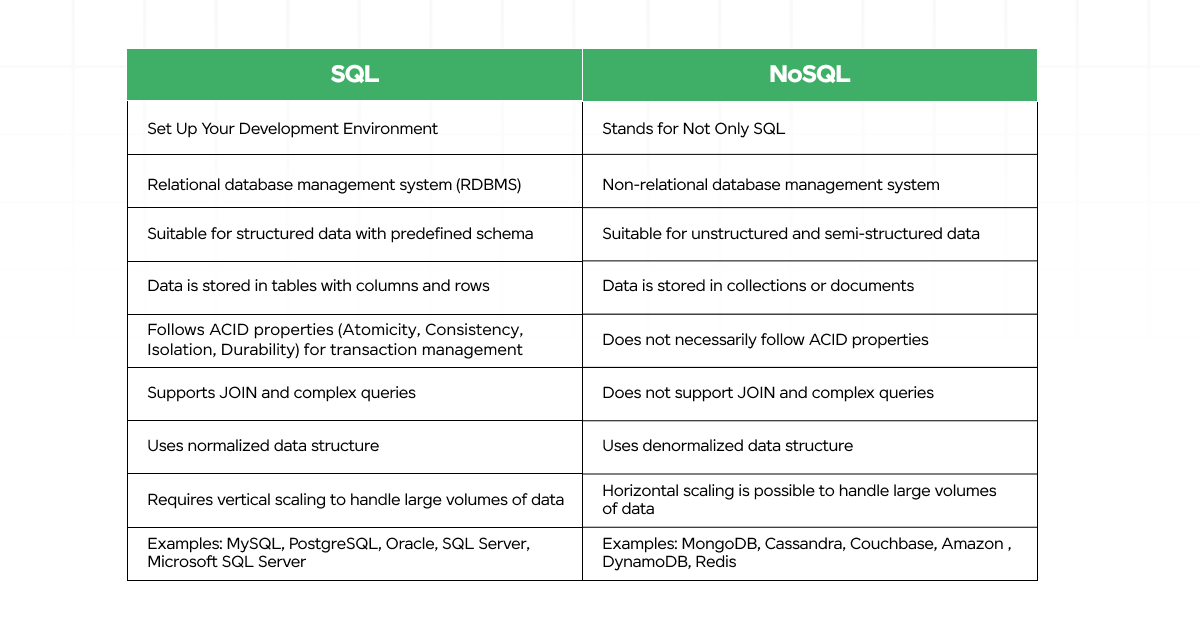
Structured Query Language (SQL) databases have been the backbone of enterprise software for decades. Systems like PostgreSQL, MySQL, and Oracle rely on rigid schemas. Every piece of data must fit into predefined tables, rows, and columns. This structure might sound restrictive, but for many analytical workloads, it is incredibly powerful.
When you deal with complex financial reporting or supply chain analytics, you need accuracy. SQL guarantees ACID properties (Atomicity, Consistency, Isolation, Durability). This means your data remains intact and reliable, even during high-concurrency events. If you’re calculating quarterly revenue, you can’t afford for a number to disappear or double-count because of a system crash.
Furthermore, the declarative nature of SQL makes it intuitive for analysts. You write what you want, not how to get it. The database engine handles the optimization. For structured data with clear relationships—like customers linking to orders linking to products—SQL remains the gold standard for enforceable data integrity.
Why NoSQL Gains Ground in Big Data
As data volumes exploded in the 2010s, traditional relational databases began to struggle with horizontal scalability. This is where NoSQL (Not Only SQL) stepped in. Databases like MongoDB, Cassandra, and Redis offer schema-less designs. You can store documents, key-value pairs, graphs, or wide-column sets without predefining every field.
This flexibility is a game-changer for big data scenarios involving semi-structured or unstructured data. Think about clickstream data from a website. Every user interaction is slightly different. One user views a product and adds it to cart; another adds a review. In a SQL database, you’d need complex joins or sparse tables. In a document store like MongoDB, you simply save the entire event as a JSON-like document.
Another major advantage is horizontal scaling. NoSQL systems are often built on distributed architectures from the ground up. Adding more servers to handle increased load is generally easier than vertically scaling a single powerful SQL server. For real-time analytics that require massive throughput, this scalability is often the deciding factor.
The Analytics Speed vs. Accuracy Trade-off
Here is where the rubber meets the road: analytics. Pure SQL databases can sometimes bottleneck under massive analytical queries because they are optimized for transactional processing (OLTP). While analytical SQL variants (like Snowflake or Redshift) exist, they often represent a hybrid approach.
NoSQL databases, particularly wide-column stores like Cassandra, excel at rapid writes and reads for specific data patterns. However, running complex aggregations across billions of rows in a distributed NoSQL cluster can be computationally expensive and sometimes less efficient than a columnar SQL warehouse. Aggregations in NoSQL often require application-level logic, pushing processing overhead away from the database engine.
If your analytics need involve heavy multi-table joins and complex mathematical aggregations, SQL-based data warehouses often provide better tooling and performance. If your analytics need real-time simplicity and high availability for vast amounts of linear data, NoSQL might leave SQL in the dust.
Common Misconceptions About the Divide
It is crucial to stop viewing this as a binary choice. Modern data ecosystems rarely use just one type of database. A typical big data architecture might look like this:
- Ingestion Layer: Kafka or similar tools stream raw data.
- Operational Store: A NoSQL document store handles high-volume, low-latency writes for user activity.
- Transactional Core: A SQL database manages core business entities like users and payments.
- Analytics Warehouse: A columnar SQL-based system (or data lake) aggregates data for reporting.
This polyglot persistence approach allows engineers to use the right tool for each specific job. You don’t need to pick a side forever. You construct a pipeline that moves data from flexible NoSQL stores into structured SQL environments for deep analysis. This separation of concerns ensures that your operational speed isn’t sacrificed for analytical depth, and your analytical accuracy doesn’t slow down your user interface.
Choosing the Right Path
So, how do you decide? Ask yourself three questions:
1. Is the data structure predictable? If you are dealing with fixed schemas like banking records, SQL is likely safer and easier to manage. If the data evolves rapidly or is unstructured like social media posts, NoSQL offers necessary agility.
2. What is the primary access pattern? Do you need complex joins across many tables? SQL handles this natively. Do you need rapid key-value lookups at massive scale? NoSQL shines here.
3. How critical is strict consistency? For financial audits or inventory control, strong consistency (SQL) is non-negotiable. For recommendation engines or feed listings where slight eventual consistency is acceptable, NoSQL’s availability benefits may outweigh the risks.
Ultimately, the "showdown" is less about which technology wins and more about understanding your specific data gravity. Big data is not a monolith. It is a collection of diverse streams requiring diverse handling mechanisms. Recognizing the strengths of both SQL’s rigorous integrity and NoSQL’s elastic scaling is the key to building a robust, future-proof analytics infrastructure. Don’t let marketing hype dictate your architecture; let your data’s nature guide your choice.
Frequently Asked Questions
Is SQL dead for big data?
No. While NoSQL has grown significantly for specific use cases, SQL remains the dominant language for data analysis and warehousing. Many modern big data tools use SQL-like syntax to query distributed datasets, blending the best of both worlds.
Can I migrate from SQL to NoSQL easily?
Migration is rarely seamless. Because the data models are fundamentally different (relational tables vs. document/graph/key-value), you often have to redesign your application logic. It is usually better to add NoSQL alongside SQL for specific high-volume needs rather than replacing the core SQL database entirely.
Which is more expensive, SQL or NoSQL?
Cost depends on your scale. Traditional SQL databases can become prohibitively expensive when scaled vertically (buying bigger servers). NoSQL systems, designed for horizontal scaling, can be more cost-effective at massive scale because they run on commodity hardware, though the operational complexity can increase engineering costs.
Do I need to know both for a data analyst role?
Proficiency in SQL is almost always required for data analytics. Knowledge of NoSQL concepts is a valuable plus, especially if you work with big data engineering teams or unstructured data sources, but SQL remains the primary tool for extracting and reporting insights.