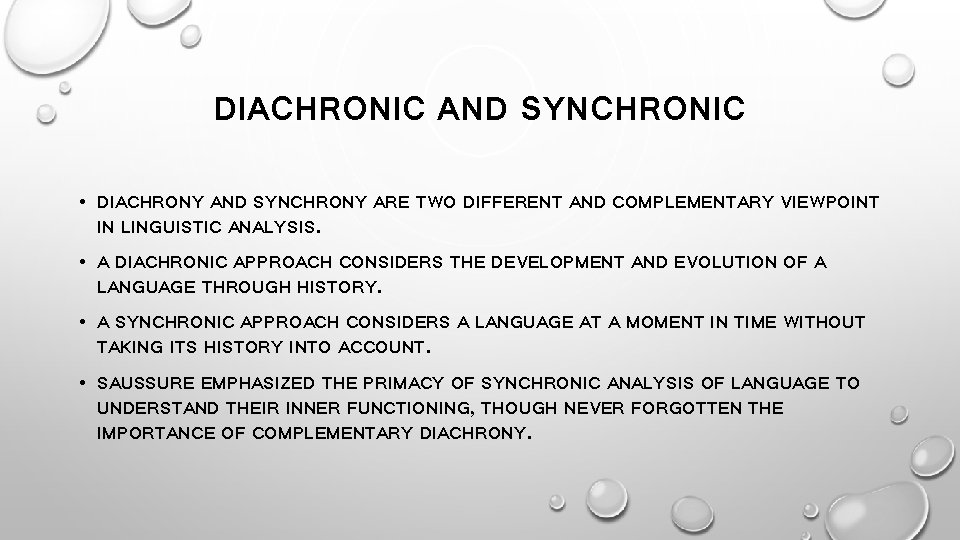
Synchronous vs. Diachronic Decoded: A Clear Linguistics Guide
If you’ve ever dived into linguistics or literary theory, you’ve likely bumped into two intimidating terms: synchronous and diachronic. They sound like complicated scientific jargon, but at their core, they represent two fundamentally different ways of looking at language. One looks at a snapshot; the other watches the movie. Understanding the difference isn’t just academic—it changes how you read texts, analyze grammar, and even understand why your grandmother speaks differently than you do.
Many students struggle with these concepts because they seem abstract. But once you separate the idea of "structure" from "history," everything clicks. Here’s a straightforward breakdown of what these terms mean, where they came from, and why the distinction matters more than you might think.
The Snapshot: What is Synchronous Analysis?
Think of a photograph. A photo captures a moment in time. It doesn’t show you how the subject got there, what they’re going to do next, or what they looked like ten years ago. It just shows you what is happening right now. That is exactly what synchronous analysis does.
In linguistics, a synchronous study looks at a language at a specific point in time. It ignores history. It doesn’t care if a word has a weird origin or if a grammar rule used to be different. It only cares about how the system works today (or in the specific year being studied).
- Focus: The internal structure and rules of a language as used by speakers at a single moment.
- Goal: To understand the langue—the abstract system of rules that native speakers know subconsciously.
- Example: Analyzing why native English speakers today find "I goed to the store" incorrect, without worrying that children historically said that or that other languages allow similar irregularities.
For writers and editors, this is the most common mode of operation. When you proofread an article, you’re applying synchronous rules. You check against the current standard of English, not against the English of Shakespeare or Beowulf. If it doesn’t fit the current mental model of the reader, it’s flagged. It’s about functionality in the present context.
The Movie: What is Diachronic Analysis?
Now, think of a time-lapse video. You see a flower blooming, a city growing, or a child aging. You see change. This is diachronic analysis. The word comes from Greek: dia (through) and chronos (time). It literally means "through time."
A diachronic study looks at how language changes over centuries. It tracks the evolution of words, the shifting of pronunciation, and the remodeling of grammar. It doesn’t care primarily about what is "correct" today; it cares about how we got here.
- Focus: The historical development and transformation of language elements.
- Goal: To uncover the causes and patterns of linguistic change.
- Example: Tracing how the Old English word storm (which meant any violent disturbance, including disease) narrowed its meaning to just weather-related storms in Modern English.
This approach is where etymology lives. If you’ve ever looked up a word’s origin and found a surprising history, you were engaging in diachronic thinking. It explains why some words look related but sound different, or why grammar rules that seem arbitrary actually emerged from systematic shifts in sound or usage.
The Saussure Revolution
We have the Swiss linguist Ferdinand de Saussure to thank for making this distinction clear. In his lectures (published posthumously as the Course in General Linguistics), he argued that linguistics had been too focused on history. He believed that to truly understand a language, you had to study it as a functioning system, independent of its past.
Before Saussure, most linguists were historical linguists. They treated language like a fossil record, digging through layers to find the oldest root. Saussure flipped this. He said, "Before we can say how things changed, we must first understand what the thing is at any given moment." His analogy was often that of a game of chess. To understand a move, you don’t need to know the history of the chessboard or how the pieces were carved. You just need to know the current positions and the rules of movement right now.
Why Does This Distinction Matter?
You might wonder, "Can’t we just look at both?" Theoretically, yes. But in practice, mixing them up leads to confused arguments. This is often called the etymological fallacy.
Consider the word " awry." Originally, it meant "away" or "aside." Over time, it shifted to mean "in a wrong direction." If someone argues that "awry" shouldn’t mean "wrong" because it originally meant "away," they are using a diachronic fact to make a synchronous claim. But language doesn’t work like that. Today, the synchronous meaning is "wrongly." The historical meaning doesn’t invalidate the current usage.
For editors, recognizing this boundary is crucial. You must prescribe based on current usage (synchronous), even if the historical logic (diachronic) seems contradictory. For linguists, however, both lenses are vital. You need the snapshot to map the system, and the movie to explain why the system looks the way it does.
Key Differences at a Glance
- Synchronous: Static, structural, focuses on state.
- Diachronic: Dynamic, historical, focuses on change.
- Synchronous: Answers "How does this work now?"
- Diachronic: Answers "How did this come to be?"
Grasping this duality gives you a fuller picture of human communication. We are creatures of habit (synchronous) who are constantly evolving (diachronic). Language is the perfect mirror of that.
FAQs on Synchronous and Diachronic Linguistics
Is one method better than the other?
Neither is inherently better; they serve different purposes. Synchronous analysis is better for describing current usage and teaching grammar. Diachronic analysis is better for understanding history, etymology, and the relationships between languages.
Who coined these terms?
Ferdinand de Saussure popularized these specific terms in his early 20th-century lectures. He insisted that linguistics must be divided into descriptive (synchronous) and historical (diachronic) sides to be scientifically rigorous.
Can a study use both approaches?
Yes, many modern sociolinguists use a "variationist" approach that looks at changes happening in real-time. They observe the synchronous state of a community while tracking minor diachronic shifts within that population over a few years.
Why do editors care about synchronous analysis?
Because editing is about current clarity. Even if a usage is historically new or irregular, if it adheres to the current synchronous norms of standard English, it is generally acceptable for modern readers. Historical correctness does not equal contemporary correctness.