David Kolb’s Learning Styles: A Practical Deep Dive
When we talk about how people learn, the conversation often circles back to one name: David Kolb. His Experiential Learning Theory, introduced in 1984, has become a cornerstone of educational psychology and corporate training. But despite its popularity, Kolb’s framework is often misunderstood as a rigid personality test rather than a dynamic cycle of growth. To truly grasp the value of this theory, we need to look beyond the simple labels of "visual" or "auditory" learner and explore the deeper mechanics of experience, reflection, and application.
The Engine of Experiential Learning
At its core, Kolb’s work isn’t just about categorizing learners; it’s about the process of learning itself. He defined learning as "the process whereby knowledge is created through the transformation of experience." This is a crucial distinction. Knowledge doesn’t just exist in a textbook waiting to be absorbed passively. It is actively constructed by the learner through their interaction with the world.
This concept challenges the traditional model of education, which often prioritizes abstract information delivery. Instead, Kolb argues that effective learning requires a holistic view that includes concrete experience, reflective observation, abstract conceptualization, and active experimentation. When one of these stages is missing, the learning cycle is broken, and true understanding rarely takes root.
Understanding the Four Stages of the Cycle
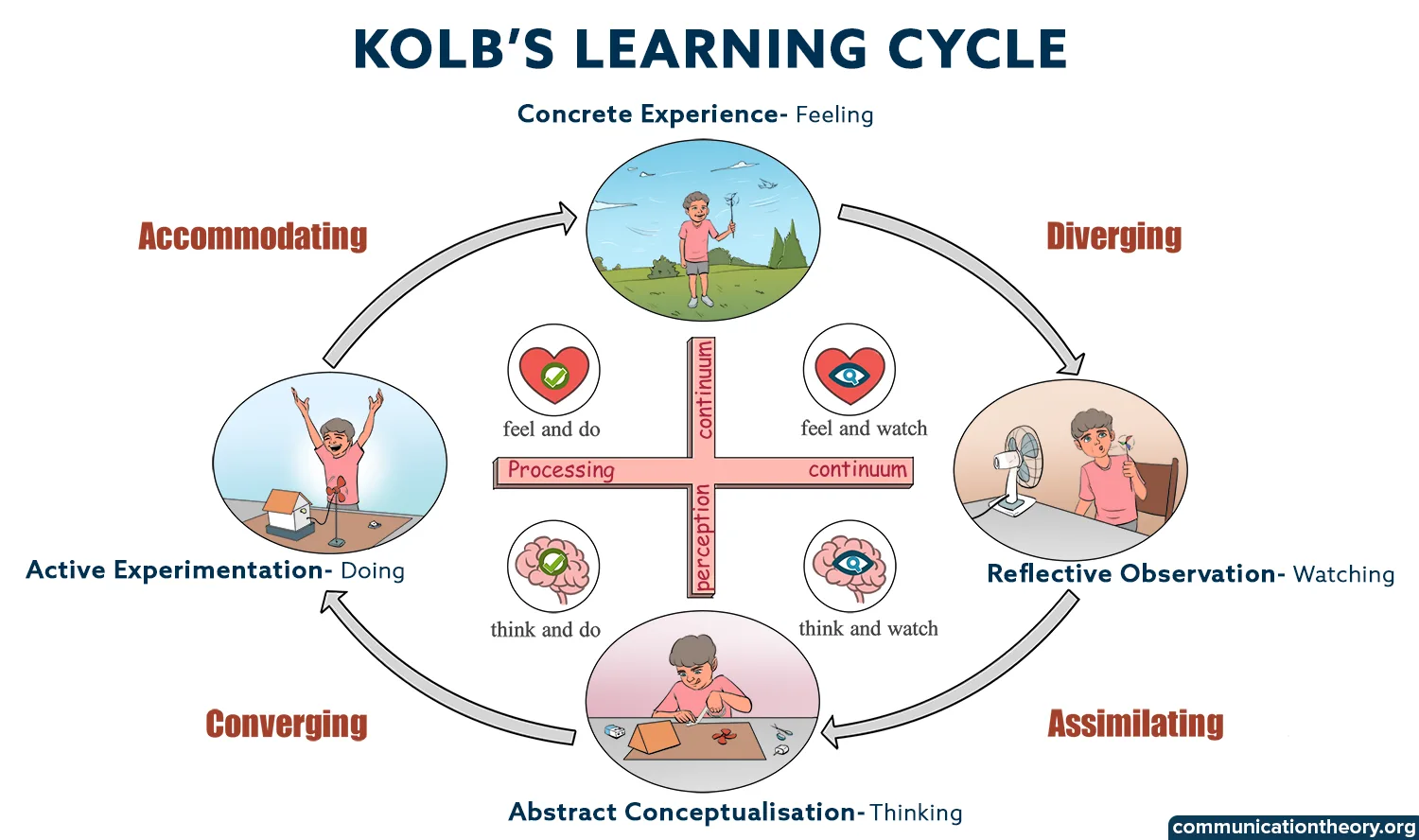
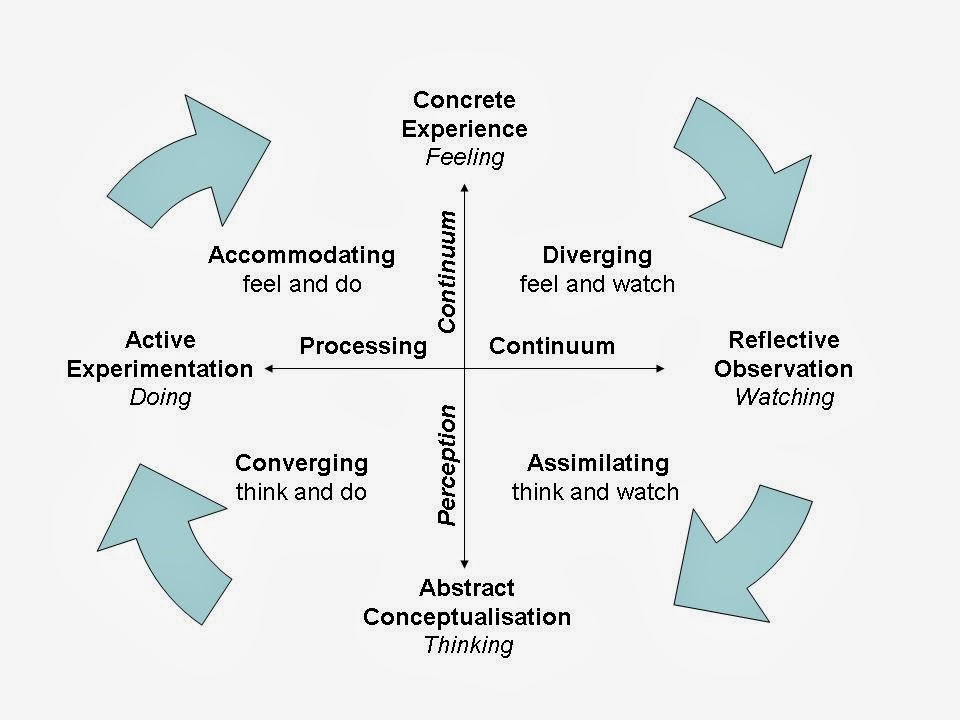
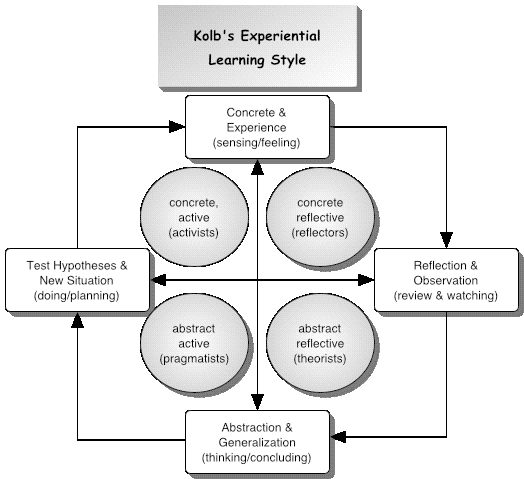
Kolb’s model is circular, suggesting that learning is continuous. To get the most out of it, we have to understand each stage distinctly. Here is how the cycle typically unfolds:
- Concrete Experience (CE): This is the "doing" phase. It involves encountering a new situation or having a new experience directly. For example, a marketing manager runs a new ad campaign without prior testing.
- Reflective Observation (RO): After the experience, the learner steps back to observe and reflect. In our example, the manager reviews the campaign results, noting what worked and what didn’t, without yet judging why.
- Abstract Conceptualization (AC): Here, the learner makes sense of their observations by forming theories or generalizations. The manager realizes that the ad failed because the target audience was too broad, leading to the concept of "niche targeting increases engagement."
- Active Experimentation (AE): Finally, the learner tests their new ideas in practice to see what results they produce. The manager designs a new campaign focused specifically on a narrow demographic, applying the newly formed concept.
The magic happens in the transitions between these stages. If you skip reflection, you might repeat the same mistakes. If you skip experimentation, you’ll have theory but no practical skill. Most people struggle because they try to bypass stages they find uncomfortable, jumping straight from experience to action without the necessary reflection.
The Four Learning Styles
While the cycle is universal, Kolb observed that people tend to favor certain stages over others. These preferences define the four primary learning styles. Recognizing your dominant style can help you tailor your approach, but it’s vital to remember that these are tendencies, not cages.
Diverging (Feeling and Watching)
Individuals strong in this style excel at imagining and viewing real-life situations from many perspectives. They are often creative, sociable, and good at brainstorming. They prefer to gather information and work in groups rather than carry out tasks alone.
Assimilating (Watching and Thinking)
This group is less focused on people and more interested in abstract ideas and concepts. They are excellent at creating theoretical models and prioritizing logic over social interaction. Academic tasks, which often require synthesis and concise organization, tend to suit this style well.
Converging (Doing and Thinking)
Convergers are best at finding practical uses for ideas and theories. They prefer technical tasks and problem-solving over social interaction. If you enjoy solving specific problems, making decisions, or working with concrete information, you likely lean toward this style.
Accommodating (Doing and Feeling)
This style is characterized by a "hands-on" approach. Accommodators rely on intuition rather than logic. They prefer to jump into new experiences and take risks. They often rely on others for information rather than analyzing the situation themselves, making them great at implementation and executing strategies.
Bridging the Gap: Why Flexibility Matters
One of the most common criticisms of Kolb’s theory is that it boxes people in. If you are a "Diverger," does that mean you can never be logical? Absolutely not. The goal of identifying your style isn’t to restrict you, but to highlight your blind spots. A strong Diverger might struggle with the logical structuring of the Assimilator, while a Converger might avoid the emotional intelligence required in team dynamics.
In professional development, the most effective leaders are those who can move fluidly through all four stages. They can feel the experience, reflect critically, conceptualize the lesson, and experiment boldly. This adaptability is what separates good performers from great ones. By consciously practicing the stages we dislike, we build a more robust learning mechanism.
Applying Kolb in the Modern Workplace
So, how do we actually use this? In training environments, facilitators can use Kolb’s cycle to design more effective workshops. Instead of just lecturing, a trainer might start with a case study (Concrete Experience), allow groups to discuss what they saw (Reflective Observation), teach the underlying management theory (Abstract Conceptualization), and finish with a role-play simulation (Active Experimentation).
For individual learners, the takeaway is to audit your own process. Do you rush into action without thinking? Do you over-analyze without ever testing your ideas? By mapping your current habits against Kolb’s cycle, you can identify where the leak is in your learning bucket and plug it.
Frequently Asked Questions
Is my learning style fixed?
No. While you may have a natural preference, learning styles are not static. With conscious effort and diverse experiences, you can strengthen your weaker stages and become more versatile in how you approach new challenges.
How does Kolb’s theory differ from VARK?
VARK (Visual, Auditory, Reading/Writing, Kinesthetic) focuses on sensory input and how you prefer to receive information. Kolb’s theory is broader, focusing on the cognitive process of transforming experience into knowledge. You might be a visual learner (VARK) but have a Converging learning style (Kolb).
Can I improve my reflective observation skills?
Yes. If you tend to jump straight to action, try keeping a learning journal. After completing a project, spend fifteen minutes writing down what happened, what you felt, and what you learned before starting the next task. This forced pause builds the muscle of reflection.
Is this theory still relevant today?
Despite some academic debate about the rigidity of learning styles, the core principle of experiential learning remains highly relevant. Modern education and training increasingly emphasize "doing" and reflection over passive listening, which aligns perfectly with Kolb’s foundational insights.