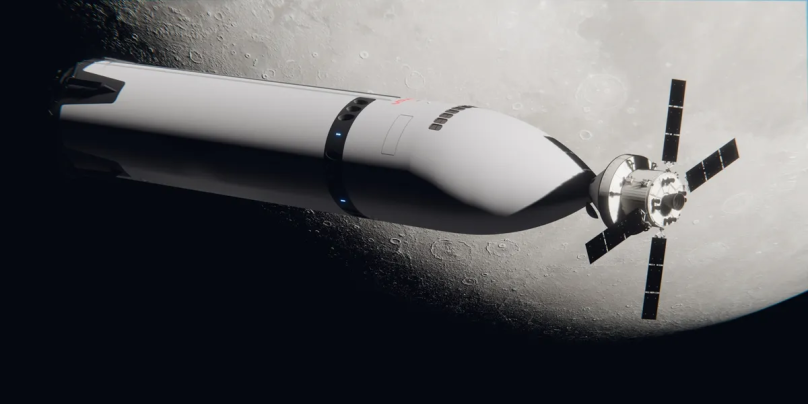
How Starship HLS Is Redefining Lunar Landing Design
Space exploration has always been a game of incremental upgrades and bold leaps. The latest incarnation of SpaceX’s Starship Human Landing System (HLS) is a prime example of that paradox—tiny tweaks that feel like revolutions. While the basic shape still resembles a sleek, stainless‑steel saucer, the inner architecture, propulsion tweaks, and reusable strategies have evolved in ways that could reshape how we think about a Moon base.
Why the New Design Matters
At its core, the Starship HLS must do three things: descend safely, deliver crew and cargo, and lift off again. The previous version handled each task, but margins were tight and the timeline for turnover was ambitious. The redesign introduces a set of redundancies and efficiencies that make the system more forgiving—an essential quality when you’re swapping lunar regolith for a thin, dusty atmosphere.
Redundant Descent Engines
Instead of relying on a single set of Raptor engines for the entire descent, the new HLS integrates a pair of smaller, throttable thrusters positioned around the vehicle’s belly. These act like a “braking assist” that can be fired independently if one of the main Raptors underperforms. The result is a smoother, more controllable touchdown, especially on uneven terrain.
Modular Cargo Bay
The cargo compartment now features a detachable “plug‑in” module. Think of it as a hard‑shell suitcase that can be swapped out mid‑mission. One module might carry scientific instruments, another could hold a compact habitat segment. This modularity means a single Starship HLS can support a series of missions without returning to Earth for a full refit.
Materials and Thermal Protection
Stainless steel remains the skin of choice, but engineers have added a nano‑ceramic coating on the leading edges. The coating reflects more solar heat while still allowing the vehicle to radiate excess warmth during the night side of the Moon. In practice, it reduces thermal stress on the structure by roughly 15 %—a modest number that translates into longer service life.
- Lightweight composites: used for interior panels to cut weight without sacrificing rigidity.
- Self‑healing sealants: microcapsules embedded in the sealant burst when cracked, releasing polymer to fill gaps.
- Radiation‑blocking layers: thin sheets of high‑density polyethylene line the crew cabin, shaving a few millisieverts off the cumulative dose.
Landing Precision—A New Navigation Suite
Landing on the Moon is no longer just a matter of “aim for the flat spot”. The latest HLS carries a suite of Lidar arrays combined with AI‑enhanced terrain‑mapping software. While we won’t claim it’s infallible, the system can identify hazards as small as a 30‑centimeter rock from 200 meters out. Operators on Earth can then approve an automated correction, or crew can take manual control if they prefer a hands‑on approach.
What This Means for Future Bases
Precision landing opens the door to building habitats on slopes or near permanently shadowed craters—areas once considered too risky. A slightly uphill site, for instance, could provide natural shielding from solar radiation, reducing the need for bulky shielding materials.
Reusability: From Concept to Routine
SpaceX’s claim of “rapid turnover” hinges on the vehicle’s ability to be refurbished in under a week. The new HLS design adds three concrete steps to make that happen:
- Automated inspection drones: after each flight, a swarm of small drones scans the hull, documenting any wear.
- Plug‑and‑play engine pods: the main Raptor cluster can be swapped out in under two hours, similar to swapping a car’s battery.
- Rapid‑cure adhesives: the self‑healing sealants mentioned earlier set fully in 30 minutes when exposed to a mild ultraviolet field.
These measures don’t eliminate the need for human technicians, but they dramatically shrink the “down time” that has historically plagued lunar missions.
Challenges Still on the Horizon
Even with these upgrades, the HLS isn’t a silver bullet. Dust remains a notorious adversary; the abrasive lunar regolith can still infiltrate moving parts despite new seals. Moreover, the modular cargo bay introduces new interfaces that must be flawlessly sealed each time they’re swapped—a potential source of leaks if not meticulously checked.
Budgetary constraints also loom. Each added redundancy or new material bumps up the per‑flight cost, and NASA’s budget cycles are famously cyclical. Balancing safety with affordability will be an ongoing negotiation between SpaceX, the agency, and international partners.
What to Watch for in the Next Year
The upcoming lunar demonstration flight, slated for early 2027, will be the first public test of these innovations. Key indicators to follow include:
- Engine performance data from the supplementary thrusters.
- Time required for post‑flight refurbishment.
- Accuracy of the Lidar‑guided landing on a pre‑selected, slightly sloped site.
If the metrics line up with expectations, we could see a cascade of commercial lunar endeavors building on the same platform—tourist excursions, mining pilots, even small research outposts.
Bottom Line
The Starship HLS’s latest design isn’t a dramatic visual overhaul, but it is a thoughtful collection of tweaks that together raise the bar for lunar landers. Redundant engines, modular cargo, smarter materials, and a sharper navigation suite all aim at one thing: making the Moon feel less like a hostile frontier and more like a place we can visit repeatedly, safely, and sustainably. The next few months will tell whether these ideas hold up under the harsh reality of space, but the trajectory is undeniably exciting.