Physics Symbols & Their Meanings: A Comprehensive Reference
From the humble m representing mass to the bold ℏ that governs quantum uncertainty, physics symbols condense complex ideas into compact notation. Whether you’re a student tackling a textbook, a researcher drafting a paper, or simply curious about the language of science, a clear grasp of these symbols unlocks deeper insight. This guide distills the most frequently encountered symbols and their meanings, offering context, examples, and quick‑reference tips to help you navigate the equations that shape our understanding of the universe.
The Alphabet of Physics
Physics borrows heavily from the Latin and Greek alphabets, often with modifications:
- α, β, γ, δ – Commonly denote angles or coefficients (e.g., α for a polar angle, β for a Lorentz factor).
- λ, μ, ν, ξ – Used for wavelengths, chemical potentials, or frequency indices.
- Σ, Π, Δ, Θ – Summation, product, change, or angle symbols in advanced mathematics.
- Greek letters appear with or without a tilde, hat, or overbar to indicate transformed or estimated quantities.
Commonly Used Symbols in Mechanics
When describing motion and forces, certain symbols recur:
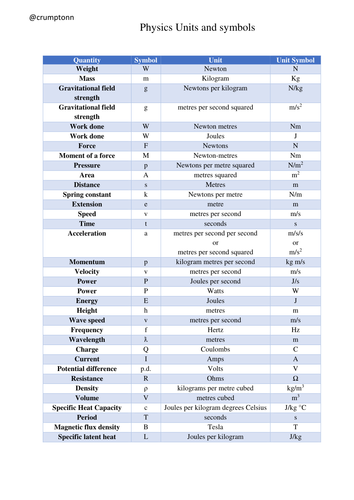
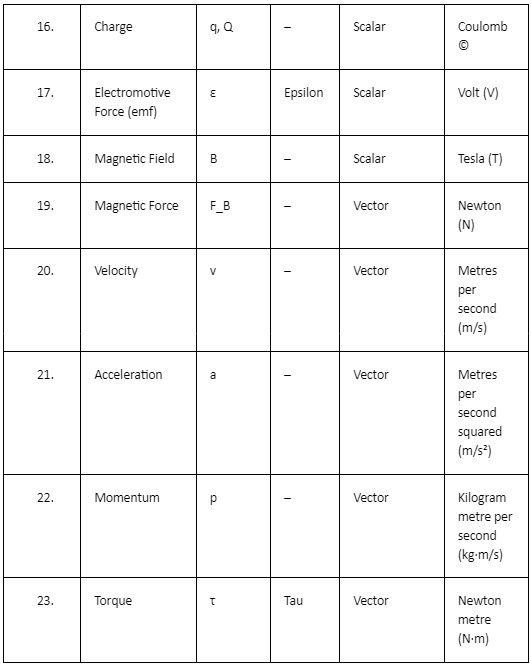
- v – Velocity (vector) in m/s.
- a – Acceleration (m/s²).
- F – Force (N), often with subscripted components like Fx.
- p – Momentum (kg·m/s).
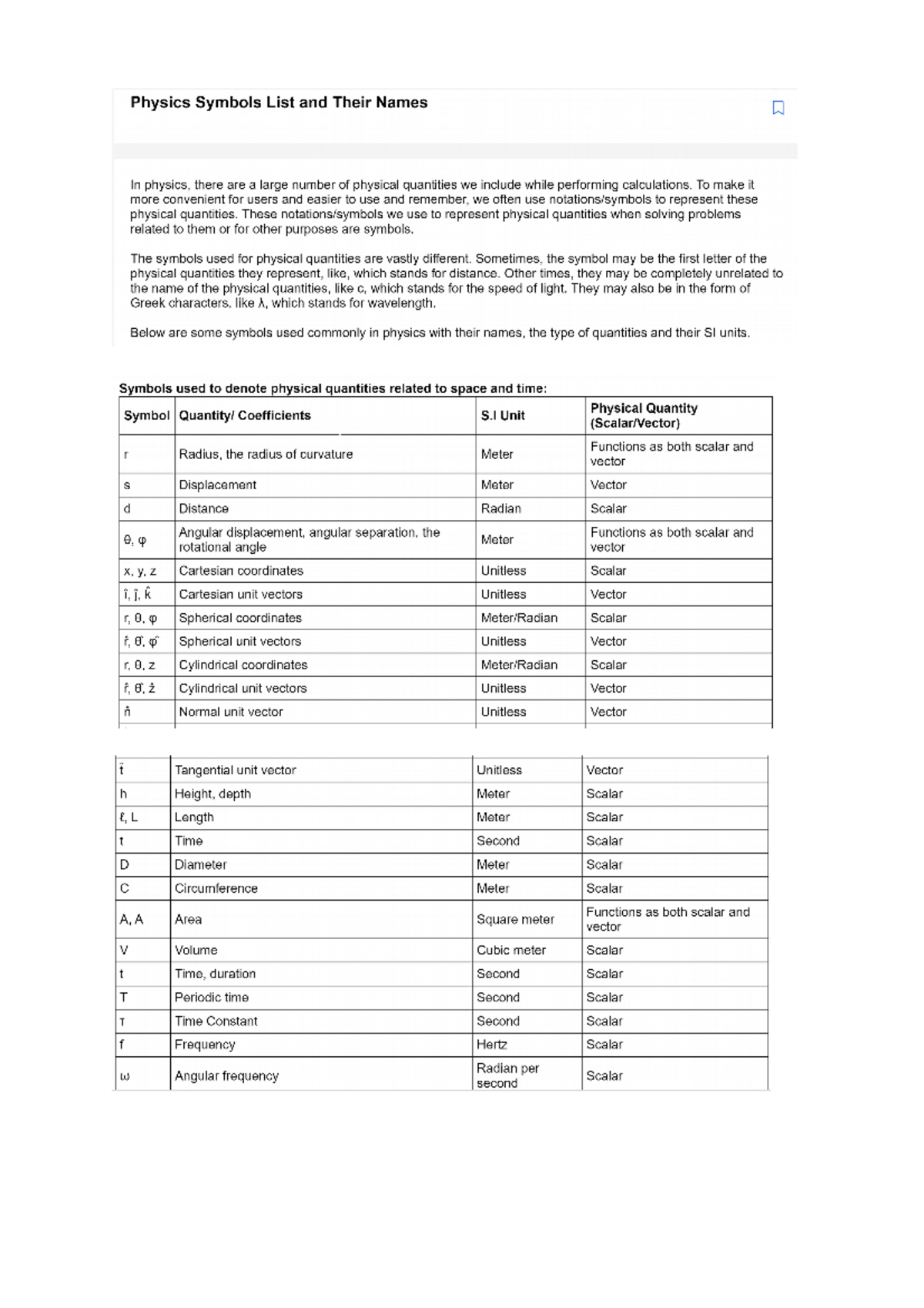
- t – Time (s).
- Δ – Change or difference; for example, Δx = x₂ – x₁.
- τ – Torque or characteristic time.
- m – Mass (kg).
Equations such as F = ma or p = mv are cornerstones, and their symbols remain constant across textbooks.
Electromagnetism and Quantum Symbols
Electromagnetic theory introduces a richer vocabulary:
- E – Electric field (V/m) or electric energy.
- B – Magnetic field (T).
- J – Current density (A/m²).
- ρ – Charge or mass density.
- Φ – Flux, either electric (ΦE) or magnetic (ΦB).
- ε₀, μ₀ – Vacuum permittivity and permeability constants.
- ℏ (h-bar) – Reduced Planck constant, central to quantum mechanics.
- ΔE – Energy difference between quantum states.
- i – Imaginary unit, often appearing in wavefunctions.
Maxwell’s equations, for example, use these symbols to succinctly express field relationships:
∇·E = ρ/ε₀, ∇×B = μ₀J + μ₀ε₀∂E/∂t.
Thermodynamics & Statistical Mechanics
Symbols in this realm encapsulate heat, work, and entropy:
- Q – Heat transfer (J).
- W – Work (J).
- T – Temperature (K).
- S – Entropy (J/K).
- U – Internal energy (J).
- F – Helmholtz free energy (J).
- G – Gibbs free energy.
- kB – Boltzmann constant.
- p – Pressure (Pa).
- V – Volume (m³).
The first law, ΔU = Q – W, demonstrates how these symbols interact.
Units and Dimensional Analysis Symbols
Physics often relies on SI base units, represented by the same letters as the corresponding symbols:
- m – Meter, distance.
- kg – Kilogram, mass.
- s – Second, time.
- A – Ampere, current.
- K – Kelvin, temperature.
- mol – Mole, amount of substance.
- cd – Candela, luminous intensity.
Dimensional symbols like [L], [M], [T] help verify equation consistency. For instance, the acceleration dimension is [L][T]⁻².
Abbreviations and Greek Letters in Context
Physics frequently abbreviates complex concepts:
- c – Speed of light (~3×10⁸ m/s).
- G – Gravitational constant.
- Λ – Cosmological constant.
- σ – Conductivity or Stefan‑Boltzmann constant.
- αs – Strong coupling constant.
- η – Efficiency or viscosity.
Greek letters also serve as indices or parameters: εij for strain tensor elements or γ for Lorentz factors.
Tips for Mastering Physics Symbols
- Build a symbol glossary for each course or paper; keep it handy.
- Practice notation translation by converting textbook equations into verbal descriptions.
- Use consistent subscripts; they often carry dimensional or positional meaning.
- Cross‑reference with definitions in the text to avoid misinterpretation.
- Leverage mnemonic devices—e.g., “F equals m a” to remember Newton’s second law.
Regular exposure turns symbols from obstacles into intuitive shorthand.
FAQ
- Q: Why does physics use so many Greek letters?
A: Greek letters provide a compact, standardized way to represent fundamental constants, variables, and operators, minimizing clutter in equations.
- Q: Are there universal symbols for all physical quantities?
A: Most textbooks adopt standard symbols, but conventions can vary between fields; always refer to the author’s definitions.
- Q: How can I remember the difference between Δ and d?
A: Δ indicates a finite change between two states, while d represents an infinitesimal differential, used in calculus.
- Q: What is the best way to learn symbols for advanced topics like quantum field theory?
A: Start with foundational symbols from quantum mechanics, then study the Lagrangian and path‑integral formalism, noting the recurring operators (e.g., ∂ for partial derivatives).