Understanding Oscillations In Physics: A Simple Guide
Ever watched a playground swing and wondered why it keeps moving back and forth? That rhythmic back‑and‑forth is the essence of an oscillation, a cornerstone concept that pops up everywhere—from tiny atoms vibrating inside a crystal lattice to massive bridges swaying in the wind. This guide peels back the jargon and gives you a clear, down‑to‑earth feel for what oscillations really are, how they’re described mathematically, and why they matter in everyday life.
The Core Idea: Repeating Motion
At its heart, an oscillation is simply a motion that repeats itself over time. Think of it as a pattern that keeps showing up, like a heartbeat or the ticking of a metronome. Two key ingredients define the pattern:
- Period (T) – the time it takes for one complete cycle.
- Frequency (f) – how many cycles occur in one second (the reciprocal of the period).
When a system returns to its starting point after a predictable interval, you’ve got an oscillator on your hands.
Simple Harmonic Motion: The Ideal Case
The textbook picture of an oscillator is the spring‑mass system, where a mass attached to a spring slides back and forth. If the spring follows Hooke’s law (force proportional to displacement), the motion is called simple harmonic motion (SHM). The governing equation looks neat:
F = -k x, where k is the spring constant and x the displacement from equilibrium.
Solving this differential equation gives a sinusoidal function—smooth, clean, and perfectly periodic.
Key Features of SHM
- Amplitude (A): maximum displacement from the center.
- Phase (ϕ): where in the cycle the motion starts.
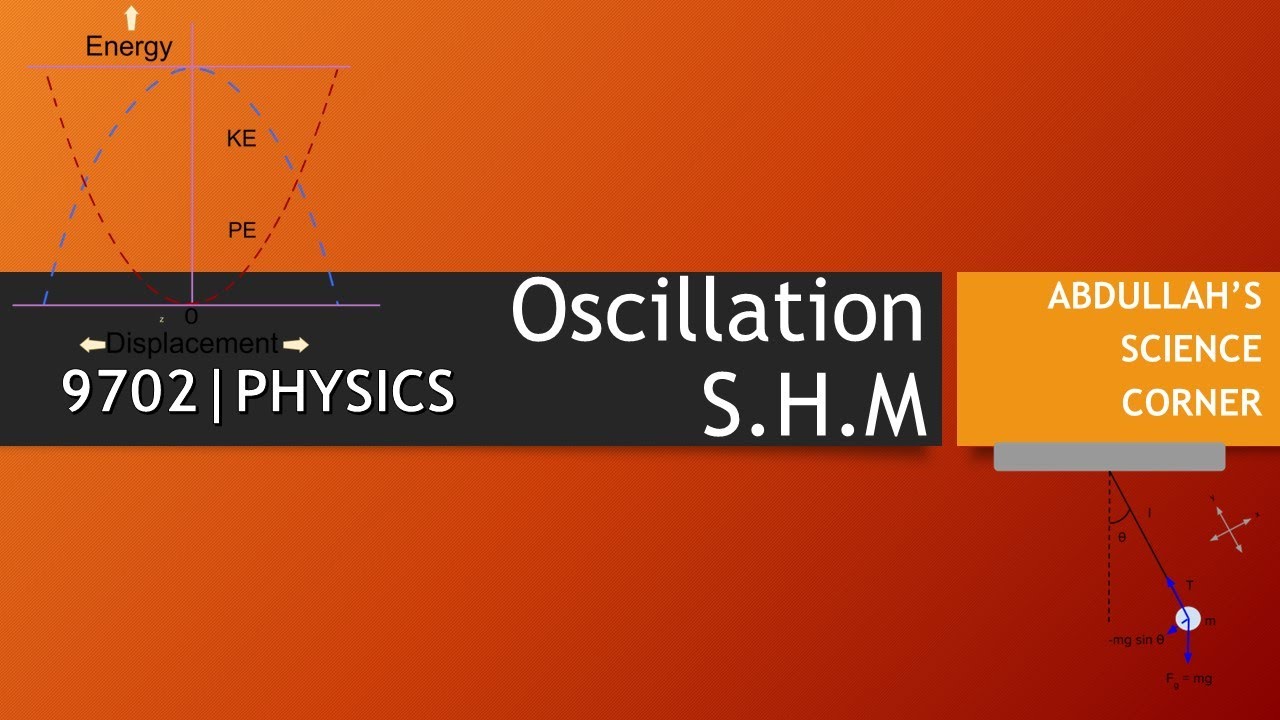
- Energy exchange: kinetic energy peaks at the center, potential energy peaks at the extremes.
Even though real life rarely offers a perfectly stretchy spring, SHM is the baseline model that helps us understand more complex oscillations.
When Things Get Real: Damping and Driving Forces
In the real world, friction, air resistance, or internal material losses sap energy away. This “damping” gradually shrinks the amplitude, eventually bringing the motion to a halt. Mathematically, we tack on a term proportional to velocity:
F = -k x - b v, where b is the damping coefficient.
Three damping regimes emerge:
- Underdamped – oscillations persist but decay slowly.
- Critically damped – returns to equilibrium as fast as possible without overshooting.
- Overdamped – sluggish return, no oscillation at all.
Now toss a periodic external force into the mix—a “driving” force—and you get forced oscillations. If the drive frequency matches the natural frequency of the system, resonance occurs, and the amplitude can soar dramatically. That’s why engineers carefully design buildings and bridges to avoid resonant frequencies that match wind or traffic loads.
Beyond Springs: Oscillations Everywhere
Oscillatory behavior isn’t limited to mechanical systems. Electrical circuits with inductors and capacitors form LC oscillators, where energy swings between magnetic fields (inductors) and electric fields (capacitors). The math mirrors the spring‑mass case, just swapping mass for inductance and spring constant for the inverse of capacitance.
Even quantum particles vibrate in potential wells, and sound waves are pressure oscillations travelling through air. The unifying thread is the same: a restoring force (or effect) that pushes the system back toward equilibrium, and a “inertia” that carries it past that point.
Spotting Oscillations In Everyday Life
Want to see oscillations without a lab?
- Pendulums: a simple kitchen clock or a child’s swing.
- Guitar strings: pluck them and watch the wave travel back and forth.
- Electrical lights: the flicker of a fluorescent lamp before it steadies is a high‑frequency oscillation.
- Heartbeats: the rhythmic expansion and contraction of the heart muscle.
These examples demonstrate that oscillatory motion is a natural language of many physical phenomena, not an abstract curiosity reserved for textbooks.
Mathematical Tools: From Differential Equations to Phasors
If you’re comfortable with calculus, the differential equation m d²x/dt² + b dx/dt + k x = F₀ cos(ωt) captures the full story of a damped, driven oscillator. Solving it yields a transient part (which dies out) and a steady‑state part (the long‑term response). For engineers, phasor diagrams turn the sinusoidal world into vector addition, making it easier to analyze amplitudes and phases at a glance.
When you’re not into heavy math, you can still get useful insights by tracking the period with a stopwatch or measuring the frequency with a simple smartphone app. Those measurements feed directly into the formulas for period (T = 2π√(m/k) for an ideal spring‑mass system) or resonant frequency (ω₀ = √(k/m)).
Why Understanding Oscillations Matters
Grasping oscillatory phenomena equips you to predict, control, or even harness them. In music, it shapes sound synthesis; in medicine, it guides the design of pacemakers that keep hearts in sync; in engineering, it informs the creation of shock absorbers that smooth out car rides. Even the universe’s largest structures—galaxies—exhibit wave‑like density oscillations traced in the cosmic microwave background.
In short, oscillations aren’t just a topic on a physics exam; they’re a toolkit that underpins technology, health, and the very fabric of reality.
Quick Recap: Key Takeaways
- Oscillation = repetitive motion; characterized by period and frequency.
- Simple harmonic motion is the ideal, sinusoidal case.
- Damping reduces amplitude; driving forces can amplify it, especially at resonance.
- Electrical, mechanical, acoustic, and even quantum systems all oscillate.
- Practical tools range from differential equations to simple timing measurements.
Armed with these basics, you’ll notice the hidden rhythms all around you—whether a coffee mug wobbling on a desk or a satellite orbiting Earth. The next time something swings back and forth, you’ll have a solid sense of why it’s happening and how to describe it.